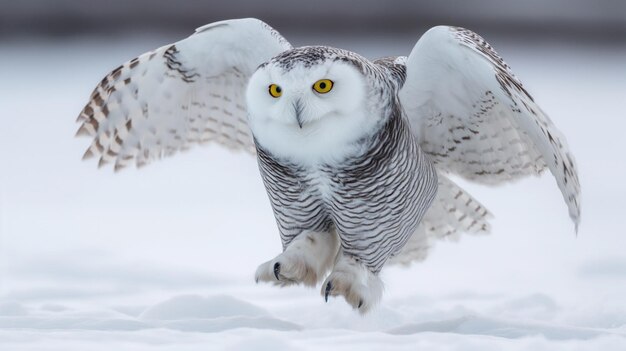
The Arctic tundra is a realm of stark beauty and relentless extremes, where life persists against the odds. Yet, even here, the arrival of a snowy owl is not merely a spectacle—it is a seismic event, a harbinger of ecological upheaval that cascades through the food web like a stone dropped into still water. These irruptions, driven by cyclical surpluses in lemming populations or the harsh realities of winter scarcity, send ripples far beyond the owl’s frozen hunting grounds. From the taiga’s edge to the boreal forests below, the presence of these silent sentinels reshapes the behavior, distribution, and survival strategies of countless species. This is the story of how a single predator’s dominance can echo through ecosystems, altering the fate of prey, competitors, and even the landscape itself.
The Irruption Phenomenon: When Snowy Owls Take Flight
Every few years, the Arctic’s delicate balance tilts. Lemmings, the primary sustenance for snowy owls, undergo population booms—explosions of abundance that fuel rapid owl reproduction. But when winter arrives and food grows scarce, these owls, driven by an ancient imperative, embark on irruptions: mass migrations southward in search of sustenance. These journeys are not random; they follow invisible highways of wind and instinct, funneling owls into regions where prey is plentiful or competition is low. The tundra’s loss becomes the boreal forest’s gain, as these transient monarchs of the snow claim temporary dominion over unfamiliar territories.
The scale of these irruptions is staggering. In some years, hundreds of snowy owls descend upon the northern United States and Canada, transforming farmlands into temporary hunting grounds. Their arrival is a spectacle of nature’s unpredictability, a reminder that even in an era of human dominance, the wild still dictates its own terms. Yet, these migrations are not mere wanderings—they are calculated gambits, where survival hinges on adaptability and the ability to exploit new ecological niches.
The Prey Paradox: How Owls Reshape Small Mammal Populations
For the lemmings and voles that form the backbone of the Arctic food web, the arrival of snowy owls is a double-edged blade. On one hand, their presence means relentless predation, a gauntlet of talons and silence that thins the ranks of small mammals with terrifying efficiency. Studies suggest that in peak irruption years, local lemming populations can plummet by over 50% within weeks. Yet, this decimation is not without consequence. With fewer lemmings to sustain them, the owls turn to alternative prey—snowshoe hares, ground squirrels, and even waterfowl. This dietary shift triggers a domino effect, as these secondary prey species face heightened predation pressure, forcing them to alter their foraging habits or migrate to safer grounds.
The paradox deepens when considering the long-term impact. In the wake of an irruption, the surviving lemmings—those that evade the owls’ gaze—may experience a population rebound, their numbers swelling in the absence of competitors. This boom-and-bust cycle is a hallmark of Arctic ecosystems, where predator and prey engage in an eternal dance of attrition and renewal. Yet, the timing of these fluctuations can disrupt the breeding cycles of other species, from ptarmigans to foxes, whose own reproductive success hinges on the availability of these small mammals.
Competitive Cascades: The Owl’s Shadow Over Other Predators
Snowy owls are not the only hunters of the north, but their irruptions often tip the scales in their favor. Arctic foxes, long the undisputed scavengers of the tundra, find their hunting grounds contested by these larger, more aggressive predators. The owls’ dominance forces foxes to retreat to marginal habitats or shift their diets, increasing pressure on bird nests and berry patches. Meanwhile, rough-legged hawks, which share a similar prey base, may face starvation as the owls monopolize the most lucrative hunting territories. This competitive exclusion can lead to localized extinctions of subordinate predators, reshaping the entire trophic hierarchy.
The ripple extends to mammalian carnivores as well. Coyotes, which venture into the northern reaches during milder winters, find their movements restricted by the owls’ presence. Even wolves, apex predators in their own right, may alter their pack dynamics to avoid direct conflict with these formidable birds. The result is a reconfiguration of the food web, where the owl’s arrival doesn’t just change who eats whom—it redefines the very rules of coexistence.
Behavioral Upheaval: Prey’s Desperate Adaptations
Survival in the face of a snowy owl irruption demands ingenuity. Small mammals, the owls’ primary targets, adopt a suite of anti-predator strategies that ripple through the ecosystem. Lemmings, for instance, may reduce their activity during daylight hours, shifting their foraging to the relative safety of twilight. Others increase their use of burrow systems, creating labyrinthine networks that confound even the most patient hunters. Yet, these adaptations come at a cost—reduced feeding time means slower growth rates, lower reproductive success, and increased vulnerability to other predators like weasels or gulls.
Birds, too, are not immune to the owl’s influence. Waterfowl nesting in the Arctic may abandon traditional sites in favor of more concealed locations, trading optimal habitat for safety. Even songbirds, which typically face little threat from snowy owls, may alter their migration timing or routes to avoid overlapping with irruption zones. These behavioral shifts can have cascading effects on plant communities, as reduced grazing pressure allows certain vegetation to flourish while others wither under the weight of unchecked growth.
The Landscape of Fear: How Fear Itself Reshapes Ecosystems
Beyond the direct impacts of predation lies a subtler, yet equally profound, force: the landscape of fear. The mere presence of snowy owls induces a state of chronic stress in prey species, altering their physiology and behavior in ways that echo through generations. Studies on snowshoe hares, for example, reveal that chronic predator stress can delay sexual maturity, reduce litter sizes, and impair immune function. These physiological changes, in turn, affect population dynamics, making prey more susceptible to disease or starvation even when the owls are no longer present.
This fear-driven ecology extends to the physical environment. In regions where small mammals are forced to abandon their burrowing activities due to owl predation, soil aeration and nutrient cycling can be disrupted. Plant communities may shift from grassy expanses to shrub-dominated landscapes, as herbivores avoid areas where they perceive higher predation risk. The result is a transformation of the tundra’s face, where the owl’s shadow lingers long after its departure.
Human Encounters: The Owl’s Unexpected Role in Modern Ecosystems
As snowy owl irruptions push these birds into human-dominated landscapes, their presence forces a reckoning with coexistence. Farmers in the northern United States and Canada may find their fields teeming with owls, their crops trampled in the owls’ relentless pursuit of voles. Yet, these encounters also offer a rare opportunity to witness the raw power of nature. Conservationists and birdwatchers flock to irruption zones, their enthusiasm tempered by the need to minimize disturbance to these stressed migrants. The challenge lies in balancing human curiosity with ecological integrity, ensuring that the owls’ temporary residency does not come at the cost of their survival.
For Indigenous communities, the arrival of snowy owls carries cultural significance. In some traditions, these birds are seen as omens or messengers, their movements interpreted as signs of environmental change. Their irruptions may signal shifts in climate or prey availability, offering insights into the health of the land. Yet, the modern world’s fragmentation of habitats complicates these ancient relationships, as owls encounter roads, power lines, and other obstacles that did not exist in their evolutionary past.
The Long Shadow: Irruptions and Climate Change
The future of snowy owl irruptions is inextricably linked to the Arctic’s warming climate. As temperatures rise, lemming populations become less predictable, their boom-and-bust cycles disrupted by erratic snowfall and vegetation changes. This instability may lead to more frequent or severe irruptions, as owls are forced to travel farther in search of food. Conversely, some models suggest that a warming Arctic could reduce the need for irruptions altogether, as alternative prey becomes more abundant in the north. The ecological ripple effect of these changes is impossible to predict with certainty, but one thing is clear: the snowy owl’s story is far from over.
What remains certain is that these irruptions are more than mere spectacles—they are barometers of ecological health. They reveal the fragility of food webs, the resilience of life, and the interconnectedness of all things. In the owl’s silent flight, we see the pulse of the wild, a reminder that even in an age of human dominance, nature still writes its own rules.