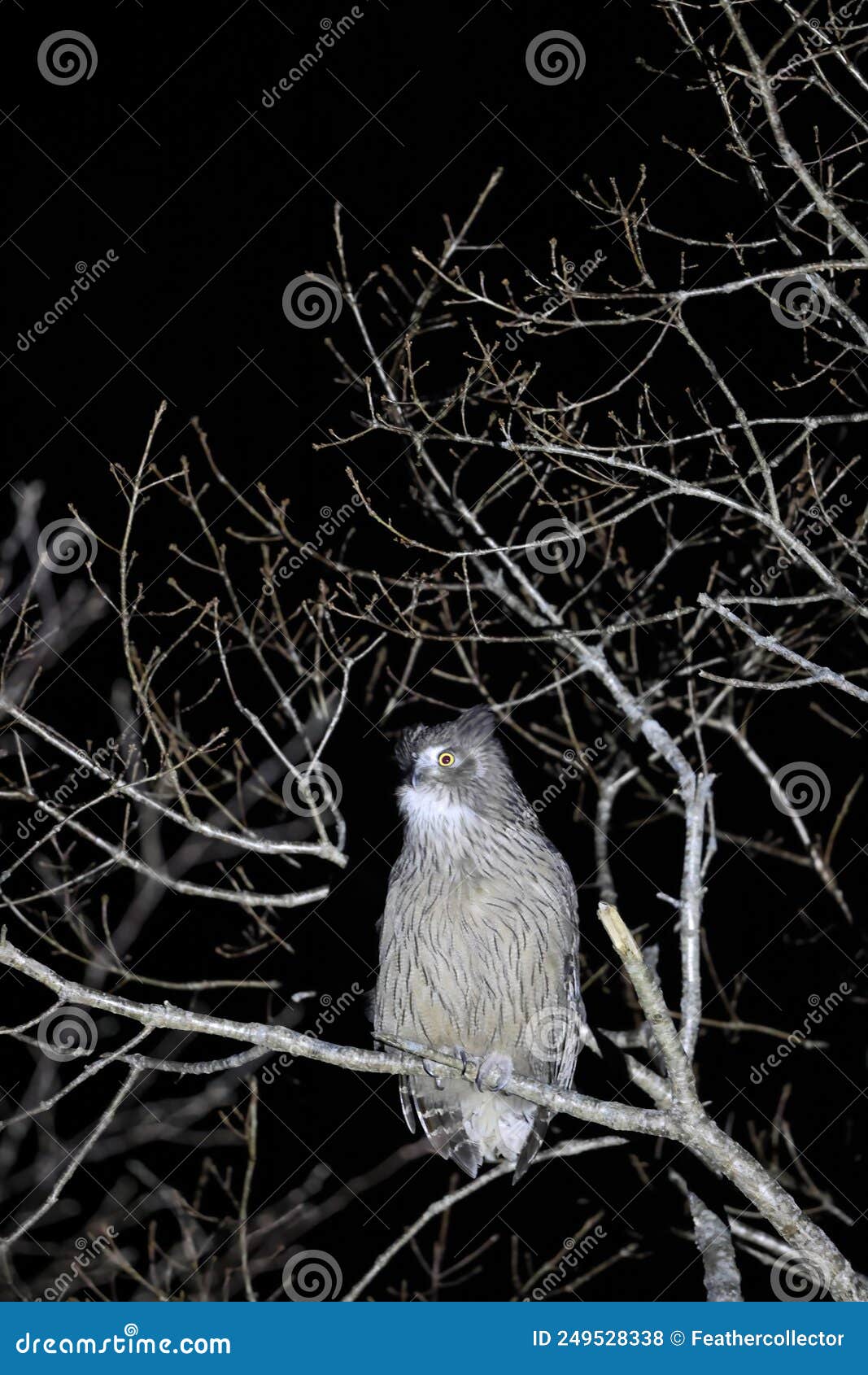
The Blakiston’s Fish Owl, a spectral presence in the mist-laden rivers of Hokkaido, is more than just a bird—it is a living emblem of resilience, a creature whose survival hinges on the delicate balance between human reverence and ecological stewardship. Once teetering on the brink of extinction, this enigmatic owl has become a testament to how community-driven conservation can rewrite the fate of a species. Its story is not merely one of biological recovery but a narrative of cultural awakening, where local traditions and modern science intertwine to breathe life into a vanishing world.
The Plight of the Ghost of the Riverbanks
To witness the Blakiston’s Fish Owl in its natural habitat is to glimpse a creature shrouded in myth. With a wingspan stretching nearly two meters and eyes that gleam like polished obsidian, it is the largest owl in the world—and one of the rarest. Yet, its majesty belies a precarious existence. Habitat loss, river pollution, and unchecked logging once conspired to push this species to the edge. By the late 20th century, fewer than 200 individuals remained, their haunting calls echoing through a landscape increasingly hostile to their survival.
The owl’s dependence on pristine river ecosystems makes it a barometer of environmental health. It thrives where cold, clear waters teem with fish, where old-growth forests provide nesting sites, and where human encroachment is minimal. Yet, as Japan’s post-war industrial boom reshaped the countryside, these conditions grew scarce. The owl’s decline was not just a biological tragedy but a cultural one—its disappearance would erase a thread from the tapestry of Hokkaido’s wild heritage.
The Spark of Local Awakening
The turning point came not from distant conservation agencies but from the communities who had long coexisted with the owl. In the rural towns of eastern Hokkaido, where the owl’s haunting *hoo-hoo* calls were once a familiar lullaby, a quiet revolution began. Local fishermen, hunters, and elders—those who knew the land’s rhythms intimately—began to notice the owl’s absence. Their observations were not just anecdotal; they were the first whispers of a crisis that demanded action.
What followed was a groundswell of grassroots activism. Villagers organized river cleanups, removing debris that choked the waterways and poisoned the fish the owls relied on. They planted native trees along riverbanks, restoring the old-growth forests that had been felled for timber. Schools incorporated owl conservation into their curricula, fostering a new generation of stewards. Even the local sake breweries joined the cause, donating proceeds to fund habitat restoration. This was not top-down conservation but a communal awakening—a realization that the owl’s survival was intertwined with their own.
The Science of Symbiosis
While community efforts laid the foundation, science provided the scaffolding for recovery. Researchers from Hokkaido University and conservation NGOs conducted meticulous studies on the owl’s ecology, tracking nesting sites, diet, and migration patterns. Their findings revealed a startling truth: the owl’s fate was not sealed by a single threat but by a cascade of interconnected challenges. Logging fragmented its habitat; dams altered river flows; pollution reduced fish populations. The solution, therefore, required a holistic approach.
One breakthrough came in the form of artificial nest boxes. With natural cavities in old trees becoming increasingly rare, conservationists designed and installed wooden nesting platforms, mimicking the owls’ preferred breeding sites. The response was immediate. Within years, occupancy rates soared, and fledgling success improved dramatically. Another innovation was the creation of “fish ladders” in rivers, allowing salmon and trout to bypass dams and reach spawning grounds, ensuring a steady food supply for the owls. These interventions were not just technical triumphs but symbols of humanity’s capacity to adapt and restore.
The Cultural Resurgence of the Sacred Bird
Beyond biology, the Blakiston’s Fish Owl holds a sacred place in Ainu folklore, the indigenous people of Hokkaido. To them, the owl is *kotan kor kamuy*—the god of the village—an omen of prosperity and guardian of the wild. This spiritual connection lent the conservation movement a moral weight that transcended science. When the Ainu community began reviving traditional ceremonies and storytelling, they reignited a cultural reverence for the owl that had waned in modern times.
Artists, too, played a pivotal role. Painters, photographers, and filmmakers captured the owl’s mystique, turning it into a cultural icon. Its image adorned everything from postage stamps to museum exhibits, embedding it in the public consciousness. This cultural renaissance was not mere sentimentality; it was a reminder that conservation is as much about preserving stories as it is about protecting species. The owl’s survival became a bridge between past and future, a living link to Hokkaido’s wild soul.
The Ripple Effect of Success
The recovery of the Blakiston’s Fish Owl is not an isolated triumph but a beacon for conservation worldwide. Its story illustrates how local action, when amplified by science and culture, can achieve the seemingly impossible. Other endangered species in Japan, from the red-crowned crane to the Japanese serow, have benefited from similar community-led initiatives. The owl’s resurgence has also sparked international interest, with researchers and conservationists from Russia and China studying its recovery to inform their own efforts.
Yet, the owl’s future remains precarious. Climate change looms as a new threat, altering river temperatures and fish populations. The delicate balance of its habitat requires constant vigilance. But the lesson is clear: when communities embrace their role as stewards, when science and tradition unite, even the most fragile species can endure. The Blakiston’s Fish Owl is no longer just a ghost of the riverbanks—it is a living testament to the power of collective will.
The Deeper Fascination: Why This Owl Captivates Us
What is it about the Blakiston’s Fish Owl that stirs something profound within us? Perhaps it is the paradox of its existence—an apex predator that depends on the health of an entire ecosystem, a creature of the night that thrives in the cold clarity of dawn. Or maybe it is the owl’s role as a mirror, reflecting our own relationship with nature. In its survival, we see a reflection of our capacity for both destruction and redemption.
There is also an element of the uncanny. The owl’s haunting calls, its piercing gaze, its nocturnal habits—all evoke a primal fascination with the unknown. It is a creature that exists just beyond the edge of our understanding, a reminder that the wild world is not ours to conquer but to share. In saving the Blakiston’s Fish Owl, we are not just preserving a species; we are reclaiming a part of ourselves—a part that still believes in magic, in mystery, and in the quiet triumph of coexistence.