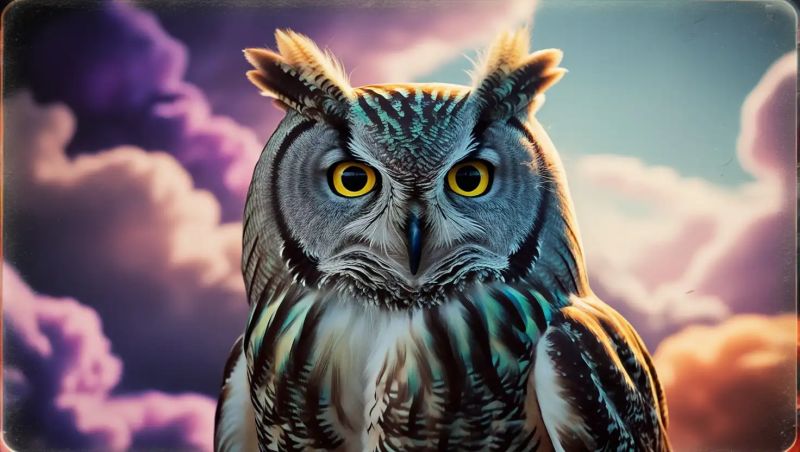
The owl, with its nocturnal gaze and silent flight, has long been a creature of mystery across civilizations. In Islam, this enigmatic bird transcends mere ornithological interest, embodying layers of spiritual symbolism, historical narratives, and theological interpretations. Far from being a mere symbol of wisdom in the Islamic tradition, the owl is a multifaceted emblem—sometimes revered, sometimes reviled—whose presence in scripture, folklore, and cultural lore invites deep reflection. To understand the owl in Islam is to unravel a tapestry woven with divine signs, cautionary tales, and profound metaphysical lessons. This exploration will traverse the sacred texts, prophetic traditions, and cultural perceptions that shape the owl’s role in Islamic thought, revealing how a bird often associated with darkness can illuminate the path to deeper spiritual understanding.
The Owl in the Quran: A Bird of Ominous Silence
The Quran does not explicitly name the owl, yet its presence lingers in the shadows of certain verses, where it becomes a silent witness to divine retribution and moral reckoning. In Surah Al-Muddaththir (74:10-11), the phrase “and what will explain to you what the Mount is?” is followed by imagery of destruction, evoking a sense of foreboding that resonates with the owl’s association with desolation. The owl, in this context, is not a direct symbol but an implied specter—a creature that thrives in ruins, much like the moral and spiritual desolation that befalls those who turn away from divine guidance. Its nocturnal habits make it a harbinger of unseen truths, a reminder that darkness often precedes revelation.
Moreover, the owl’s eerie call, often described as a lament, mirrors the Quranic emphasis on the Day of Judgment, where the heavens themselves will “split asunder” (Quran 69:16). The bird’s presence in such eschatological imagery underscores its role as a metaphor for the consequences of human arrogance and heedlessness. In Islamic exegesis, the owl thus becomes a living parable—a creature whose very existence challenges the complacency of those who mistake material comfort for spiritual security.
Prophetic Traditions: Between Caution and Curiosity
The Hadith literature offers a more direct, though ambivalent, portrayal of the owl. Narratives from the Prophet Muhammad (peace be upon him) present the bird as a creature to be approached with circumspection. One tradition recounts that the Prophet discouraged the killing of owls, a directive that has sparked centuries of debate among scholars. Some interpret this as a sign of respect for all living creatures, while others argue that the owl’s prohibition in hunting reflects its symbolic role as a guardian of sacred spaces—perhaps even the Kaaba itself, where its presence was once noted in pre-Islamic Arabia.
Yet, not all traditions are benevolent. Another narration describes the owl as a “messenger of death,” a harbinger of misfortune for those who hear its call at night. This duality—reverence and revulsion—mirrors the owl’s complex symbolism in Islamic culture. It is a bird that occupies the liminal space between the seen and unseen, the sacred and the profane. For the mystics of Islam, such as the Sufis, the owl’s nocturnal nature becomes a metaphor for the seeker’s journey through the darkness of ignorance toward the light of divine knowledge. Its flight, silent and unobtrusive, symbolizes the soul’s ascent, unburdened by the distractions of the material world.
Cultural Lore: The Owl in Folklore and Superstition
Beyond the sacred texts, the owl’s symbolism in Islamic culture is richly embroidered with folklore and local traditions. In many Arab societies, the owl’s hoot is still believed to foretell death or misfortune, a superstition that persists despite the bird’s ecological importance. This belief is not unique to Islam but is deeply rooted in pre-Islamic Arabian culture, where the owl was associated with the jinn—mischievous or malevolent spirits that inhabited the desert’s unseen realms. The Islamic tradition, while purifying many of these superstitions, retained the owl’s association with the uncanny, transforming it into a symbol of the unseen forces that govern human fate.
In Persian and Turkish folklore, the owl takes on a more nuanced role. It is sometimes depicted as a protector of libraries and scholars, its keen eyes symbolizing the vigilance required to preserve knowledge. This portrayal aligns with the Islamic emphasis on seeking knowledge, as exemplified by the Hadith “Seek knowledge, even if it be in China.” Here, the owl becomes an ally of the intellect, a creature that thrives in the quietude of study and contemplation. Yet, even in these narratives, the owl’s duality remains—it is both a guide and a warning, a creature of light and shadow.
Symbolism in Islamic Art and Architecture
The owl’s presence in Islamic art and architecture is subtle but significant. While figurative art is generally discouraged in Islamic tradition, the owl appears in decorative motifs, particularly in manuscripts and textiles, where its form is stylized into intricate patterns. In Persian miniatures, the owl often adorns the margins of scientific and philosophical texts, symbolizing the pursuit of hidden knowledge. Its inclusion in such works reflects the Islamic world’s reverence for learning, where the owl’s nocturnal habits parallel the scholar’s dedication to study under the cover of darkness.
Architecturally, the owl’s symbolism is less direct but no less profound. In the intricate tile work of the Alhambra or the geometric patterns of the Taj Mahal, the owl’s essence is distilled into abstract forms that evoke mystery and depth. The bird’s silent flight becomes a metaphor for the soul’s journey through the labyrinthine paths of spiritual enlightenment. Even in the absence of direct representation, the owl’s influence is felt in the Islamic aesthetic tradition, where the interplay of light and shadow—much like the owl’s own duality—creates a visual language that speaks to the soul.
The Owl as a Metaphor for the Seeker’s Path
For the Sufis, the owl is a powerful metaphor for the spiritual seeker. Its ability to navigate the darkness with unerring precision mirrors the mystic’s journey through the veils of illusion. The renowned Sufi poet Rumi often employed avian imagery to describe the soul’s ascent, and while he did not specifically mention the owl, his verses resonate with the bird’s symbolism. The owl’s solitary nature, its detachment from the clamor of the day, and its reliance on intuition over sight all align with the Sufi ideal of fana—annihilation of the self in the divine presence.
In this light, the owl becomes a guide for those treading the path of spiritual refinement. Its hoot is not a curse but a call to awakening, a reminder that true knowledge is not found in the glare of daylight but in the quietude of the night. The Sufi masters teach that the seeker must embrace the darkness, for it is in the shadows that the light of divine truth is most keenly perceived. The owl, in this context, is not a harbinger of doom but a companion on the journey, its presence a silent affirmation that the path to God is one of patience, perseverance, and profound introspection.
Modern Interpretations: Reconciling Tradition and Ecology
In contemporary times, the owl’s symbolism in Islam has expanded to include ecological awareness. As the natural world faces unprecedented threats, the owl’s role as a predator of rodents and pests has led to a reevaluation of its place in Islamic thought. Conservationists and scholars alike point to the Quranic principle of “khilafa”—man’s role as a steward of the Earth—as a framework for protecting such creatures. The owl, once seen as an omen, is now celebrated as a vital component of the ecosystem, a living testament to the balance and harmony that Islam seeks to preserve.
This modern reinterpretation invites a fresh dialogue between tradition and science. The owl’s nocturnal habits, once a source of superstition, are now understood as an evolutionary adaptation that contributes to the health of the environment. In this light, the Islamic tradition’s ambivalence toward the owl can be seen as a call to deeper reflection—to look beyond surface-level interpretations and recognize the wisdom embedded in all of God’s creation. The owl, in its silent flight, becomes a symbol of the interconnectedness of all life, a reminder that even the most misunderstood creatures hold a place in the divine plan.