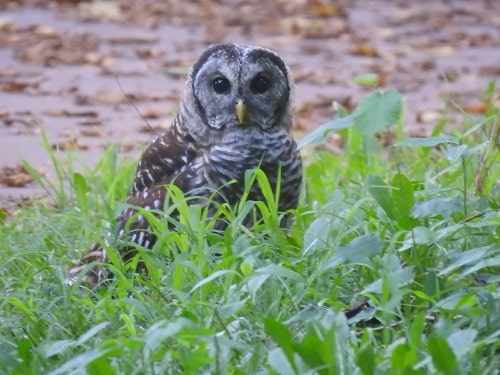
Ever found yourself wondering if an owl’s hoot in the dead of night is just a random sound or a secret message sent across the forest? What if the intricate symphony of Barred and Spotted owls is more than mere birdcalls—could these vocalizations be keys to unlocking their elusive behaviors and movements? Tracking these enigmatic creatures poses a challenge riddled with curiosity and complexity, beckoning the cutting-edge science of bioacoustics to join the pursuit.
The Enigmatic Language of Barred and Spotted Owls
Barred and Spotted owls share the nocturnal stage with a repertoire of vocalizations—each one brimming with biological significance. Barred owls, known for their distinctive “Who cooks for you?” call, weave a tapestry of nuanced hoots and barks that facilitate territorial claims and mating rituals. Meanwhile, Spotted owls, with their more subdued yet persistent whistle-like calls, convey their own intricate messages amidst the dense woodlands. These acoustic signals are a living lexicon, a language shaped by evolution’s hand to serve vital communication roles in darkness where vision fades.
Yet, decoding this language is no trivial task. The interplay of overlapping calls, ambient forest noise, and the owls’ cryptic behaviors create a symphonic challenge, obscuring meaning and location alike. What if the secrets tucked within these calls could be captured, analyzed, and translated with scientific precision?
Bioacoustics: The Sonic Microscope for Owl Tracking
Bioacoustics emerges as the perfect lens—an auditory microscope—to magnify and decipher the calls of these nocturnal raptors. By deploying advanced audio recording equipment in habitat zones, researchers capture the pure essence of owl vocalizations, filtering nature’s chorus with machine learning algorithms and spectrogram analyses. These tools allow scientists to distinguish species-specific calls, individual vocal signatures, and even emotional states conveyed through pitch, rhythm, and amplitude variations.
But there lurks a technical conundrum: How does one ensure consistent data collection in varying weather conditions, terrains, and ecological communities? The answer lies in innovative autonomous recording units, often rugged and remotized, that patiently listen for weeks or months, amassing sonic datasets far beyond what human observers could gather.
Distinguishing Barred from Spotted Owl Calls: A Sonic Puzzle
At the heart of bioacoustic tracking lies the intricate task of species differentiation. Barred and Spotted owls often inhabit overlapping territories, and their vocalizations may share acoustic features, making identification an almost cryptic endeavor. Researchers navigate this labyrinth by mapping frequency ranges, temporal patterns, call length, and harmonic structure—each parameter a piece of the puzzle.
Barred owls typically exhibit a sonorous series of hoots with a steady cadence, while Spotted owls showcase sharper, more abrupt whistles and trills. Effectively cataloging these distinctions fuels conservation measures, as Spotted owls are considered vulnerable due to habitat loss and competition. Accurate call identification helps monitor population dynamics, spatial distribution, and interspecies interactions without intrusive visual contact.
Challenges in Bioacoustic Monitoring and Data Interpretation
Despite the promise of bioacoustics, the path is strewn with hurdles. Ambient noise pollution—from rustling leaves to flowing streams—can mask subtle owl calls, necessitating robust noise-filtering algorithms that avoid dismissing faint but critical signals. Moreover, vocal variability within individual owls and across environmental contexts complicates pattern recognition.
The dynamic vocal plasticity of owls means that calls can morph depending on social context, time of year, or even stress levels, blurring lines between learned and innate vocal patterns. How then can researchers avoid misclassification? The solution involves integrating bioacoustic data with ecological and behavioral observations, creating a multidimensional framework that embraces complexity rather than shying away from it.
Technological Innovations Revolutionizing Owl Acoustic Studies
Recent advances in artificial intelligence and sensor technology have supercharged bioacoustic applications. Neural networks trained on vast owl call libraries now identify calls in real-time, even in challenging acoustic environments. Spatial acoustic localization techniques use arrays of microphones to triangulate an owl’s position, turning elusive sounds into mapped points of presence within a forest grid.
Furthermore, bioacoustic monitoring dovetails with environmental DNA (eDNA) analysis and satellite telemetry to paint rich ecological portraits. This fusion of methodologies enables scientists to track lifestyle shifts, migratory patterns, and reproductive success without intrusive capture or disturbance—ushering in a new era of ethical, insightful wildlife research.
Ecological and Conservation Implications of Acoustic Tracking
The practical payoff of decoding owl calls reverberates beyond academic interest. Understanding vocalization patterns illuminates the health and connectivity of forest ecosystems. Barred owls, being more adaptable and aggressive, pose competitive exclusion risks to their Spotted cousins, whose survival hinges on undisturbed old-growth habitats. Bioacoustics provides an early warning system, detecting shifts in species prevalence and alerting conservationists to the urgency of intervention.
Moreover, monitoring breeding calls can inform habitat protection timings. It enriches citizen science initiatives by empowering enthusiasts to contribute acoustic data, transforming everyday nature lovers into guardians of avian soundscapes. Ultimately, bioacoustics nurtures a profound connection to these ambient ambassadors of the night—reminding us that listening is the first step toward understanding and protecting our planet’s intricate wildlife tapestry.
Looking Ahead: The Future Symphony of Owl Bioacoustics
As technology advances and analytical frameworks evolve, the future holds tantalizing possibilities. Imagine a network of AI-powered listening posts, real-time dashboards reporting owl activity, and predictive models forecasting population trends under climate perturbations. The playful complexity of owl calls may soon yield to predictive clarity, empowering precise, timely conservation strategies.
The challenge remains: to harmonize technological prowess with ecological sensitivity, ensuring that the quest to understand owl vocalizations never silences the natural mystery that makes their hoots so mesmerizing. Bioacoustics is not merely about sound—it’s about forging a deeper dialogue with nature’s night-singers, bridging gaps between human curiosity and wild instinct in a dance as timeless as the moonlit forest.