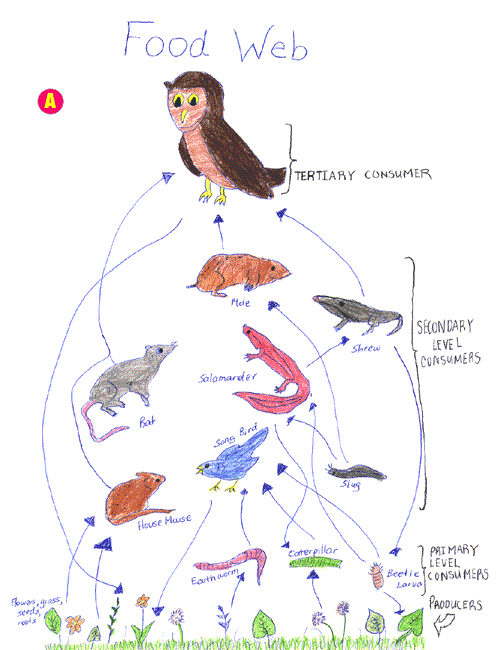
Owls have long captivated the human imagination, embodying both wisdom and mystery with their silent flight and penetrating gaze. Among their many intriguing traits, their dietary habits reveal complex ecological interactions that ripple through the natural world. A common observation is their predilection for rodents, small mammals that constitute the cornerstone of many owl species’ diets. But what if these ubiquitous rodents vanished entirely? How would owls adapt their feeding strategies and what broader ecological reverberations might ensue? This exploration delves into the hypothetical extinction of rodents and its profound implications for owl sustenance, revealing a narrative of resilience, adaptation, and the intricate tapestry of food webs.
The Centrality of Rodents in Owl Diets
Rodents—mice, voles, rats, and their kin—have evolved alongside owls in a delicate dance of predator and prey. Their abundance and high reproductive rates render them a reliable and energy-rich food source. This dependable availability has allowed many owl species to fine-tune their hunting techniques and dietary preferences around these nimble mammals. The nocturnal activity patterns of both rodents and owls align with this predator-prey dynamic, enabling efficient hunting under the veil of darkness. Through evolutionary time, the physiological and behavioral traits of owls have mirrored the prevalence of rodents in their ecosystems, underscoring the interdependence of these species.
Disappearance of Rodents: Ecological Shockwaves
The hypothetical disappearance of all rodents would constitute an ecological cataclysm far beyond the immediate dietary disruption faced by owls. Rodents function not merely as prey but as pivotal components in seed dispersal, soil aeration, and as a food source for myriad predators. Owls, deprived of their primary prey, would confront an abrupt nutritional crisis. This sudden scarcity would likely precipitate a cascade of behavioral and physiological changes as these raptors attempt to navigate a desert of familiar food. What emerges is an ecological paradox—one where the disappearance of such small creatures magnifies into a vast void, challenging the adaptability of even the apex avian hunters of the night.
Dietary Plasticity and Adaptive Foraging Strategies
Owls are not dietary monoliths; many possess a degree of dietary plasticity that hints at their potential for adaptation. In the absence of rodents, owls may shift towards other small vertebrates such as insects, amphibians, reptiles, and even other birds. This dietary pivot, however, is fraught with challenges. While insects may be abundant, their lower caloric density demands increased hunting effort and exposes owls to greater energetic costs and predation risks. Transitioning to amphibians or small birds requires altered hunting tactics and might involve competition with other predators. The return on this investment in time and energy might not parallel the efficiency of preying upon rodents, forcing owls into precarious survival scenarios.
Physiological Constraints and Energetic Implications
Owls’ morphology and hunting mechanisms are highly specialized for capturing swift, warm-blooded prey like rodents. Their talon grip strength, flight stealth, and nocturnal vision coalesce optimally to hunt such animals. Moving away from these prey types could impose significant physiological constraints. Predating on insects or small reptiles may not only be less satisfying energetically but could also demand novel hunting behaviors unfamiliar to certain owl species. Moreover, caloric deficits could compromise reproductive success, impair immune responses, and increase vulnerability to environmental stressors. This physiological bottleneck underscores the fragility of ecological specialization when confronted with rapid environmental upheavals.
Inter-Species Competition and Shifts in Predator Assemblages
The rodent extinction would not solely affect owls but reshape entire predator guilds. Other small mammal predators and insectivores would encounter altered prey landscapes, escalating interspecific competition. Owls, forced to diversify their diets, might increasingly overlap with these competitors, intensifying struggles for limited resources. Certain owl species may experience population declines, while others with broader dietary niches could expand their ranges. This reshuffling could give rise to novel predator-prey dynamics and potentially facilitate the rise of opportunistic species able to exploit the new ecological conditions. Such trophic reconfigurations highlight nature’s complexity and ceaseless flux.
Evolutionary Trajectories in Response to Prey Absence
Over evolutionary timescales, the persistent absence of rodents would likely impel profound morphological and behavioral changes in owl populations. Species might develop enhanced capabilities to capture alternative prey—perhaps sharper reflexes for catching flying insects or stronger talons for handling reptiles. Auditory and visual systems might adapt to detect different sound frequencies or movement patterns. Concurrently, reproductive strategies could shift, favoring smaller clutch sizes or altered breeding timings to optimize offspring survival under nutritional constraints. This evolutionary plasticity underscores the enduring resilience of life, yet also points to the potential loss of the iconic traits that define today’s owls.
Cultural and Symbolic Reverberations: Why We Are Fascinated
Our fascination with owls transcends their ecological roles, entwining with cultural symbolism as harbingers of wisdom, mystery, and the supernatural. The hypothetical radical shift in their diets invites reflection on the fragility of nature and the interconnectedness of life. When a creature so emblematic of nocturnal prowess is threatened by the disappearance of its staple prey, it becomes a poignant metaphor for ecosystem collapse. This intrinsic human intrigue compels us to appreciate the delicate balances within nature and the unforeseen consequences of biodiversity loss. The owl’s dietary plight, imagined through this lens, resonates deeply—stirring empathy and a renewed commitment to conservation.
The Broader Implications for Ecosystem Stability
Owls occupy crucial ecological niches as mesopredators, regulating populations of their prey and maintaining balance within their habitats. The eradication of rodents would disrupt these dynamics profoundly, likely triggering overgrowth of other species and destabilizing plant communities due to diminished seed predation and dispersal. This imbalance could cascade up and down the trophic levels, impairing ecosystem functions such as nutrient cycling and habitat integrity. The adaptive responses of owls and other predators will thus not only define their survival but also influence the resilience and recovery trajectories of entire ecosystems.
Conclusion: A Lesson in Interconnectedness and Change
Imagining a world without rodents spotlights the inextricable linkages binding predator and prey, species and ecosystem. Owls, masters of the night sky, would confront a dietary and ecological upheaval forcing them to adapt in extraordinary ways or face decline. This scenario exemplifies the delicate choreography of natural systems, where each chapter of survival is authored by adaptation and interrelation. Beyond biology, it speaks to our own responsibility—to cherish and safeguard the myriad forms of life whose existence sustains and enriches our world, often in ways unseen but profoundly felt.