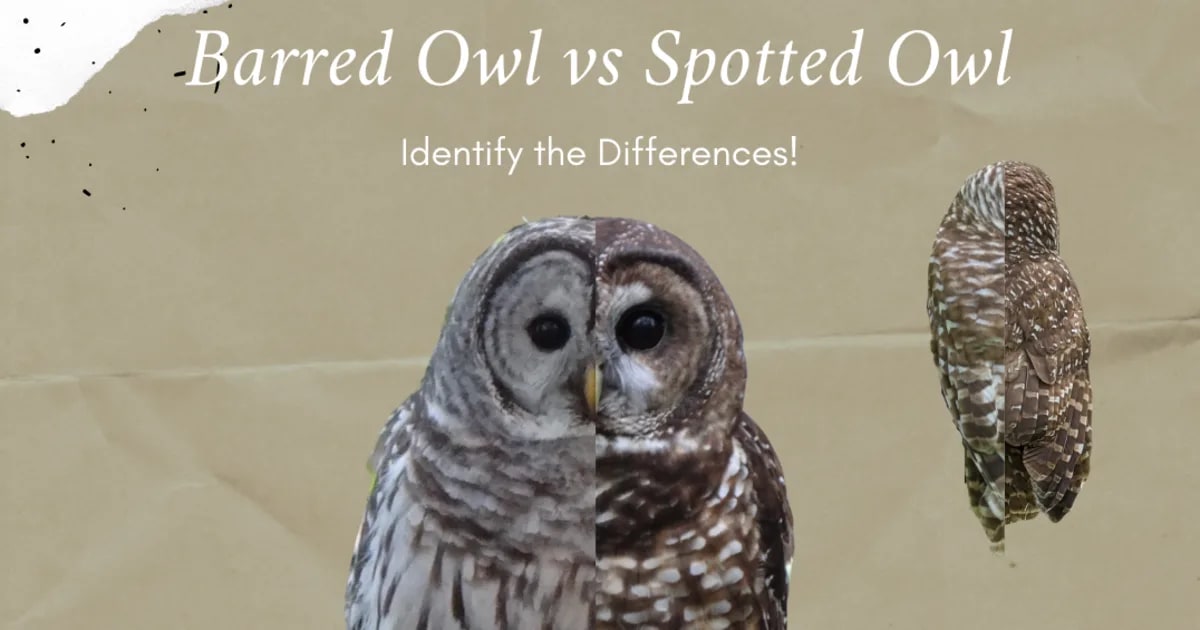
The Barred Owl vs. Spotted Owl controversy isn’t just a clash of feathered titans—it’s a living parable of ecological adaptation, human interference, and the stubborn resilience of nature. For decades, this feud has unfolded across the Pacific Northwest’s ancient forests, where the Spotted Owl, a relic of evolutionary patience, finds itself outmaneuvered by the Barred Owl, a relative upstart from the east. What began as a conservation crisis has quietly morphed into a masterclass in ecosystem dynamism, forcing scientists, policymakers, and even the public to confront uncomfortable truths about how we define success in nature. This isn’t a story of winners and losers, but of a forest rewriting its own rules—and what it might teach us about embracing change rather than resisting it.
The Owls and the Illusion of Stability
For years, the Spotted Owl was the poster child of conservation, its survival hinging on the preservation of old-growth forests. Its decline was framed as a cautionary tale: human logging had carved up its habitat, leaving it stranded in fragmented pockets of wilderness. The Barred Owl, meanwhile, was a latecomer, its range expanding westward as climate shifts and human activity redrew the continent’s ecological map. At first glance, this looked like an invasive species usurping a native one—a narrative that fit neatly into conservation dogma. But the deeper we dug, the more the story unraveled.
Ecosystems are not static cathedrals of balance; they are volatile symphonies where every species plays a role, even the uninvited ones. The Barred Owl didn’t just arrive—it thrived, adapting to the same forests the Spotted Owl depended on, but with a ruthless efficiency that left scientists baffled. Was this a sign of ecological collapse, or a sign that the forest itself was evolving? The Spotted Owl’s plight wasn’t just about competition; it was about an entire habitat’s capacity to absorb disruption. And that capacity, it turns out, was far greater than we’d assumed.
The Forest’s Silent Revolution
Beneath the canopy, something extraordinary was happening. The Barred Owl’s arrival coincided with a subtle but profound shift in the forest’s rhythm. Where Spotted Owls relied on deep, undisturbed old-growth, Barred Owls were generalists—happy to nest in younger trees, hunt in edge habitats, and exploit resources that the Spotted Owl ignored. Their vocalizations, once alien to the Pacific Northwest, now echoed through valleys that had known only the Spotted Owl’s haunting four-note call for centuries. The forest wasn’t just changing; it was rewriting its own soundtrack.
This wasn’t just a story of one owl outcompeting another. It was a story of niche expansion, of a habitat’s ability to absorb new players without collapsing. The Barred Owl didn’t replace the Spotted Owl; it forced it to adapt, to share space, or to retreat. And in doing so, it revealed a truth that conservationists had long ignored: ecosystems are not fragile glass sculptures but living, breathing organisms capable of reinvention. The question wasn’t whether the forest could survive the Barred Owl’s arrival—it was whether we could survive the revelation that our definitions of “natural” and “stable” were woefully outdated.
The Human Hand in the Owl Wars
Of course, no ecological drama unfolds without human fingerprints. The Spotted Owl’s decline was accelerated by logging, but the Barred Owl’s expansion was also a product of human activity—climate change, urban sprawl, and the unintended consequences of conservation efforts elsewhere. When we dammed rivers, paved forests, and fragmented habitats, we didn’t just displace species; we created pathways for others to move in. The Barred Owl’s march westward wasn’t an act of ecological terrorism; it was a response to the same pressures that had already reshaped the continent.
This forces us to ask: Are we truly managing ecosystems, or are we just managing our own guilt? Conservation has long been about freezing landscapes in amber, preserving them as they were before human interference. But what if the most resilient ecosystems aren’t the ones we’ve frozen in time, but the ones that can adapt to our mistakes? The Barred vs. Spotted Owl debate isn’t just about owls—it’s about whether we can accept that nature’s resilience might look nothing like the nature we thought we knew.
The Paradox of Protection
Here’s the uncomfortable truth: The more we try to protect the Spotted Owl, the more we might be undermining the forest’s ability to adapt. Conservation strategies that focus solely on preserving old-growth habitats ignore the fact that the Barred Owl’s success could be a sign of the forest’s health, not its decline. What if the Spotted Owl’s survival isn’t the ultimate measure of success, but rather the forest’s ability to support multiple species, even if it means reshuffling the deck?
This isn’t to say we should abandon the Spotted Owl. But it does mean we need to expand our toolkit. Maybe that involves creating corridors for both species to coexist. Maybe it means accepting that some habitats will change, and that change itself isn’t failure. The Barred Owl’s arrival has forced us to confront a brutal reality: Our best-laid conservation plans might be holding ecosystems hostage to our own nostalgia. And if we can’t let go of that, we might miss the forest for the trees.
Lessons in Adaptive Thinking
The owl controversy is more than a biological curiosity—it’s a blueprint for how we might approach conservation in an era of rapid change. It teaches us that resilience isn’t about stasis; it’s about flexibility. It reminds us that invasive species aren’t always villains, and that native species aren’t always saints. Most importantly, it challenges us to rethink our role in nature—not as its guardians, but as its collaborators.
What if the next generation of conservation isn’t about building walls to keep out change, but about designing systems that can bend without breaking? What if the forest’s ability to absorb the Barred Owl is a sign not of failure, but of strength? These aren’t just questions for scientists—they’re questions for all of us. Because the owl wars aren’t just about owls. They’re about whether we can learn to see nature not as a museum piece, but as a living, evolving entity that doesn’t need our permission to reinvent itself.
The Future: A Forest Without Guarantees
So where do we go from here? The answer isn’t simple. It involves hard conversations about what we value in nature, and what we’re willing to sacrifice. It means accepting that some species will decline, and others will rise—and that neither outcome is inherently good or bad. It means recognizing that the Barred Owl’s success isn’t a tragedy, but a testament to the forest’s ability to adapt.
The Spotted Owl may never reclaim its throne. The Barred Owl may never leave. And the forest? It will keep changing, as it always has. The question isn’t whether we can stop that change. It’s whether we can learn to dance with it.