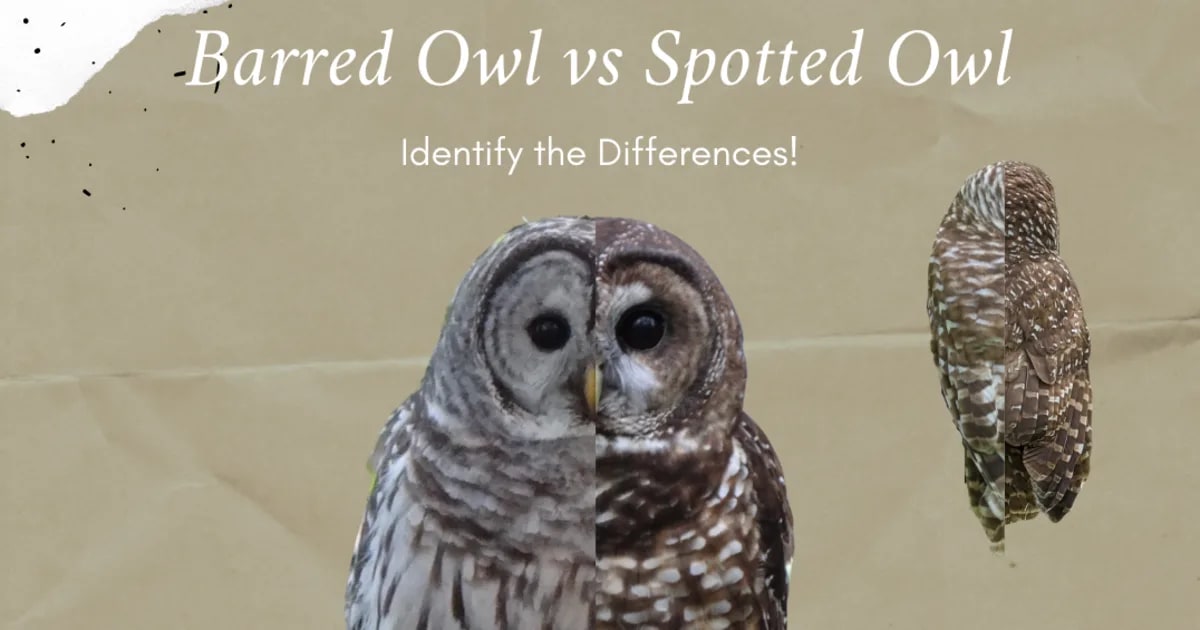
The Pacific Northwest’s emerald forests are not just a sanctuary for towering conifers and moss-draped oaks—they are the stage for an ancient rivalry, a silent war of feathers and talons waged between two of the most enigmatic raptors on Earth. The Barred Owl and the Spotted Owl, though both masters of the night, embody contrasting philosophies of survival, each a living paradox of elegance and ferocity. One is a bold interloper, a charismatic opportunist who thrives in the shadows of human encroachment, while the other is a relic of ancient woodlands, a dweller of cathedral-like groves where time itself seems to slow. To understand their clash is to peer into the heart of ecological tension—a battle not just for territory, but for the soul of a forest that has stood for millennia.
The Invader and the Indigenous: A Tale of Two Owls
The Barred Owl (*Strix varia*), with its soulful dark eyes and haunting, rhythmic call that echoes like a question posed to the moon—”Who cooks for you? Who cooks for you-all?”—is a relative newcomer to the Pacific Northwest. Once confined to the eastern United States, this adaptable predator has expanded its range westward with unsettling efficiency, hitching rides on the coattails of climate change and deforestation. Where the old-growth forests once stood unchallenged, the Barred Owl now perches, a feathered opportunist who thrives in fragmented landscapes, suburban edges, and even urban parks.
Contrast this with the Spotted Owl (*Strix occidentalis*), a creature of mythic solitude, its mottled plumage a whisper of the forest floor itself. The Spotted Owl is a denizen of ancient woodlands, where Douglas firs and redwoods rise like sentinels and the air hums with the scent of damp earth and pine resin. It is a specialist, bound to the dense, multi-layered canopies that once blanketed the Pacific Slope. To the Spotted Owl, the forest is not just a home—it is a cathedral, and its survival depends on the preservation of a world that is vanishing faster than the echoes of its own four-note whistle.
The Symphony of Survival: Hunting and Habitat
Listen closely on a mist-laden evening in the Hoh Rainforest, and you might hear the Spotted Owl’s call—a soft, descending hoot that seems to dissolve into the fog. This owl is a patient hunter, its diet a meticulous selection of woodrats, flying squirrels, and other old-growth specialists. Its hunting grounds are meticulously mapped in its mind, a labyrinth of mossy trunks and towering branches where it glides with the stealth of a shadow. The Spotted Owl does not merely hunt; it choreographs a ballet of stillness and sudden motion, its talons snatching prey from the air with surgical precision.
The Barred Owl, by contrast, is a generalist with a ravenous appetite. Where the Spotted Owl requires ancient forests, the Barred Owl adapts to clear-cuts, riparian zones, and even agricultural lands. It preys on a smorgasbord of creatures—mice, voles, small birds, even other owls. Its call, a cacophony of gurgles and cackles, rings out in places where the Spotted Owl’s haunting melody would fall silent. The Barred Owl’s adaptability is its greatest weapon, allowing it to colonize territories the Spotted Owl once considered its exclusive domain.
The Silent Usurpation: Competition and Conflict
The Pacific Northwest’s forests are not merely battlegrounds; they are arenas of displacement. As the Barred Owl’s range expands, it encroaches upon the Spotted Owl’s last refuges. Studies have shown that where Barred Owls establish territories, Spotted Owl populations decline—a silent usurpation where the invader does not need to fight directly but merely outcompetes its rival for food and nesting sites. The Barred Owl’s larger size and aggressive nature give it an edge, its dominance forcing the Spotted Owl into retreat.
This is not a battle of brute force alone. The Spotted Owl, though less confrontational, is a creature of deep instinct, its survival tied to a landscape that is disappearing. The Barred Owl, meanwhile, is a harbinger of change—a living testament to the resilience of life in the face of upheaval. Yet in this clash, there are no true victors, only survivors. The forest, once a sanctuary for the Spotted Owl’s ancient lineage, now faces a future where both species may be forced to coexist—or perish together.
The Call of the Wild: Communication and Character
The voices of these owls are as distinct as their personalities. The Spotted Owl’s call is a melancholic refrain, a series of four soft hoots that rise and fall like the tide. It is a sound that evokes the deep, unbroken silence of old-growth forests, a reminder of a world that is slipping away. The Barred Owl, on the other hand, is a vocal virtuoso, its repertoire a chaotic symphony of whinnies, cackles, and gurgles that echo through the night like a mischievous spirit.
These calls are more than mere communication—they are declarations of identity. The Spotted Owl’s voice is the whisper of the wild, a sound that belongs to a time before humans carved their names into the bark of ancient trees. The Barred Owl’s cacophony is the laughter of a survivor, a creature that thrives where others falter. In their voices, we hear the echoes of evolution itself—a story of adaptation, displacement, and the relentless march of change.
The Future of the Forest: Conservation in the Balance
The fate of these owls is inextricably linked to the fate of the Pacific Northwest’s forests. For the Spotted Owl, survival hinges on the preservation of old-growth ecosystems, where centuries-old trees provide both sustenance and sanctuary. Conservation efforts have focused on protecting these critical habitats, but the encroachment of the Barred Owl complicates the equation. Should we cull Barred Owls to save the Spotted Owl? Or is their presence a sign of a changing world, one where the boundaries between species blur and the old rules no longer apply?
This is not a question with easy answers. The Barred Owl’s expansion is a symptom of broader ecological shifts—climate change, habitat fragmentation, the relentless march of human development. To save the Spotted Owl, we may need to rethink our approach to conservation, embracing a future where both species can coexist. Perhaps the answer lies not in conflict, but in coexistence—a forest where the haunting call of the Spotted Owl and the raucous laughter of the Barred Owl both find a place.
The Owls and the Mirror: What Their Struggle Teaches Us
In the silent war between these two owls, we see reflected our own struggles—our battles with change, our fears of displacement, our desperate clinging to the past. The Spotted Owl is a symbol of what we stand to lose: the wild, the untamed, the ancient. The Barred Owl is a reminder that life adapts, that resilience is its own form of strength. Their conflict is a mirror held up to the natural world, a reflection of the choices we make as stewards of this planet.
Perhaps the most poignant lesson is this: the forest is not a static place. It is a living, breathing entity, constantly evolving, constantly changing. The Barred Owl and the Spotted Owl are not just competitors—they are characters in an ongoing story, a tale of survival that is as old as the trees themselves. To understand their battle is to understand the heart of the wild—a place where beauty and brutality, loss and adaptation, are forever intertwined.