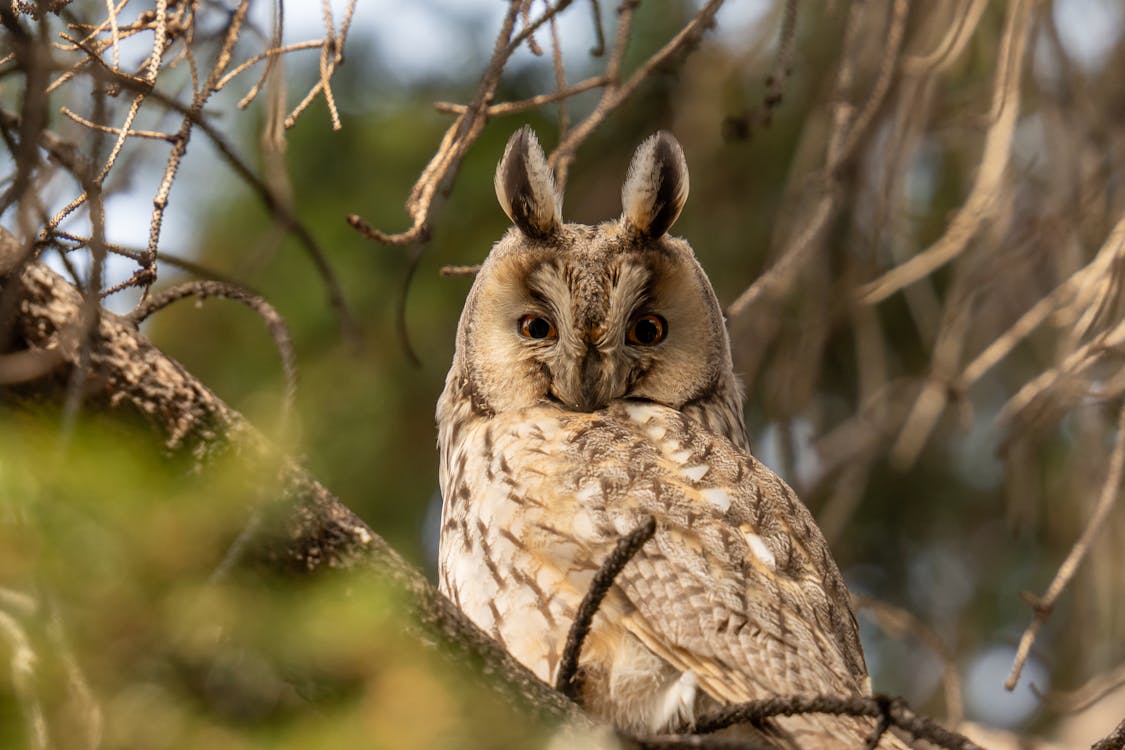
In the emerald embrace of Spain’s woodlands, where the whispers of ancient oaks mingle with the rustle of underbrush, a silent sentinel takes flight—the long-eared owl. Once a ghostly presence, barely glimpsed in the twilight, this enigmatic bird has become a symbol of nature’s resilience, its survival story intricately woven into the tapestry of habitat restoration. Across the Iberian Peninsula, conservationists have waged a quiet revolution, transforming degraded landscapes into thriving ecosystems where the owl’s haunting call now echoes with renewed vigor. This is the tale of how Spain’s long-eared owls, those feathered philosophers of the dusk, have been given a second chance—not through grand gestures, but through the patient, deliberate art of ecological rebirth.
The Long-Eared Owl: A Phantom of the European Night
Perched like a sentinel carved from twilight itself, the long-eared owl (*Asio otus*) is a master of camouflage and stealth. With ear-like tufts that belie its true nature, it is neither owl nor horned creature, but a living paradox—a bird that dances on the edge of perception. Its plumage, a symphony of tawny browns and intricate barring, dissolves into the bark of trees, making it nearly invisible until the moment it takes flight, a silent shadow with golden eyes that pierce the gloom. In Spain, this species has long been a creature of mystery, its presence hinted at but rarely confirmed, its nesting sites as elusive as the owl’s own nocturnal habits.
Yet, the long-eared owl is more than a phantom; it is an indicator, a living barometer of the health of its habitat. Where it thrives, the ecosystem hums with balance. Where it falters, the land whispers warnings of decline. For decades, Spain’s woodlands suffered under the weight of deforestation, agricultural expansion, and the creeping shadow of urbanization. The owl’s decline was not an isolated tragedy but a symptom of a landscape gasping for breath. Then, conservationists listened—not to the owl’s call, but to the silence that followed its absence—and decided to act.
The Decline: When the Night Fell Silent
Imagine a forest stripped of its soul. The long-eared owl, a creature of old-growth woodlands and dense thickets, found itself marooned in a world that no longer suited its needs. The Mediterranean woodlands of Spain, once a mosaic of cork oaks, holm oaks, and pine, were being carved into fragments by relentless development. Agricultural lands encroached, pesticides poisoned the soil, and the understory—critical for nesting and hunting—was trampled beneath the march of progress. The owl’s prey, small mammals like voles and mice, dwindled as their habitats vanished. Without food, without shelter, the owl’s haunting presence faded from the night.
By the late 20th century, the long-eared owl’s population in Spain had dwindled to a precarious edge. Conservationists sounded the alarm, but the challenge was Herculean: how do you restore a habitat when the very land has been reshaped by human hands? The answer lay not in reversing time, but in rewriting the future. Habitat restoration became the owl’s lifeline—a deliberate, painstaking process of healing the wounds inflicted by decades of neglect.
The Restoration: A Symphony of Soil and Seed
Restoring a habitat is not merely planting trees; it is composing an ecosystem from scratch, layer by layer, like a painter blending hues on a canvas. In Spain, conservationists adopted a multi-pronged approach, each strategy a note in the symphony of renewal. First came the reintroduction of native flora—holm oaks, cork oaks, and Mediterranean pines—planted in carefully curated patterns to mimic the natural density of old-growth forests. These trees were not mere saplings; they were the architects of a new world, their roots binding the soil, their canopies sheltering the understory.
But trees alone could not restore the owl’s domain. The understory, a tangled web of shrubs, brambles, and grasses, is the owl’s hunting ground, where voles and mice scurry beneath the cover of thorns and leaves. Restoration efforts included controlled burns to mimic natural wildfires, which thin out dense thickets and encourage new growth. In some areas, invasive species were uprooted, their dominance broken to make way for native plants that sustained the owl’s prey. Even the soil itself was nurtured—composted, aerated, and enriched to foster the mycorrhizal networks that sustain healthy forests.
The result was a landscape reborn, not as it once was, but as it could be—a thriving, dynamic ecosystem where the owl’s presence was no longer a fleeting glimpse but a constant presence. The restoration was not instantaneous; it was a slow, deliberate unfolding, like the petals of a night-blooming flower finally unfurling in the dark.
The Owl’s Return: A Ghost Reborn
As the woodlands regrew, so too did the long-eared owl’s fortunes. Nesting boxes, strategically placed in the heart of restored forests, offered safe havens for breeding pairs. These artificial cavities, designed to mimic the owl’s preference for old woodpecker holes, became the first signs of the species’ resurgence. Conservationists monitored the nests with the reverence of archaeologists uncovering a lost civilization, documenting each fledgling as a triumph of nature’s tenacity.
The owl’s return was not just a biological victory; it was a cultural one. Local communities, once indifferent or even hostile to the bird’s presence, began to see it as a symbol of their land’s healing. Farmers, who once viewed the owl as a pest, now recognized its role in controlling rodent populations. Tourists, drawn by the allure of Spain’s wild landscapes, sought out the owl’s haunting calls as a testament to the country’s ecological revival. The long-eared owl, once a phantom, had become a living emblem of hope.
Yet, the owl’s resurgence was not without its challenges. Climate change loomed as a silent threat, altering the delicate balance of the ecosystem. Droughts parched the land, while unseasonal storms uprooted young trees. Conservationists adapted, introducing drought-resistant species and creating microhabitats to buffer against extreme weather. The owl’s story was no longer just one of restoration, but of adaptation—a reminder that nature’s resilience is not infinite, but must be nurtured with vigilance.
The Ripple Effect: How One Species Transforms an Ecosystem
The long-eared owl’s recovery is more than a conservation success story; it is a case study in ecological interconnectedness. As the owl returned, so too did its prey, the small mammals that had nearly vanished. With them came predators like foxes and genets, restoring the food web to its natural complexity. Birds that had abandoned the area, deterred by the lack of cover, began to return, their songs weaving through the restored forests. Even the soil, once depleted and lifeless, teemed with microorganisms, fungi, and insects that had been absent for generations.
This ripple effect extended beyond the woodlands. Rivers and streams, once choked by sediment from eroded hillsides, ran clearer as the restored forests held the soil in place. Pollinators, drawn to the blooming understory, thrived, ensuring the reproduction of countless plant species. The long-eared owl, in its silent way, had become a keystone species—a linchpin holding the entire ecosystem together. Its presence was not just a sign of health, but a catalyst for renewal.
The Future: A Night Still Worth Listening To
Today, the long-eared owl’s haunting call echoes through Spain’s woodlands once more, a reminder that even the most fragile ecosystems can heal when given the chance. But the work is far from over. Habitat restoration is not a one-time act, but a lifelong commitment—a promise to listen to the land and respond to its needs. Conservationists continue to monitor the owl’s population, adapting strategies as the climate shifts and new threats emerge. Local communities remain engaged, their stewardship ensuring that the owl’s habitat is not just restored, but protected for generations to come.
The long-eared owl, with its golden eyes and feathered crown, is no longer a phantom of the night. It is a living testament to the power of restoration, a bird that has reclaimed its place in the world not through force, but through patience and persistence. Its story is a call to action—for every landscape that has been wounded, for every species that has been forgotten, there is still time to heal. The night is still worth listening to, and in Spain’s woodlands, the owl’s song is a reminder that nature, when given the chance, will always find a way to rise again.