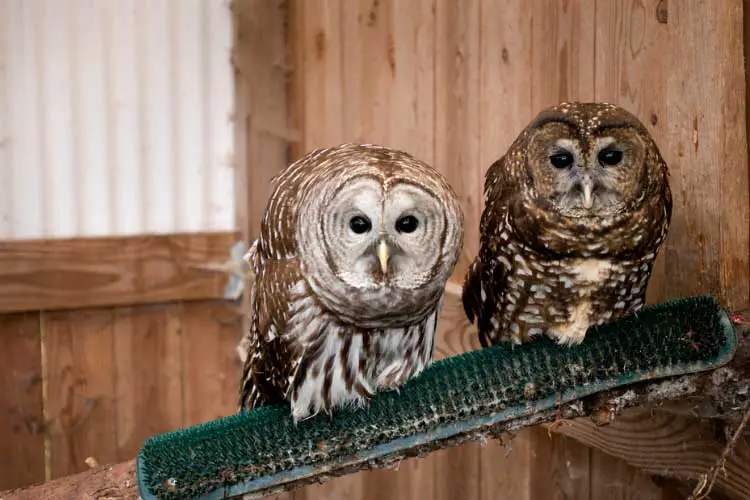
Imagine, for a moment, that you are a barred owl, perched high in the ancient canopy of a Pacific Northwest forest. The air is thick with the scent of moss and damp earth, and the night hums with the whispers of unseen creatures. How would you feel if a silent, invisible detective—one that doesn’t need to see or hear you—could reveal your presence to the world? This isn’t science fiction. It’s the reality of environmental DNA, or eDNA, a revolutionary tool that’s reshaping how we detect elusive species like the barred and spotted owl. But as with any innovation, it comes with its own set of challenges, ones that could redefine the boundaries of conservation.
The Silent Sentinels: What Is eDNA and How Does It Work?
Environmental DNA is the genetic material shed by organisms into their surroundings—tiny fragments of skin, feathers, fur, or even waste that float in the air, water, or soil. For creatures like barred and spotted owls, this means that every time they preen, shed a feather, or let out a hoot, they’re leaving behind a molecular calling card. Scientists collect samples from the environment—whether it’s a swab of moss, a vial of stream water, or a filter from the air—and then sequence the DNA to identify which species are present.
This method is a game-changer for species that are rare, nocturnal, or masters of camouflage. Unlike traditional surveys that rely on visual sightings or audio recordings, eDNA doesn’t discriminate. It doesn’t care if the owl is sleeping, hunting, or simply out of sight. It only cares about the genetic traces it leaves behind. For barred owls, a species known for its adaptability and invasive tendencies, eDNA offers a way to track their spread without disturbing their habitats. For spotted owls, a threatened species clinging to existence in fragmented forests, it provides a lifeline to monitor their elusive populations.
The Owl Detectives: How eDNA Uncovers Hidden Populations
Picture a team of researchers, armed with nothing but a backpack of sampling kits and a sense of adventure, venturing into the dense, mist-shrouded forests of California or Oregon. They’re not looking for owls directly. Instead, they’re collecting water from streams, scraping lichen from tree bark, or running air through specialized filters. Back in the lab, these samples are analyzed for the genetic signatures of barred and spotted owls. The results? A map of where these birds are hiding, even if they’ve never been seen by human eyes.
This method has already proven its worth. In some cases, eDNA has detected barred owls in areas where they were previously unknown, revealing their encroachment into spotted owl territories. In others, it has confirmed the presence of spotted owls in regions where their calls were too faint to pick up on audio recorders. The beauty of eDNA lies in its sensitivity. A single feather, a drop of water, or even a puff of air can contain enough genetic material to identify a species. It’s like having a detective who can solve a crime without ever seeing the suspect—just by analyzing the clues they’ve left behind.
The Dance of Detection: Challenges in the Wild
But here’s the twist: eDNA isn’t perfect. It’s a tool, and like all tools, it has its limitations. One of the biggest challenges is the ephemeral nature of DNA in the environment. Environmental factors like sunlight, temperature, and microbial activity can degrade DNA quickly, making it harder to detect. In a rainforest, where the air is humid and the water is flowing, genetic material might linger just long enough to be found. In a dry, sun-baked forest, it could vanish in hours. This means that timing is everything. A sample taken too late might miss the owl entirely, leaving researchers with a puzzle missing a crucial piece.
Another hurdle is the sheer complexity of the environment. Forests are teeming with life, and the DNA soup in a single sample can contain traces from dozens of species. Sorting through this genetic cacophony to pick out the barred or spotted owl is like finding a needle in a haystack—except the haystack is made of fungi, insects, and other birds, and the needle is a fragment of owl DNA. Scientists use advanced bioinformatics tools to sift through the noise, but the process is computationally intensive and not without its own risks of error.
And then there’s the ethical dilemma. While eDNA is non-invasive, it raises questions about privacy in the wild. If we can detect an owl’s presence through its shed DNA, could we one day use similar methods to track other species—even humans—without their consent? The potential for misuse looms like a shadow over this technology, a reminder that innovation must always be tempered with responsibility.
The Future of the Forest: What’s Next for eDNA?
Despite these challenges, the future of eDNA in owl conservation is bright. Researchers are already experimenting with new techniques to improve detection rates. One promising avenue is the use of environmental RNA, or eRNA, which degrades even faster than DNA but can provide a snapshot of which genes are actively being expressed. This could tell us not just where an owl is, but what it’s doing—whether it’s hunting, nesting, or simply passing through.
There’s also the potential for real-time eDNA monitoring. Imagine a network of sensors scattered through the forest, continuously sampling the air and water for genetic traces of barred and spotted owls. These sensors could send alerts to researchers the moment an owl’s DNA is detected, allowing for rapid response to threats like habitat destruction or invasive species. It’s a vision of a smart forest, one that watches over its inhabitants with the precision of a guardian angel.
But the most exciting possibility is the role eDNA could play in rewilding efforts. As conservationists work to restore habitats and reintroduce species, eDNA could become the ultimate tool for measuring success. Did the reintroduction of barred owls into a new area take hold? Did the spotted owl population rebound after habitat restoration? With eDNA, the answers could be just a sample away.
A Call to the Canopy: Why This Matters
At its core, the story of eDNA and owls is a story about listening to the whispers of the wild. It’s about recognizing that the forest is not just a place of towering trees and hidden creatures, but a living, breathing entity with its own language—one written in DNA. For barred owls, this language might signal an invasive takeover. For spotted owls, it could be a cry for help. And for us, it’s an invitation to rethink how we interact with the natural world.
So the next time you find yourself beneath the canopy of an old-growth forest, pause for a moment. Listen. The trees are talking. The streams are murmuring. And somewhere in the shadows, an owl is leaving its mark—not with a hoot, not with a flash of wings, but with the silent language of its DNA. Will we listen?