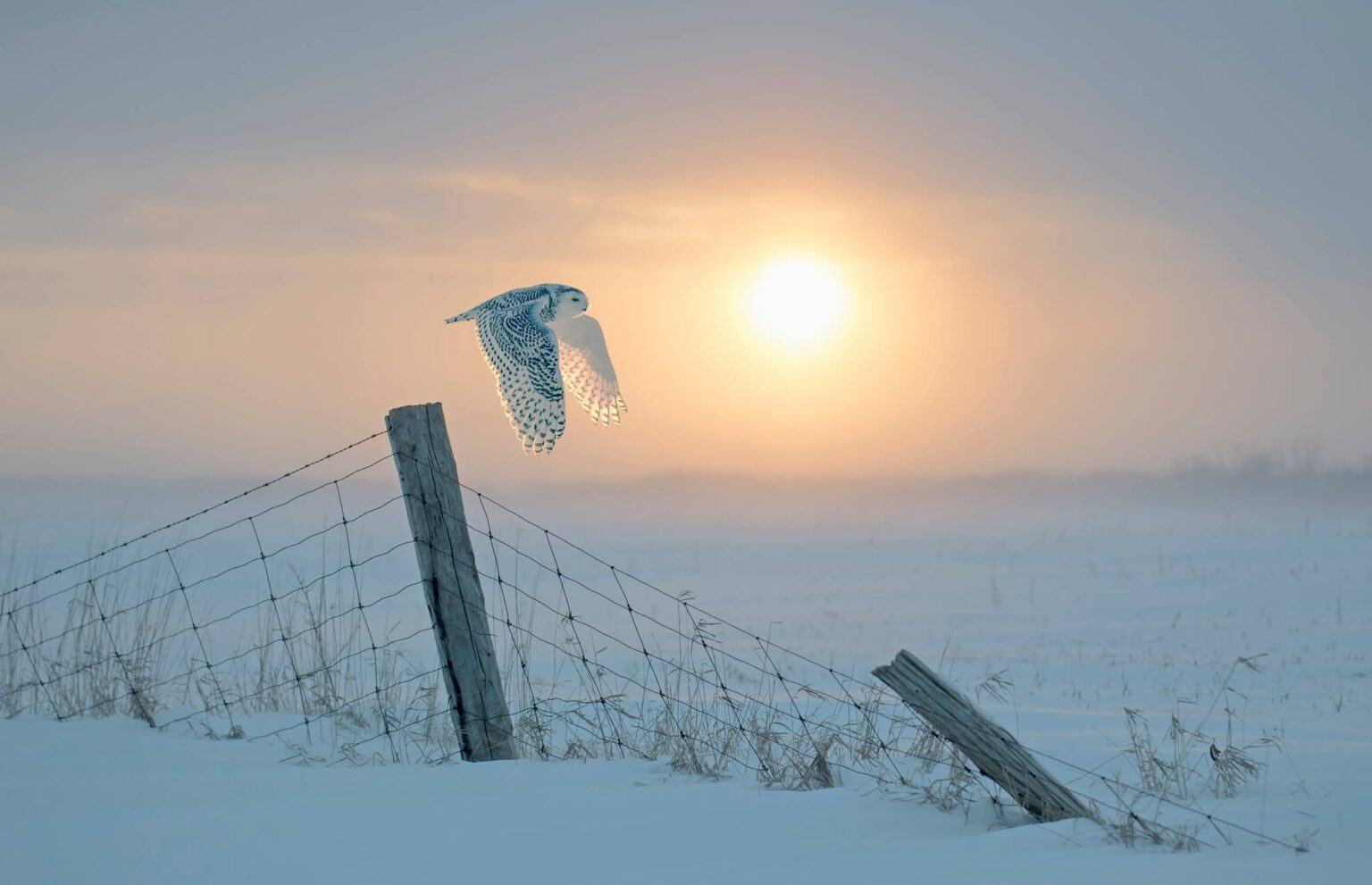
In the remote Arctic tundras where the sun refuses to dip below the horizon for weeks on end, a mysterious and majestic creature reigns supreme. The snowy owl, with its ghostly white plumage and piercing yellow eyes, is an emblem of resilience and adaptation amidst extreme environmental conditions. As daylight stretches relentlessly through the summer months, one might wonder: How does this enigmatic bird manage to thrive when the world around it glows in an endless embrace of light? The answer challenges our conventional understanding of time, biology, and survival, promising to shift your perspective on life under the midnight sun.
The Unbroken Daylight: An Ecological Enigma
In the Arctic, from late spring to early summer, the sun’s continuous presence creates an exceptional habitat—one where darkness is but a distant memory. This phenomenon, known as the Midnight Sun, subjects all living beings to persistent daylight for up to 24 hours a day. For most species, this relentless illumination would prove disorienting, disrupting internal rhythms honed over millennia. Yet, the snowy owl has carved out a unique niche, harmonizing its physiology and behavior with an environment that defies the natural cycle of night and day. Understanding how it does so necessitates a journey into the owl’s remarkable adaptive toolkit.
Recalibrating Circadian Rhythms Amid Perpetual Light
At the heart of the snowy owl’s adaptation lies a complex modulation of its circadian rhythms—the internal biological clock governing sleep, activity, and hormonal cycles. Unlike creatures that succumb to the absence of darkness, snowy owls exhibit a plasticity in their circadian system that permits a departure from strict diurnal-nocturnal distinctions. This temporal ambiguity allows them to optimize hunting and resting periods whenever prey activity reaches its peak, rather than adhering to artificial thresholds of daylight and darkness.
Some scientific studies suggest that these owls possess an extraordinary capacity for temporal flexibility. Their neural mechanisms can buffer the disruptive effects of constant illumination by adjusting hormone secretion patterns, particularly melatonin, which is typically suppressed by light in most animals. This endocrine adaptation mitigates the potential chaos caused by continuous daylight, enabling snowy owls to maintain vital physiological functions and cognitive alertness.
Behavioral Mastery: Timing Hunts in a Radiant Arena
While the sun never sets, the Arctic environment is not static. The intensity of sunlight varies, and subtle shadows emerge from terrain undulations or sparse vegetation. Snowy owls have fine-tuned their hunting behavior to exploit these ephemeral nuances of light, striking when prey is most vulnerable. They often hunt during the softer light of dawn and dusk tones—the “golden hours”—even though these are faint when compared to temperate zones.
Moreover, their prey, primarily lemmings and other small mammals, exhibit activity patterns influenced by factors beyond simple daylight. Snowy owls vigilantly track these rhythms, adjusting their foraging expeditions accordingly. This behavioral plasticity—accelerated by acute sensory adaptations such as enhanced vision and hearing—allows snowy owls to synchronize their predatory efforts with the subtle ebbs and flows of a seemingly unending day.
Physiological and Morphological Enhancements for a Luminous Habitat
Adaptations in the snowy owl transcend behavior and delve deep into physiological realms. Their eyes are evolutionarily optimized for detecting contrast and motion in an overwhelmingly bright environment. Unlike many nocturnal counterparts adapted to darkness, snowy owls possess retinal cells that balance sensitivity and protection against glare, allowing them to scan vast landscapes with supreme precision. This ocular specialization is critical for spotting minute movements of prey in the blinding Arctic light.
Further, their plumage—usually pure white—functions not solely as camouflage against snow but also in thermoregulation and UV protection. The reflective feathers reduce heat absorption, maintaining body temperature despite prolonged exposure to solar radiation. This delicate equilibrium of insulation and cooling is vital for sustaining energy during extended daylight hours, which demand constant vigilance rather than prolonged rest.
The Metabolic Economy of the Endless Day
Continuous daylight imposes energetic demands unlike any other natural setting. For snowy owls, maintaining metabolic balance means reconceptualizing the traditional feast-and-fast cycles linked to nightfall. They capitalize on abundant prey that thrive in the Arctic summer bloom, enabling rapid replenishment of energy stores. However, their metabolism remains remarkably economical, avoiding exhaustion amid constant activity.
Recent insights reveal that snowy owls employ a strategy akin to metabolic torpor on a micro scale—brief episodes of reduced physiological activity that conserve energy without compromising alertness. This nuanced energy management is critical for navigating a habitat where the conventional cues for rest are absent, ensuring longevity and reproductive success in a taxing environment.
Implications for Understanding Wildlife Adaptations in a Changing Climate
The snowy owl’s adeptness at life during Arctic summers offers profound implications beyond mere ornithological curiosity. As global climate patterns shift, polar ecosystems face unprecedented transformations. The ability of species like the snowy owl to modulate internal clocks and behaviors underscores the plasticity that can buffer against environmental upheaval. Yet, it also raises questions about the limits of such adaptability amid accelerated changes in temperature, prey availability, and snow cover.
Exploring the snowy owl’s survival strategies not only deepens appreciation for the ingenuity of natural evolution but also shines a light on the resilience and fragility of Arctic biomes. Their existence under ceaseless daylight invites us to rethink the interplay between organism and environment, challenging dichotomies of night and day, rest and activity, survival and flourishing.
A Shift in Narrative: Embracing the Paradox of Perpetual Light
The story of the snowy owl under the midnight sun invites a transformative gaze—one that transcends simplistic notions of diurnal cycles and normalcy. It compels us to acknowledge that life is animated by adaptability and fluidity in the face of extremes. The perpetual daylight of Arctic summers, far from being a bane, becomes a stage where evolution scripts new acts of endurance and grace.
In embracing this paradox, we glimpse a world where time dissolves into a tapestry of endless possibility, and survival is an art form sculpted by light itself. The snowy owl does not merely endure the 24 hours of daylight; it thrives within it, redefining the boundaries of nature’s rhythm and inviting us to marvel at the audacity of life.