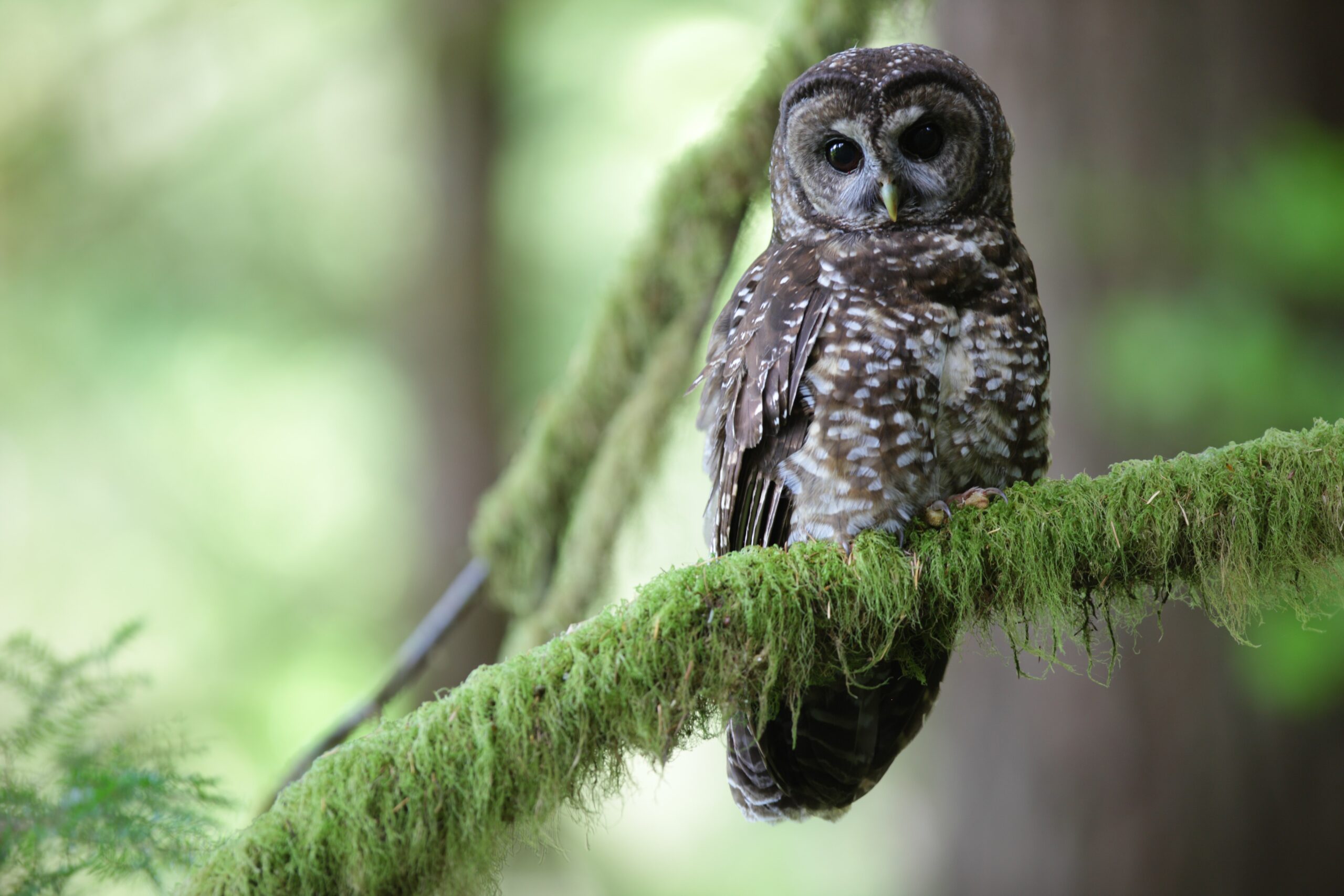
The spotted owl, with its piercing amber eyes and mottled brown-and-white plumage, is more than just a bird—it is a living emblem of the Pacific Northwest’s ancient forests, a symbol of ecological fragility, and a silent witness to humanity’s tumultuous relationship with nature. In the mist-laden canopies of Oregon, Washington, and British Columbia, this nocturnal sentinel has become a cultural touchstone, its presence echoing through Indigenous cosmologies, environmental movements, and even the timber wars of the late 20th century. To understand why the spotted owl holds such profound significance is to unravel a tapestry woven from science, myth, and the urgent call of conservation. This is not merely the story of a species under threat—it is the story of a region wrestling with its identity, its past, and its future.
The Spotted Owl as a Keystone of Old-Growth Mythology
Long before European settlers carved their names into the region’s history, the spotted owl occupied a sacred space in the spiritual narratives of Indigenous peoples. For the Coast Salish, the Nuu-chah-nulth, and the Klamath tribes, the owl was not merely a creature of the night but a messenger between worlds—a guardian of secrets whispered through the wind. Its haunting four-note call, often likened to a soft, melancholic whistle, was believed to carry the voices of ancestors or omens of change. In some traditions, the owl’s presence foretold the arrival of storms or the shifting of seasons, its movements interpreted as a bridge between the seen and unseen.
This mythological weight lent the spotted owl an almost totemic status. Unlike the more common barn owl or great horned owl, the spotted owl’s dependence on ancient, undisturbed forests made it a living barometer of ecological health. Where it thrived, the land was whole. Where it vanished, so too did the intricate web of life that had sustained Indigenous communities for millennia. The owl’s decline thus became a metaphor for the erosion of cultural memory—a slow, creeping loss that mirrored the felling of old-growth giants like Douglas fir and western hemlock. To protect the owl was not just to save a species; it was to honor a way of life that had coexisted with the land for thousands of years.
The Environmental Battleground: How the Owl Became a Symbol of Resistance
The 1980s and 1990s marked a turning point in the spotted owl’s cultural ascent, as its fate became inextricably linked to the fierce debates over logging and land use. With its reliance on dense, multi-layered forests, the owl became the inadvertent face of a movement that sought to halt the clear-cutting of old-growth ecosystems. Environmentalists, armed with scientific data and a growing sense of urgency, framed the owl’s survival as a litmus test for humanity’s stewardship of the planet. The bird’s listing under the Endangered Species Act in 1990 was not just a legal victory—it was a cultural earthquake, a moment when the owl transcended its biological role to become a rallying cry for those who saw the Pacific Northwest’s forests as cathedrals of biodiversity rather than commodities.
Yet the owl’s newfound fame was not without controversy. Timber-dependent communities, already reeling from economic shifts, viewed the bird as a symbol of governmental overreach. Protests erupted. Bumper stickers emblazoned with “Save a Logger, Eat an Owl” appeared alongside more nuanced slogans like “Jobs vs. Owls.” The conflict laid bare a deeper tension: the clash between short-term economic needs and the long-term imperative of ecological preservation. In this crucible, the spotted owl became a polarizing figure—adored by some, vilified by others, but never ignored. Its image adorned protest signs, its name was chanted in rallies, and its fate was dissected in op-eds and town halls. The owl had become a cultural Rorschach test, reflecting the fears, hopes, and contradictions of a region—and a nation—grappling with modernity.
The Aesthetic and Literary Muse: The Owl in Art and Storytelling
Beyond its ecological and political roles, the spotted owl has left an indelible mark on the region’s artistic and literary landscape. Writers like Ursula K. Le Guin and poets like Gary Snyder have invoked the owl’s presence in their works, using it as a metaphor for solitude, wisdom, or the haunting beauty of wilderness. In Le Guin’s The Wind’s Twelve Quarters, the owl’s call becomes a recurring motif, a reminder of the untamed heart of the natural world that persists even in the face of human encroachment. Snyder, in his essays, often turns to the owl as a symbol of the “deep ecology” he championed—a creature whose existence is intertwined with the health of the entire forest.
Visual artists, too, have been captivated by the owl’s enigmatic presence. Painters like David Boxley, a Tsimshian artist, have incorporated the owl into traditional formline designs, blending Indigenous iconography with the owl’s modern symbolism. Photographers, meanwhile, have sought to capture its elusive grace, often framing the bird against the backdrop of towering conifers or the golden light of dawn breaking over the Cascade Range. The owl’s striking appearance—its dark eyes like polished obsidian, its feathers patterned like lichen on bark—makes it a natural subject for those who wish to convey both the fragility and resilience of nature. In galleries and books, the spotted owl endures as a muse, its image a bridge between the tangible and the symbolic.
The Owl in the Age of Climate Change: A Canary in the Forest
Today, the spotted owl’s significance has taken on a new dimension as climate change reshapes the Pacific Northwest’s ecosystems. Rising temperatures, prolonged droughts, and the increasing frequency of wildfires are altering the forests the owl depends on, pushing it further toward the brink. Some scientists now warn that the northern spotted owl, already listed as threatened, may face even greater pressures as its habitat becomes drier and more fragmented. This has elevated the owl’s status from a symbol of old-growth forests to a harbinger of the broader ecological crises looming on the horizon.
Yet the owl’s story is not one of unrelenting doom. Conservation efforts, from captive breeding programs to the controversial removal of invasive barred owls (which outcompete spotted owls for resources), offer glimmers of hope. The owl’s struggle has also spurred innovative approaches to forest management, such as the creation of large, contiguous protected areas and the restoration of degraded habitats. In this context, the spotted owl serves as a living reminder of the interconnectedness of all life—its fate inextricably tied to the health of the forests, the rivers, and the communities that call the Pacific Northwest home. To protect the owl is to protect a way of life, a cultural legacy, and a future that is still within reach.
The Owl as a Mirror: What the Spotted Owl Reveals About Us
Perhaps the most enduring aspect of the spotted owl’s cultural significance is what it reveals about humanity’s relationship with nature. The owl forces us to confront uncomfortable truths: that progress often comes at a cost, that our actions have consequences that ripple across generations, and that the natural world is not a resource to be exploited but a web of life to be revered. In an era where biodiversity loss and climate change dominate headlines, the spotted owl stands as a poignant example of how a single species can embody the struggles and aspirations of an entire region.
It is a bird that demands we ask ourselves: What do we value? What are we willing to sacrifice? And how will we be remembered by the creatures that come after us? The spotted owl does not provide easy answers. Instead, it offers a challenge—a call to see the world not as a backdrop for human ambition, but as a living, breathing entity deserving of respect. In its silent, watchful gaze, we may yet find the wisdom to listen.