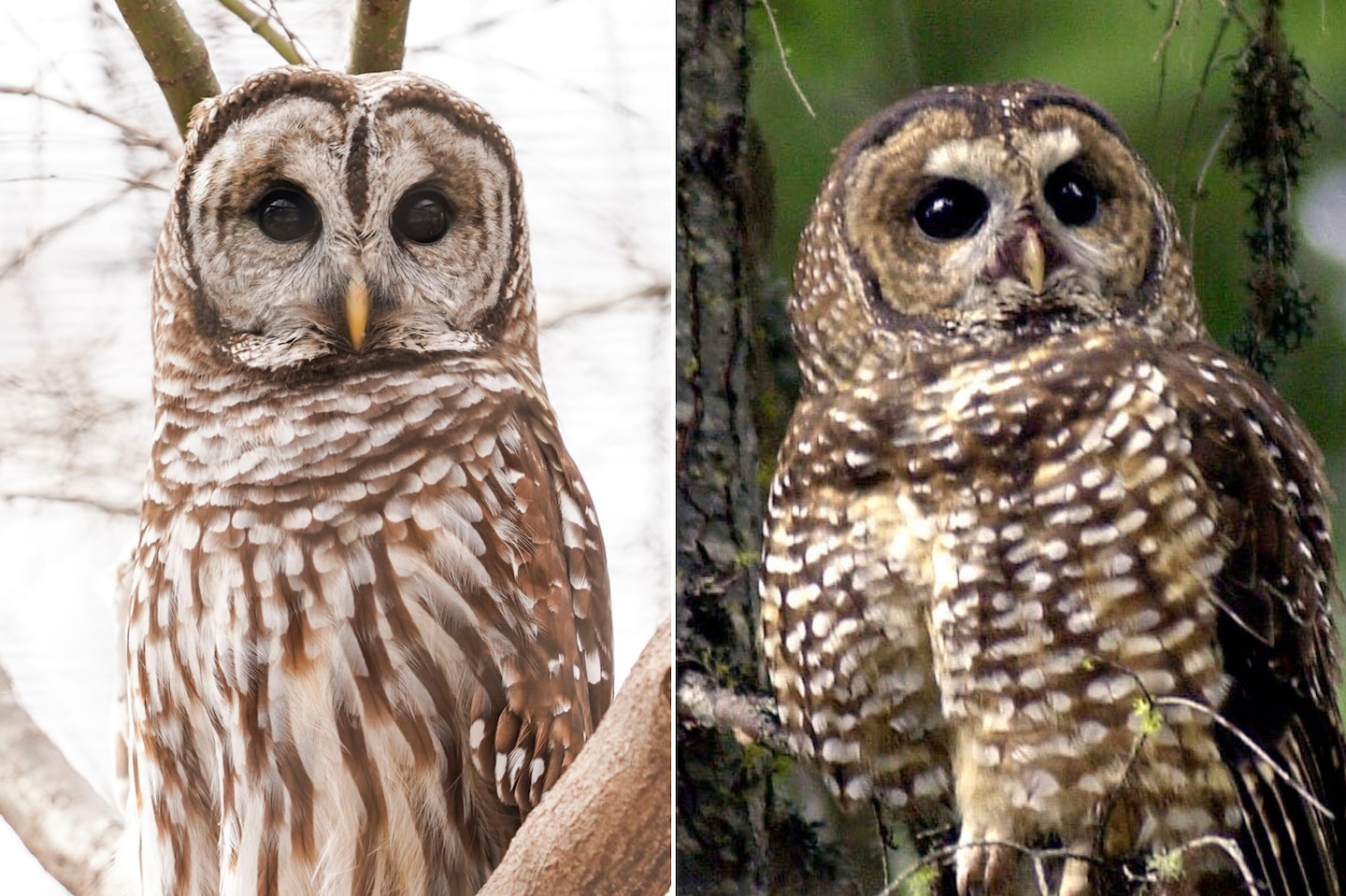
The Pacific Northwest is a land of emerald forests and mist-laced valleys, where the air hums with the whispers of ancient trees and the rivers sing of untamed wilderness. Yet beneath this serene canopy, a silent war rages—not between armies, but between two owls: the barred and the spotted. One, a bold interloper with a voice like a rasping laugh, the other, a dwindling relic of old-growth forests, clinging to existence like a whisper in the storm. The decision to cull 450,000 barred owls to save the spotted owl is not merely ecological policy; it is a moral reckoning, a clash of survival strategies, and a testament to the fragility of balance in nature’s grand design.
The Owls and Their Domains: A Tale of Two Predators
The barred owl, *Strix varia*, is a relative newcomer to the Pacific Northwest, its range expanding westward like a slow-burning wildfire. With its distinctive “Who cooks for you? Who cooks for you-all?” call echoing through the woods, this owl thrives in fragmented forests, adaptable to human encroachment. Its barred plumage and round, dark eyes give it an almost comical demeanor, yet its adaptability is no joke—it outcompetes the spotted owl, *Strix occidentalis*, in nearly every ecological niche.
The spotted owl, a creature of old-growth forests, is a symbol of endurance. Its mottled brown and white feathers blend seamlessly with the moss-draped branches of ancient trees, and its haunting four-note whistle is the soundtrack of a vanishing world. Where the barred owl sees opportunity, the spotted owl sees sanctuary. But as clear-cutting and development have gnawed at the old-growth forests, the spotted owl’s domain has shrunk to a fraction of its former glory. Now, it faces not just habitat loss, but a more cunning foe: an owl that doesn’t just share its space but dominates it.
The Ecological Chessboard: Who Wins, Who Loses?
Nature is a chessboard where every move reverberates through the food web. The barred owl’s arrival has tilted the board irrevocably. Studies show that where barred owls establish themselves, spotted owl populations decline by up to 50% within a decade. This isn’t just competition for food—it’s a full-scale invasion. Barred owls are larger, more aggressive, and more vocal, using their dominance to claim territory and even prey upon spotted owls directly.
Yet the irony is bitter. The barred owl’s success is a symptom of human disruption. Climate change, deforestation, and urban sprawl have fragmented forests, creating the perfect conditions for this adaptable generalist. The spotted owl, a specialist of ancient ecosystems, is the canary in the coal mine—a harbinger of what happens when nature’s delicate mosaics are torn apart. To save the spotted owl, we must ask: Is this a war we can win without losing something far greater—the very essence of wildness?
The Moral Quandary: Conservation or Culling?
The proposal to kill 450,000 barred owls is a radical act of triage. It forces us to confront uncomfortable truths: Is it ethical to play executioner in the name of conservation? The barred owl is not an invasive species in the traditional sense—it didn’t arrive by ship or plane, but by the slow creep of ecological change. Should we punish it for thriving in a world we’ve reshaped?
Yet the alternative is extinction. The spotted owl is already listed as threatened under the Endangered Species Act, its numbers dwindling to a few thousand. Without intervention, it may follow the dodo into oblivion. Conservationists argue that culling is a necessary evil, a last resort to preserve biodiversity. But the act itself is a stain on our conscience—a reminder that even in our efforts to heal the Earth, we are still its most destructive force.
Perhaps the real question is not whether we should cull, but why we allowed the situation to reach this point. The barred owl’s expansion is a mirror held up to our own failures—our relentless logging, our sprawling cities, our refusal to live in harmony with the wild. If we must wield the axe, let it be against the systems that created this dilemma, not the owls caught in its wake.
The Cultural Tapestry: Owls in Myth and Memory
Owls have long been woven into the cultural fabric of the Pacific Northwest. Indigenous traditions speak of the spotted owl as a guardian of the forest, a silent sentinel watching over sacred lands. In contrast, the barred owl’s arrival is often met with unease—a harbinger of change, a disruptor of ancient rhythms. Yet both owls are part of the same story, their fates intertwined in the grand narrative of the wild.
Literature and folklore have immortalized owls as symbols of wisdom, mystery, and foreboding. Edgar Allan Poe’s raven, a creature of the night, is but one iteration of this archetype. The barred owl’s laughter-like call and the spotted owl’s eerie whistle evoke different emotions—one playful, the other haunting. Their conflict is not just ecological but poetic, a clash of mythologies playing out in the real world.
The Future of the Forest: Can We Find Balance?
The battle between barred and spotted owls is a microcosm of a larger struggle—our relationship with nature itself. Can we restore the old-growth forests that the spotted owl depends on? Can we create corridors that allow both species to coexist? Or are we doomed to play god, deciding which species deserves to survive?
Some conservationists advocate for habitat restoration as the ultimate solution. By reviving ancient forests, we could give the spotted owl a fighting chance without resorting to culling. But restoration is a slow, painstaking process, and time is not on our side. The barred owl’s expansion is relentless, and the spotted owl’s decline is accelerating.
Perhaps the answer lies in coexistence. Some researchers are exploring non-lethal methods to deter barred owls, such as playing recordings of spotted owl calls to discourage them from settling in certain areas. Others argue for translocating barred owls to regions where they won’t compete with spotted owls. These solutions are imperfect, but they offer a glimmer of hope—a way forward that doesn’t require bloodshed.
The Unseen Costs: What Else Are We Losing?
Every species lost is a thread unraveled from the tapestry of life. The spotted owl is more than just a bird—it is an indicator of the health of the entire ecosystem. Its decline signals the degradation of old-growth forests, the loss of biodiversity, and the erosion of ecological resilience. When we lose the spotted owl, we lose a piece of the Pacific Northwest’s soul.
But the barred owl’s rise is also a warning. It is a creature of adaptability, thriving in a world we’ve reshaped. Its success is a testament to nature’s resilience, but also to its desperation. In the end, both owls are victims of our choices—one of neglect, the other of an unchecked expansion. The real battle is not between the owls, but between humanity and its own conscience.
The Call to Action: A Plea for the Wild
The Pacific Northwest’s forests are not just a backdrop for this drama—they are the stage upon which the future of wildlife is being decided. We stand at a crossroads. Do we continue down the path of destruction, or do we choose restoration? The barred and spotted owls are not just competitors; they are symbols of the choices we must make.
Let us not reduce this conflict to a simple narrative of good versus evil. The barred owl is not a villain, nor is the spotted owl a helpless victim. They are both players in a larger story, one that we have written through our actions. The question is not whether we can save one species at the expense of another, but whether we can save the wildness that sustains them both.
The forests of the Pacific Northwest deserve better than this. They deserve a future where owls can thrive without the shadow of human intervention looming over them. They deserve a world where balance is not enforced by the barrel of a gun, but nurtured by the careful hand of conservation. The battle for the Pacific Northwest’s ecosystems is not just about owls—it is about our own humanity, our own relationship with the wild. And it is a battle we cannot afford to lose.