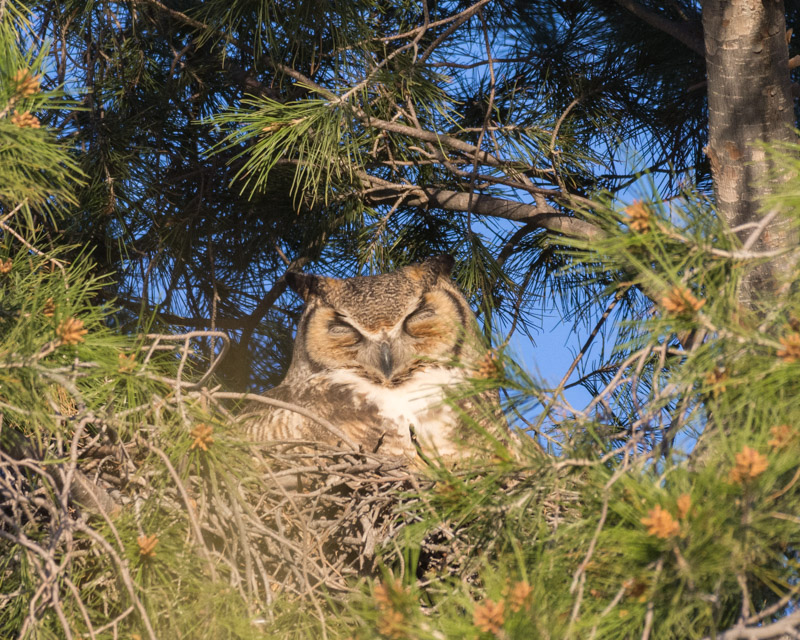
The Great Horned Owl, a nocturnal sovereign of the North American wilds, is not merely a feathered predator—it is an ecological architect, a silent architect of balance, whose wings whisper through the twilight as they reshape the very fabric of wildlife communities. With piercing amber eyes that pierce the darkness like twin lanterns, this apex sentinel does not merely hunt; it orchestrates. Its hoarse, resonant call—“Who’s awake? Me too.”—echoes across forests, grasslands, and deserts, a clarion call that signals both warning and wonder. This bird is not just a creature of the night; it is a living metaphor for the unseen forces that govern biodiversity, a shadowy conductor whose influence ripples through the food web with the subtlety of a moonlit breeze.
The Silent Conductor: How Great Horned Owls Shape Trophic Cascades
In the grand symphony of North American ecosystems, the Great Horned Owl plays the role of the silent conductor, its presence dictating the tempo of life and death across multiple trophic levels. Unlike more conspicuous predators, it does not roar with territorial dominance; instead, it exerts its influence through stealth, patience, and an uncanny ability to exploit ecological niches. By preying upon smaller mammals such as rabbits, squirrels, and even skunks, it curtails populations that might otherwise overgraze vegetation or spread disease. In doing so, it indirectly preserves the understory, allowing seedlings to flourish and maintaining the structural integrity of forests. This is not mere predation—it is ecological alchemy, transforming chaos into coherence through the quiet calculus of survival.
Consider the ripple effect: when Great Horned Owls suppress rodent numbers, they reduce the pressure on tree saplings, enabling oaks and pines to mature. These trees, in turn, become nesting sites for songbirds and shelter for amphibians. The owl’s influence cascades upward and downward, a living feedback loop where every death nourishes new life. It is a paradox of power—its strength lies not in brute force, but in the delicate art of restraint, a masterclass in ecological equilibrium.
The Feathered Shadow: Nocturnal Predation as an Evolutionary Masterstroke
To understand the Great Horned Owl’s impact, one must first appreciate its temporal dominance. While most diurnal creatures retreat into dormancy as dusk falls, the owl emerges, cloaked in a plumage of mottled browns and grays that renders it nearly invisible against the bark of ancient trees. Its flight is a whisper, its talons a silent promise of fate. This nocturnal reign is not accidental—it is the result of millions of years of evolutionary refinement, a survival strategy honed in the crucible of competition.
By occupying the night shift, Great Horned Owls avoid direct conflict with eagles, hawks, and other raptors that dominate the daylight hours. Yet, their adaptability extends beyond mere timing. They are opportunistic generalists, thriving in habitats ranging from dense coniferous forests to arid deserts, from urban peripheries to remote wilderness. This versatility allows them to exploit ecological vacuums, stepping into roles vacated by more specialized predators. In doing so, they prevent monocultures from forming, ensuring that no single species dominates the landscape. The owl, in essence, is the ecological referee, blowing the whistle on imbalance before it festers into collapse.
The Talons of Influence: Direct and Indirect Predation on Competitors
The Great Horned Owl’s predatory prowess extends beyond its immediate prey. It is a serial usurper, a thief of nests and a dismantler of dynasties. Barred Owls, once confined to eastern forests, have seen their populations surge westward—only to find themselves in the crosshairs of their larger, more aggressive cousin. The Great Horned Owl does not merely compete with other predators; it eradicates competition. By preying on smaller owls, hawks, and even foxes, it reshapes the predator hierarchy, ensuring that its own lineage thrives at the expense of rivals.
This dominance is not without consequence. In regions where Great Horned Owls have expanded their range, native species such as the Spotted Owl have faced steep declines. The owl’s arrival is not an invasion—it is an ecological reset, a brutal but necessary correction where weaker links in the food chain are pruned away. Yet, this ruthlessness is not cruelty; it is the cold arithmetic of nature, where survival favors the adaptable, the cunning, and the relentless. The Great Horned Owl does not ask permission to rule—it takes the throne by the sheer force of its existence.
The Keystone of Biodiversity: How Owls Sustain the Web of Life
To label the Great Horned Owl as merely a predator is to underestimate its role as a keystone species—a linchpin around which entire ecosystems revolve. Its presence ensures that scavengers such as vultures and foxes have a steady supply of carrion, reducing waste and disease. Its abandoned nests become sanctuaries for other birds, from wood ducks to squirrels, who repurpose the hollowed-out cavities for their own offspring. Even the soil benefits: the nutrients from owl prey enrich the earth, fueling the growth of fungi and plants that sustain herbivores.
In this way, the owl is a living fertilizer, a decomposer in feathered form. It does not merely take—it gives back, ensuring that the cycle of life continues unbroken. Without it, forests would grow dense with unchecked rodent populations, understories would wither under the weight of overgrazing, and the delicate balance of predator and prey would tilt toward chaos. The Great Horned Owl is not just a participant in the ecosystem; it is its guardian, its silent sentinel standing watch over the intricate dance of survival.
The Haunting Call: Cultural and Ecological Symbolism
Beyond its ecological role, the Great Horned Owl carries a profound cultural weight. In Indigenous traditions, it is often seen as a messenger between worlds, a spirit guide that traverses the boundary between the living and the dead. Its call is not just a sound—it is a voice, one that has echoed through generations, carrying warnings, omens, and wisdom. In modern times, it has become a symbol of wilderness itself, a reminder of the untamed heart that still beats within the continent’s vast landscapes.
This symbolism is not mere folklore—it reflects a deeper truth. The owl’s survival in an era of human expansion speaks to the resilience of nature, its ability to adapt even as its habitats shrink. Yet, this resilience is not infinite. As climate change alters ecosystems and urbanization encroaches on wild spaces, the Great Horned Owl faces new challenges. Its adaptability is tested, its dominance threatened by forces beyond its control. To lose this owl would be to lose more than a predator—it would be to lose a chapter from the story of North America itself.
The Future in the Shadows: Conservation and Coexistence
The Great Horned Owl’s story is one of dominance and adaptation, but it is also a cautionary tale. Its success is not guaranteed. Habitat fragmentation, rodenticide poisoning (from consuming contaminated prey), and climate-induced shifts in prey availability threaten its reign. Conservation efforts must recognize the owl’s role as an ecological linchpin—protecting its habitat is not just about saving a species, but about preserving the intricate web of life it sustains.
Yet, coexistence is possible. By minimizing pesticide use, preserving old-growth forests, and maintaining corridors for wildlife movement, humans can ensure that the Great Horned Owl continues to rule the night. In doing so, we do not just protect a bird—we safeguard the balance of nature, the quiet harmony that allows life to thrive in all its complexity.
The Great Horned Owl does not need our pity. It is not a creature in need of rescue—it is a force of nature, a living testament to the power of adaptation and the inevitability of predation. But it does need our respect. For in its golden eyes, we see reflected the wild heart of a continent, a reminder that even in the darkest hours, life persists, fierce and unbroken.