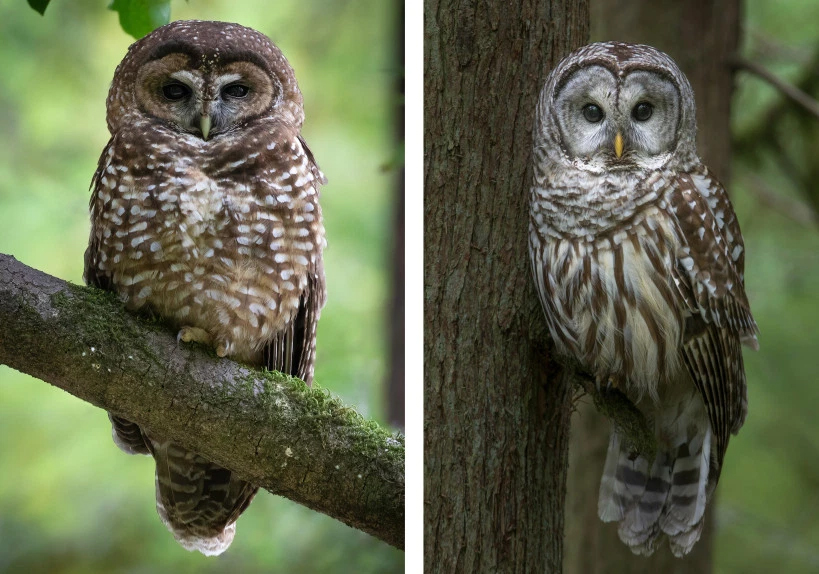
The Pacific Northwest’s ancient forests, where mist clings to towering Douglas firs and the air hums with the whispers of unseen creatures, once echoed with the haunting calls of the northern spotted owl. This enigmatic bird, with its chocolate-brown plumage and soulful eyes, became the unlikely mascot of a fierce conservation battle—a battle that would reshape environmental policy, ignite fierce debates, and ultimately prove that when science, activism, and policy converge, even the most besieged species can find reprieve.
The Northern Spotted Owl: A Canary in the Coal Mine of Old-Growth Forests
Before it became a symbol of ecological fragility, the northern spotted owl was simply a creature of the deep woods, perfectly adapted to the dense, moist forests of the Pacific Northwest. Its existence, however, was inextricably tied to the towering old-growth trees that had stood for centuries—trees that were, by the 1980s, rapidly vanishing beneath the relentless chains of industrial logging. The owl’s decline was not an isolated tragedy; it was a harbinger of ecological collapse, a silent scream from an ecosystem pushed to its brink.
Unlike more adaptable species, the spotted owl is a strict habitat specialist. It requires large, contiguous patches of old-growth forest for nesting, roosting, and foraging. Its territorial nature means that even small reductions in suitable habitat can have outsized consequences. By the late 20th century, the owl’s population had plummeted by nearly 40% in some regions, prompting scientists to sound the alarm. The northern spotted owl was not just another endangered species—it was a living indictment of humanity’s rapacious relationship with nature.
The Endangered Species Act: A Lifeline Thrown into the Abyss
The Endangered Species Act (ESA), enacted in 1973, was designed to be a bulwark against extinction, a legal fortress where biodiversity could find sanctuary. When the northern spotted owl was listed as threatened in 1990, it became one of the first species to test the ESA’s mettle in the face of economic pressure. The timber industry, a titan of the Pacific Northwest’s economy, howled in protest, warning of job losses and economic ruin. Politicians, ever eager to placate powerful lobbies, scrambled to weaken protections. Yet, the ESA held firm—a rare triumph of ecological imperative over short-term greed.
The listing of the spotted owl was not merely a bureaucratic formality; it was a seismic shift in how society viewed wilderness. For the first time, an entire ecosystem—old-growth forests—was granted legal personhood in the eyes of conservation. The ESA forced land managers to confront an uncomfortable truth: some habitats are too precious to sacrifice on the altar of profit. The owl’s survival became a litmus test for whether the United States would honor its commitment to preserving the natural world for future generations.
The Battle for the Forests: Activism, Lawsuits, and the Power of Public Outcry
The fight to save the northern spotted owl was not waged solely in courtrooms or legislative chambers; it was a grassroots uprising, a chorus of voices rising from the moss-draped forests themselves. Environmental groups like the Sierra Club, Greenpeace, and the Audubon Society mobilized communities, organized protests, and filed lawsuits to halt logging in critical owl habitats. Activists chained themselves to ancient trees, risking arrest to draw attention to the plight of both the owl and the forests it depended on.
Public opinion, once firmly in the timber industry’s corner, began to shift. Images of clear-cut landscapes and orphaned owl fledglings seared into the national consciousness. Documentaries, news exposés, and the tireless work of scientists and advocates painted a stark picture: the Pacific Northwest’s old-growth forests were not just economic resources; they were irreplaceable cathedrals of biodiversity. The spotted owl became a rallying cry, a symbol of what was at stake if humanity continued to treat the natural world as an endless frontier to be conquered.
Economic Fallout and Political Backlash: The Cost of Conservation
No victory comes without a price, and the battle to save the northern spotted owl exacted a heavy toll. Timber-dependent towns in Oregon, Washington, and Northern California faced economic hardship as logging restrictions tightened. Jobs vanished overnight. Families struggled. Politicians, quick to exploit the pain of displaced workers, demonized the ESA as a job-killer, ignoring the fact that the timber industry’s unsustainable practices had sowed the seeds of its own decline.
The backlash was swift and brutal. Congress, under pressure from industry lobbyists, attempted to weaken the ESA’s protections for the spotted owl. The infamous “God Squad”—a committee empowered to exempt species from ESA protections—was convened to decide the owl’s fate. In a rare display of integrity, the panel ultimately upheld the owl’s protections, but not before the timber industry had extracted painful concessions. The lesson was clear: conservation is not a painless endeavor. It demands sacrifice, foresight, and an unwavering belief that some things are worth preserving, even if the cost is high.
Recovery Efforts: A Delicate Balancing Act
Saving the northern spotted owl was never going to be a simple matter of halting all logging. Recovery required a nuanced approach—one that balanced the needs of the owl with the economic realities of the region. Habitat conservation plans, designed in collaboration with scientists, land managers, and local communities, became the cornerstone of the owl’s resurgence. These plans identified critical habitat areas, established buffer zones, and promoted sustainable forestry practices in less sensitive areas.
But conservation is not a static endeavor. Climate change, invasive species, and shifting forest dynamics introduced new threats. The barred owl, a more aggressive and adaptable cousin of the spotted owl, began encroaching on the northern species’ territory, outcompeting it for resources and nesting sites. The U.S. Fish and Wildlife Service responded with controversial barred owl control measures, sparking ethical debates about whether humans should intervene in such a direct manner. The recovery of the northern spotted owl was not a linear path but a labyrinth of challenges, each requiring careful navigation.
The Owl’s Legacy: A Blueprint for Future Conservation
The northern spotted owl’s story is more than a tale of survival; it is a blueprint for how to confront the biodiversity crisis of the 21st century. It demonstrated that when science guides policy, when activism fuels public will, and when communities are engaged in the process, even the most dire predictions can be averted. The ESA, despite its flaws and frequent political assaults, proved its worth as a tool for preserving the natural world.
Yet the owl’s story also serves as a cautionary tale. The barred owl’s expansion is a stark reminder that conservation does not occur in a vacuum. Global forces—climate change, invasive species, habitat fragmentation—do not respect borders or economic interests. The northern spotted owl’s recovery is not guaranteed; it is a fragile equilibrium, one that demands constant vigilance and adaptation. The Pacific Northwest’s old-growth forests remain under threat from logging, development, and climate change. The owl’s survival is a testament to what can be achieved, but it is not a permanent victory.
Why This Story Matters for All of Us
The northern spotted owl is not just a bird. It is a mirror held up to humanity, reflecting our choices, our values, and our capacity for both destruction and redemption. Its story forces us to ask: What are we willing to sacrifice for the sake of the natural world? Are we content to live in a world where the last remnants of ancient forests are reduced to stumps and sawdust? Or will we choose a different path—one where biodiversity is not a luxury but a necessity?
The Endangered Species Act, for all its imperfections, remains one of our most powerful tools in this fight. It is a reminder that nature is not a resource to be exploited but a heritage to be cherished. The northern spotted owl’s fight is our fight. Its survival is not just a victory for conservationists; it is a victory for all who believe that the Earth is not ours to plunder but to protect.
So the next time you hear the haunting call of an owl in the night, listen closely. It is not just a sound—it is a plea, a promise, and a challenge. The question is: Will we answer?