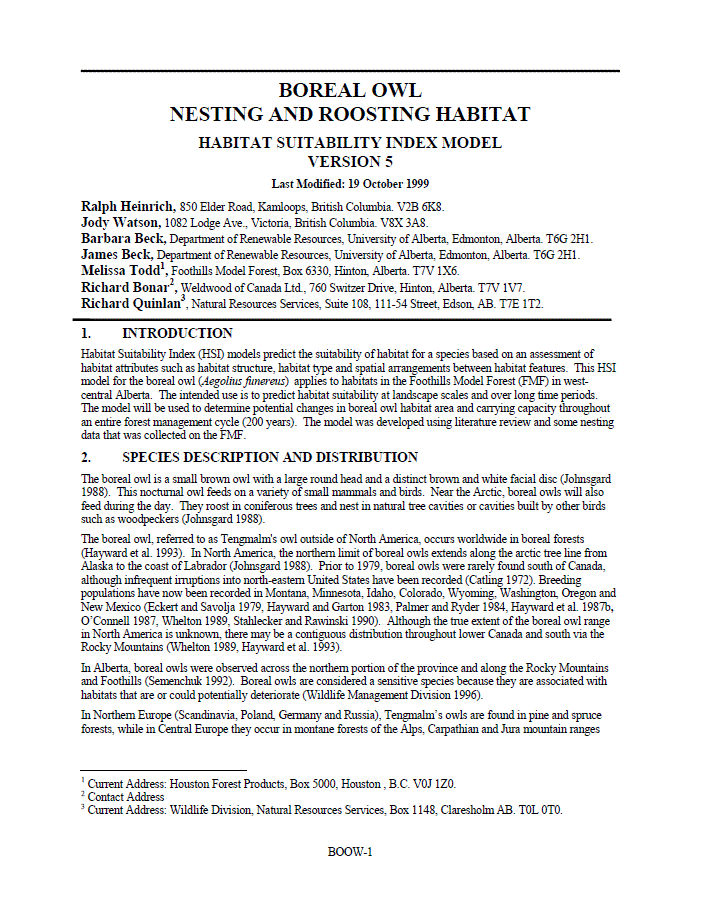
In the quiet, undisturbed corners of boreal forests, where the scent of pine and damp earth lingers in the crisp air, a silent drama unfolds each spring. The boreal owl, a creature of twilight and shadow, stakes its claim on the world, weaving its survival around the delicate balance of nesting and roosting habitat. Yet, this balance is increasingly threatened by climate change, deforestation, and human encroachment. Enter machine learning—a beacon of hope in the fight to preserve biodiversity. With algorithms that learn, adapt, and predict, scientists are now peering into the future of owl populations, forecasting nesting success with unprecedented precision. This is not just a story of data and code; it is a testament to human ingenuity and our growing ability to listen to the whispers of the wild.
The Alchemy of Data: Turning Pixels into Predictions
At the heart of machine learning’s predictive power lies a vast and meticulously curated dataset. Every pixel in a satellite image, every temperature reading, and every historical nesting record becomes a thread in a larger tapestry of ecological insight. For the boreal owl, these data points are not mere numbers—they are clues to an ancient rhythm. Machine learning models, particularly convolutional neural networks (CNNs) and random forests, sift through this digital landscape, identifying patterns invisible to the naked eye. The algorithm learns that certain forest densities, elevations, and proximity to water sources correlate with higher nesting success. It is as if the forest itself is speaking, and the machine is translating its language into actionable intelligence.
But data is not static. It breathes, shifts, and evolves with the seasons. Time-series analysis, powered by long short-term memory (LSTM) networks, captures the ebb and flow of environmental variables over decades. A particularly harsh winter might reduce prey availability, leading to lower nesting success the following year. The model doesn’t just see a cold snap—it understands the ripple effects across the ecosystem. This dynamic approach transforms raw data into a living, breathing forecast, one that adapts as swiftly as the forest does.
From Pixels to Pines: The Role of Remote Sensing
Imagine standing atop a mountain, gazing down at a sea of green, and knowing with certainty which patches of forest will cradle the next generation of owls. Remote sensing makes this possible. Satellites and drones equipped with multispectral sensors capture the forest’s health in wavelengths beyond human vision. Chlorophyll fluorescence, canopy density, and even the moisture content of the soil become visible through the lens of remote sensing. Machine learning models then dissect these images, identifying microhabitats that meet the owl’s exacting standards.
Yet, remote sensing is not without its challenges. Cloud cover, sensor noise, and the sheer scale of boreal forests can obscure critical details. Here, machine learning steps in as a problem-solver. Techniques like image super-resolution and denoising algorithms sharpen the data, revealing hidden gems of suitable habitat. The result? A high-fidelity map of nesting potential, where conservationists can prioritize their efforts with surgical precision.
The Symphony of Variables: What Makes a Habitat Ideal?
To predict owl nesting success, one must first understand what makes a habitat ideal. The boreal owl is a creature of contradictions—it thrives in both dense old-growth forests and fragmented landscapes, provided there are enough cavities for nesting. Machine learning models dissect this complexity by weighing dozens of variables, from microclimate conditions to the presence of competing species. A random forest model, for instance, might reveal that owls prefer nest sites with a specific aspect (north-facing slopes, perhaps, to avoid overheating) and a certain distance from human activity.
But the owl’s needs are not static. Climate change is rewriting the rules of habitat suitability. Warmer winters may reduce snowpack, altering prey availability, while longer fire seasons could reshape entire ecosystems. Machine learning models are uniquely equipped to handle this uncertainty. By incorporating climate projections into their training data, these models can simulate future scenarios, offering a glimpse into how owl populations might fare in a warming world. It is a form of ecological time travel, allowing us to prepare for what is to come.
Conservation in Action: How Predictions Drive Real-World Impact
The true power of machine learning lies not in its ability to predict, but in its capacity to act. Armed with detailed habitat suitability maps, conservationists can target their efforts where they are most needed. Controlled burns can be strategically planned to create new nesting sites. Artificial nest boxes can be installed in areas where natural cavities are scarce. Even policy decisions, such as protected area designations, can be informed by these predictions. The boreal owl becomes more than a species—it becomes a symbol of how data-driven conservation can bridge the gap between science and stewardship.
Yet, the application of these predictions is not without ethical considerations. Machine learning models are only as good as the data they are trained on, and biases in historical records can lead to blind spots. For instance, if past nesting sites were predominantly recorded in easily accessible areas, the model might overlook remote or rugged terrain where owls also thrive. Conservationists must remain vigilant, ensuring that their tools do not inadvertently exclude the very habitats they seek to protect.
The Future of Wildlife Forecasting: A Glimpse Beyond the Trees
The success of machine learning in predicting owl nesting success is just the beginning. The same techniques are being applied to other species, from migratory birds to elusive big cats. The boreal owl, with its cryptic nature and specialized needs, serves as a proving ground for methodologies that could revolutionize wildlife conservation. Imagine a world where every endangered species has its own predictive model, where habitat restoration is guided by real-time data, and where human-wildlife conflict is minimized through foresight.
This is not a distant dream. It is a tangible future, one where algorithms and ecology dance in harmony. The boreal owl, with its haunting calls and elusive presence, reminds us that nature is not a static backdrop but a dynamic, ever-changing tapestry. Machine learning gives us the tools to listen, to understand, and to act. The question is no longer whether we can predict the future of owl nesting success—it is whether we will use this knowledge to ensure that the forest’s whispers are never silenced.