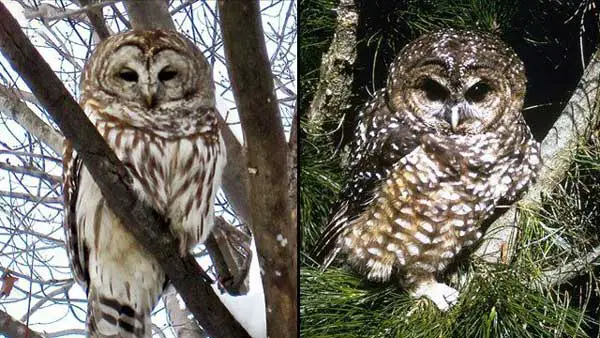
Imagine, for a moment, that you are a barred owl—perched high in the canopy of an ancient forest, your piercing eyes scanning the underbrush for the faintest rustle of a mouse. You return to your nest, a carefully woven sanctuary of twigs and moss, to find it disturbed by an intruder: a spotted owl, your ecological rival. Now, what if I told you that high above, a silent sentinel in the sky—a satellite—is watching this very scene, its mechanical gaze trained not on you, but on the patterns of your nest hidden in the foliage? And what if, instead of a human scientist trekking through dense woods, a machine learning algorithm is the one identifying your home from space?
The Silent Revolution: How Machine Learning Unfolds in the Canopy
Satellite imagery has long been a tool for ecologists, offering a godlike vantage over vast landscapes. Yet, the challenge of detecting something as small and ephemeral as an owl’s nest—often no larger than a dinner plate—has always been a needle-in-a-haystack problem. Enter machine learning, the unsung hero of modern ecology. By training neural networks on thousands of labeled images, researchers can now teach algorithms to recognize the subtle signatures of barred and spotted owl nests in dense forest canopies. These models don’t just see pixels; they interpret textures, shadows, and even the spectral signatures of foliage that betray the presence of a nest.
The magic lies in convolutional neural networks (CNNs), which mimic the human visual cortex’s ability to detect edges, shapes, and patterns. But here’s the twist: these models don’t just look for nests. They learn to differentiate between the architectural quirks of each owl species. A barred owl’s nest, for instance, might be more loosely constructed, often reused year after year, while a spotted owl’s is a more meticulous, freshly built affair. The algorithm doesn’t just spot a nest—it decodes the story of its maker.
The Data Deluge: Feeding the Algorithmic Beast
Of course, no machine learning model is born from thin air. It requires a veritable feast of data—thousands of satellite images, each annotated with the precise locations of owl nests. But here’s where the challenge rears its head: how do you ensure the data is representative? Forests are not uniform. A nest in the Pacific Northwest’s misty rainforests looks vastly different from one in California’s dry chaparral. The algorithm must learn to generalize across these variations, avoiding the trap of overfitting—a scenario where it becomes so attuned to one type of forest that it fails in another.
Enter transfer learning, a technique where a pre-trained model (often on a different but related task) is fine-tuned for the specific challenge of nest detection. Researchers might start with a model trained on general forest imagery, then refine it using a smaller, species-specific dataset. This approach not only saves computational resources but also ensures the model isn’t blindsided by the unexpected—a sudden shift in foliage density, a nest camouflaged by lichen, or the interference of human activity.
The Ethical Quandary: When Algorithms Meet Wildlife
Yet, for all its promise, machine learning in ecology is not without its ethical dilemmas. The same technology that tracks owl nests could, in less scrupulous hands, be repurposed to locate and disturb them. Conservationists must grapple with the dual-edged sword of surveillance: how to use it for protection without enabling exploitation. The answer may lie in federated learning, where models are trained across multiple institutions without sharing raw data, preserving the privacy of sensitive habitats.
There’s also the question of bias. If the training data is skewed—say, overrepresenting nests in easily accessible areas—the model may fail to detect those in remote or rugged terrain. Ecologists must actively seek out underrepresented habitats to ensure their algorithm isn’t just a tool for the low-hanging fruit of conservation.
The Human Element: Why We Still Need the Field Biologist
One might wonder: if machines can do this, why bother sending humans into the field at all? The truth is, machine learning is not a replacement for boots on the ground—it’s a force multiplier. Algorithms can sift through terabytes of data in hours, flagging potential nests for human verification. This partnership between man and machine allows researchers to focus their efforts where it matters most, reducing the time spent in the field while increasing the accuracy of their findings.
Moreover, the act of ground-truthing—physically locating and confirming a nest—provides invaluable data for refining the model. Each verified nest becomes a data point, a whisper of truth in the algorithm’s otherwise silent world. It’s a dance of reciprocity: the machine learns from the human, and the human, in turn, gains insights that would have been impossible to glean alone.
The Future: A World Where Owls Are Counted from Space
As machine learning continues to evolve, so too will its applications in wildlife conservation. Imagine a future where satellites, equipped with ever-more sophisticated sensors, can not only detect nests but also monitor their health over time. Drones, deployed with lightweight thermal cameras, could swoop in for a closer look, confirming the presence of chicks or assessing the nest’s structural integrity. The data could be streamed in real-time to conservationists, creating a living, breathing map of owl populations across continents.
But the real revolution may lie in the unexpected. What if these same techniques could be adapted to track other elusive creatures—lynx dens, bat roosts, or even the nests of endangered birds in the heart of a warzone? The possibilities are as vast as the forests themselves.
So, the next time you look up at the sky and see a satellite streaking overhead, remember: it’s not just watching the clouds. It’s watching the owls. And with a little help from machine learning, it’s learning to speak their language.