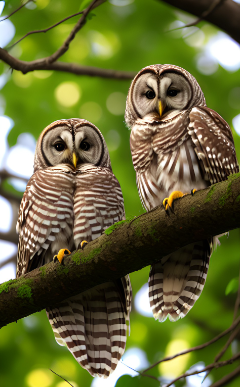
Could machines ever truly peer into the shadowed embrace of ancient forests and decipher the secretive abodes of Barred and Spotted Owls? The challenge of identifying their nests, cloaked in nature’s intricate tapestry, has intrigued ornithologists and conservationists alike. But amidst the cacophony of chirps, rustling leaves, and dappled light, how might artificial intelligence step beyond human limitations and unveil these elusive sanctuaries? The use of machine learning in identifying Barred and Spotted Owl nests heralds a fascinating convergence between technology and ecology, promising not only to elevate scientific precision but also to deepen our symbiotic relationship with the wild.
The Intricacies of Barred and Spotted Owl Nesting Habits
Barred and Spotted Owls, while cousins in the woodlands, harbor unique nesting behaviors that complicate traditional identification methods. Barred Owls, known for their hauntingly resonant hoots, prefer tree cavities or abandoned nests of other birds, perching high amidst dense deciduous or mixed forests. Conversely, Spotted Owls gravitate towards deep shaded groves of old-growth forests, nesting within dense coniferous stands and exhibiting a stealthier disposition. These subtle ecological preferences create a labyrinthine puzzle for researchers. The nests are often concealed beneath veils of moss, lichen, or dense foliage, thwarting even the most seasoned eyes. Furthermore, the overlap in geographical ranges and habitat features between these two species injects an added layer of complexity, making visual differentiation arduous and sometimes subjective.
The Challenge of Conventional Nest Identification
Conventional techniques for nest location and identification involve laborious field surveys, auditory cue monitoring, and manual inspections. Researchers descend into remote woodlands, armed with binoculars, notebooks, and not infrequently, the patience of saints. Despite meticulous efforts, the process is fraught with limitations: nests may be overlooked due to their cryptic placement; audio cues can be confounded by other forest inhabitants; and human presence risks disturbing sensitive breeding activities. Moreover, inter-observer variability and environmental conditions such as fog, rain, or dense underbrush can skew data accuracy. Ultimately, these traditional methods struggle to keep pace with the urgent conservation demands spurred by habitat loss and climate perturbations threatening these species’ survival.
Machine Learning: A Paradigm Shift in Wildlife Ecology
Enter machine learning—a transformative beacon poised to illuminate the obscured secrets of owl nesting ecology. By harnessing sophisticated algorithms capable of interpreting large, complex data streams, machine learning transcends human sensory constraints. It offers an unprecedented ability to extract meaningful patterns from multi-dimensional ecological datasets including images, acoustic recordings, and environmental variables. Unlike classic software programs bounded by rigid rules, machine learning models thrive through iterative learning, adapting and refining their predictive prowess over time. This adaptive intelligence is invaluable in parsing the nuanced visual and auditory cues that distinguish Barred Owl nests from their Spotted counterparts, even under challenging environmental conditions.
Image Recognition and Automated Nest Detection
Among the most promising applications is image recognition powered by convolutional neural networks (CNNs). These networks emulate human visual processing but operate at superhuman scales and speeds. High-resolution imagery captured via drones or remote cameras is fed into CNN-based models trained to recognize distinctive nest features such as shape, location on the tree, surrounding foliage, and even subtle textural variations in nesting materials. The models can sift through thousands of images in moments, flagging potential nest sites with impressive accuracy. This automation drastically reduces the field labor required and minimizes disturbance to the owls. Furthermore, meticulous training of these networks using annotated datasets containing confirmed nests bolsters their ability to differentiate between Barred and Spotted Owl nests despite their cryptic similarities.
Acoustic Signal Processing: Listening to the Forest Mysteries
Beyond vision, sound is a vital diagnostic in owl ecology. Barred and Spotted Owls have distinct vocal patterns—Barred Owls famous for their “who-cooks-for-you” calls, Spotted Owls characterized by softer, more mournful hoots. Machine learning models, particularly those leveraging recurrent neural networks (RNNs) or transformer architectures, excel at parsing complex auditory data. By analyzing spectrograms—the visual representation of acoustic frequencies—these models can detect owl calls even when obscured by overlapping forest sounds or environmental noise. When integrated with temporal and spatial data, acoustic monitoring facilitates real-time, non-invasive nest detection and species classification. Such auditory automation holds immense promise in mapping population distributions dynamically and monitoring behavioral changes driven by environmental stressors.
Data Integration and Environmental Contextualization
Machine learning’s potency multiplies when synthesizing heterogeneous data streams. Integrative models combine imagery, audio, geographic information systems (GIS), and environmental parameters (like temperature, humidity, and vegetation type) to construct holistic models of nesting ecology. This approach enables not just binary detection but also predictive insights—identifying high-probability nesting zones, forecasting seasonal nesting patterns, and flagging anomalous behaviors that might signal ecological distress. In conservation strategies, such predictive foresight is invaluable. It empowers targeted habitat protection measures and informs policy decisions with empirical rigor previously unattainable through manual methods.
Challenges and Ethical Considerations in Machine Learning Deployment
While the potential is immense, deploying machine learning in owl nest identification is not devoid of challenges. Data quality and quantity remain pivotal bottlenecks; acquiring sufficiently diverse and labeled datasets for model training demands extensive fieldwork and collaboration. Overfitting models to specific ecosystems risks diminishing generalizability across regions with differing forest compositions. Additionally, ethical imperatives dictate minimal disturbance to fragile wildlife habitats—balanced against the imperative for data transparency and reproducibility. The reliance on technology should complement, not replace, human expertise and ecological intuition, ensuring that machines serve as allies rather than arbiters in conservation.
The Future Landscape: Synergizing Technology and Conservation
Looking forward, the synthesis of machine learning with emerging technologies like edge computing, Internet of Things (IoT) sensors, and autonomous drones offers a tantalizing vision. Imagine fleets of silent aerial robots perpetually surveying remote forests, their onboard AI instantly decoding both visuals and sounds to map owl nests with unprecedented spatial-temporal resolution. Coupled with citizen science platforms democratizing data collection and ground truth verification, a vast, collaborative ecological observatory might arise. This paradigm would empower not only researchers but communities and policymakers in preserving the fragile legacies of Barred and Spotted Owls, whose nocturnal sentinels have long inspired awe and reverence. Machine learning, with all its intricacies and potential pitfalls, might just be the key that unlocks new chapters in the enduring narrative of coexistence between humanity and the wild.