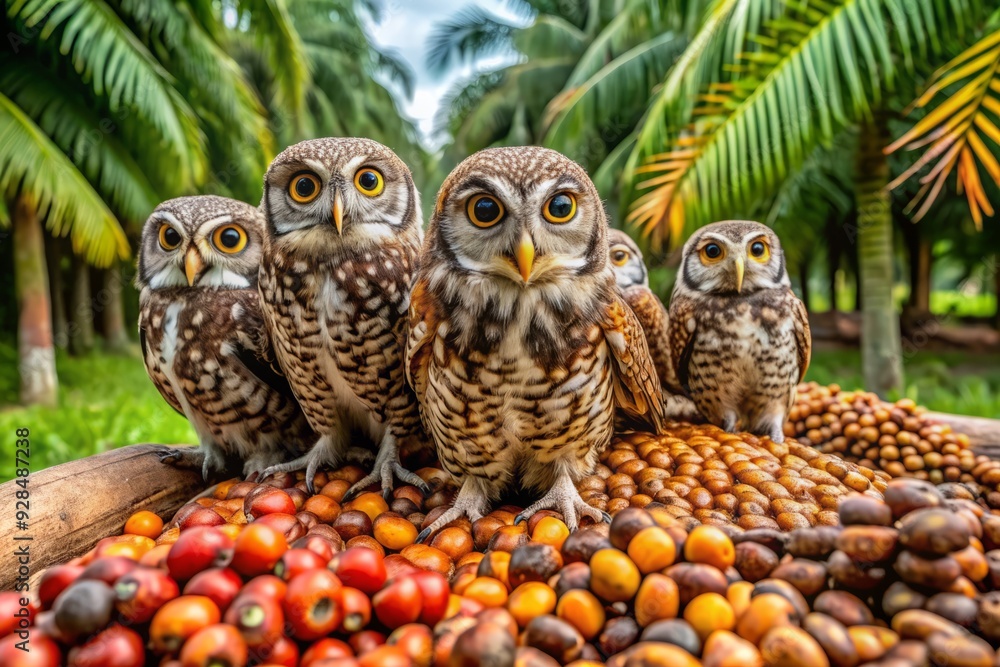
The emerald canopies of Southeast Asia once echoed with the nocturnal serenades of owls, their haunting calls weaving through the dense foliage like threads of moonlight. Today, those same forests are increasingly giving way to vast monocultures of oil palm, their fronds rustling in the wind like a siren’s whisper—luring progress forward while silencing the voices of the wild. The transformation is stark, almost surreal: where once stood a cathedral of biodiversity, now stretches an unbroken sea of uniform green, a landscape that whispers promises of economic prosperity but roars with the silent extinction of ancient ecosystems. The plight of owls in these altered realms is not merely a footnote in the annals of conservation; it is a poignant testament to the fragility of nature’s balance, a reminder that every creature, no matter how stealthy or nocturnal, is a thread in the intricate tapestry of life.
The Vanishing Canopy: How Palm Oil Erases Owl Sanctuaries
Imagine a world where the night sky is no longer a canvas for the silent flight of owls, where the rustle of leaves no longer carries the whispers of their hunting prowess. This is the reality unfolding across Southeast Asia, where palm oil plantations have metastasized like an invasive species, consuming vast swaths of primary and secondary forests. Owls, those enigmatic sentinels of the night, are among the first casualties of this ecological upheaval. Their survival hinges on the intricate web of the forest—dense canopies for nesting, diverse prey populations, and undisturbed quietude for their predatory rituals. Yet, the relentless expansion of oil palm monocultures strips away these necessities with surgical precision. The once-lush understory, teeming with small mammals and insects, is replaced by a monotonous carpet of palm fronds, bereft of the vertical complexity that owls rely upon. The result? A silent hemorrhage of owl populations, their territories shrinking like ice under a relentless sun.
The Silent Extinction: Why Owls Are the Canaries in the Palm Oil Mine
Owls are not merely passive victims of habitat loss; they are harbingers of ecological collapse, their decline a barometer of the health of entire ecosystems. Unlike their diurnal counterparts, owls occupy a unique niche as apex nocturnal predators, their presence indicative of a thriving food chain. When these birds vanish, it is not just their haunting calls that fall silent—it is the unraveling of an entire subterranean world. The absence of owls signals the depletion of small mammals, the disruption of pollination cycles, and the silent creeping of ecological imbalance. In the relentless march of palm oil plantations, owls are the first to disappear, their disappearance a stark reminder that we are not just losing species; we are dismantling the very architecture of life itself.
The Illusion of Coexistence: Can Owls Survive in the Palm Oil Matrix?
Some might argue that owls, with their adaptable natures, could find refuge in the fragmented landscapes left in the wake of palm oil expansion. Yet, the reality is far more grim. Even in areas where remnant forests persist, the surrounding monocultures create a hostile matrix, a landscape of ecological deserts that isolate owl populations into ever-shrinking pockets. The fragmentation of habitats forces owls into smaller territories, increasing competition for resources and exposing them to heightened risks of predation and disease. Moreover, the chemical stew of pesticides and fertilizers used in palm oil cultivation poisons the very prey that owls depend upon, turning their hunting grounds into toxic traps. The illusion of coexistence is shattered by the cold calculus of survival—owls cannot thrive in a world where their needs are an afterthought.
The Cultural Erasure: Owls in the Collective Imagination of Southeast Asia
Beyond their ecological roles, owls hold a profound place in the cultural and spiritual tapestry of Southeast Asia. In many indigenous traditions, these birds are revered as omens, messengers between the human and spirit worlds, their calls interpreted as portents of fortune or misfortune. Yet, as their habitats vanish, so too does the cultural memory of their significance. The silent forests of the past, where owls once perched as guardians of the night, are being replaced by the hum of machinery and the scent of monoculture. The erasure is not just physical; it is existential. When owls disappear, a piece of the region’s soul vanishes with them, leaving behind a hollowed-out landscape that is as bereft of meaning as it is of biodiversity.
The Economics of Extinction: Who Really Pays the Price?
The expansion of palm oil plantations is often justified by the promise of economic growth, a narrative that frames conservation as a luxury rather than a necessity. Yet, the true cost of this industry is borne by the natural world—and by humanity itself. The loss of owl populations is not an abstract concern; it is a tangible blow to the region’s ecological resilience. Owls, as natural pest controllers, help regulate populations of rodents and insects, reducing the need for chemical interventions that further degrade the environment. Their decline forces farmers to rely more heavily on pesticides, creating a vicious cycle of ecological degradation. Moreover, the loss of biodiversity undermines the long-term sustainability of agriculture, leaving future generations with a landscape that is as economically barren as it is ecologically impoverished. The economics of extinction are a ledger with no winners—only losers.
The Path Forward: Can We Rewrite the Story?
The fate of owls in Southeast Asia is not yet sealed, but the window for action is closing rapidly. The solution lies not in halting progress, but in reimagining it—transforming the palm oil industry from a bulldozer of biodiversity into a steward of ecological harmony. This requires a paradigm shift: from monocultures to agroforestry, from chemical-intensive practices to regenerative agriculture, and from short-term profits to long-term sustainability. It demands the integration of owl-friendly corridors within plantations, the preservation of remnant forests, and the empowerment of local communities to become custodians of their natural heritage. The path forward is not easy, but it is necessary. For every owl that takes flight in a restored forest, every call that echoes through the night, we are reminded that nature is not a resource to be exploited, but a legacy to be cherished.
The story of owls in Southeast Asia is a mirror held up to humanity’s choices. In their haunting calls, we hear the echoes of a world we are in danger of losing—a world where the night is alive with mystery, where the forest hums with the symphony of unseen creatures, and where the balance of life is not a luxury, but a necessity. The question is no longer whether we can afford to save the owls; it is whether we can afford not to.