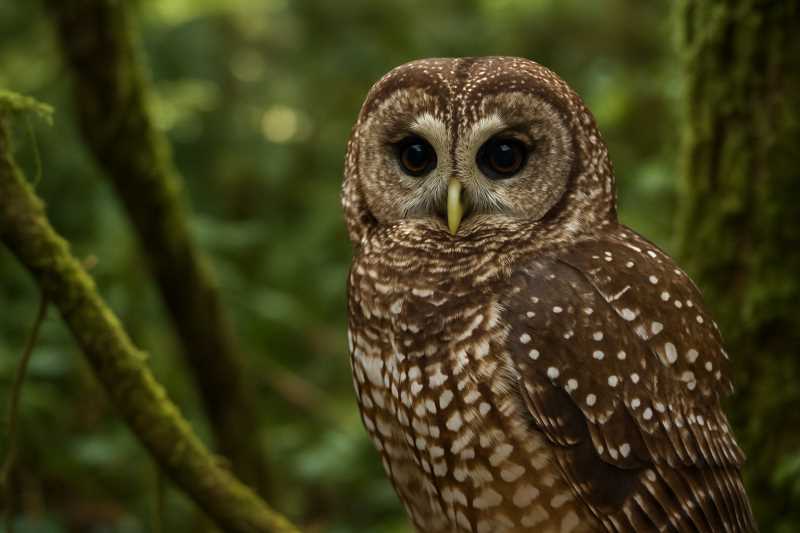
Have you ever wondered what it takes for a mysterious creature of the night, cloaked in mottled feathers and silent grace, to thrive in the depths of ancient woodlands? The Spotted Owl, a symbol of wilderness and ecological balance, poses a unique challenge to conservationists. Its survival hinges on the preservation of habitats that have resisted the march of time—old-growth forests. But why exactly are these age-old forests so indispensable to the Spotted Owl? What makes these ecosystems more than just a backdrop for a nocturnal spectacle? Let’s embark on a journey into the heart of these towering arboreal sanctuaries and uncover the intricate relationship between the Spotted Owl and its irreplaceable home.
The Enigmatic World of the Spotted Owl
Before delving into the complexity of the owl’s habitat, it’s crucial to appreciate the Spotted Owl’s distinctiveness. This nocturnal raptor, adorned with chocolate-brown feathers punctuated by pale spots, embodies stealth and sensitivity. It depends heavily on an environment that supports its hunting, nesting, and roosting activities. Unlike some adaptable birds of prey, the Spotted Owl is a habitat specialist—its entire existence intertwined with the ancient woodlands that harbor a unique structure and biodiversity.
What Defines an Old-Growth Forest?
Old-growth forests are no ordinary woodlands. They are living reliquaries of time, composed of towering giants, trees that have weathered centuries, if not millennia. These forests exhibit complex vertical layers—canopies, understories, and a rich forest floor teeming with life. Unlike second-growth forests, which often regenerate after logging or natural disturbances, old-growth forests retain a multi-aged structure, diverse tree species, and a wealth of dead standing and fallen logs known as “coarse woody debris.” This structural heterogeneity creates a mosaic of microhabitats essential for myriad species, including the Spotted Owl.
Structural Complexity: The Owl’s Fortress
What does the Spotted Owl seek within these ancient forests? First and foremost, structural complexity. This includes large, mature trees with expansive canopies that provide shelter from the elements and concealment from predators. The owl’s nests often reside in tree cavities or abandoned nests of other birds, nestled high above the forest floor. The presence of snags—standing dead trees—and fallen logs is equally vital, facilitating hunting perches and roosting spots. Without this intricate architecture, the Spotted Owl’s ability to rest, breed, and evade threats diminishes drastically.
Abundant Prey: A Delicate Food Web
Old-growth forests are ecological treasure troves, supporting a rich variegation of life forms. For the Spotted Owl, this abundance translates directly into sustenance. Its diet primarily consists of small mammals—rodents such as flying squirrels, woodrats, and various species of mice—that thrive in the dense understory and coarse woody debris of untouched forests. The owl’s hunting strategy, characterized by stealth and precision, depends on the quiet nocturnal bustle of the forest floor. Without a stable and diverse prey base, the owl’s energetic demands cannot be met, imperiling its reproductive success and long-term viability.
The Challenge of Habitat Fragmentation
Could a Spotted Owl survive in a patchwork quilt of fragmented forest patches? Unfortunately, habitat fragmentation is one of the gravest challenges facing these owls. Logging, urban expansion, and invasive species disrupt the integrity of old-growth forests, carving them into isolated pockets. This fragmentation not only reduces the available habitat but also impedes the movement and genetic exchange among owl populations. Increased exposure to predators and competitors—such as the more aggressive Barred Owl—exacerbates the risk. The owl’s reluctance or incapacity to adapt to younger, less mature forests only intensifies the peril.
The Interplay Between Fire Regimes and Forest Health
Fire may seem destructive, but in the ecology of old-growth forests, it plays a nuanced role. Historically, low-intensity fires cleared underbrush and maintained a mosaic of habitat types, fostering biodiversity. For the Spotted Owl, this helps maintain a mix of dense cover and open patches vital for hunting. However, decades of fire suppression have led to unnaturally dense forests liable to catastrophic fires, jeopardizing not just trees but the owl’s delicate habitat. Understanding this interplay is central to forest management strategies aimed at safeguarding the owl’s future.
Conservation Efforts and the Preservation of Legacy Woods
Protecting the Spotted Owl means protecting the irreplaceable old-growth forests. Conservation strategies focus on protecting large swaths of contiguous forest, restricting logging, and promoting ecological restoration practices that mimic natural disturbance regimes. Habitat corridors are established to connect fragmented patches, enabling safe movement and genetic diversity. The implementation of adaptive management practices—where science and on-the-ground experience guide interventions—also holds promise. Ultimately, the preservation of these legacy woodlands is an investment in the owl’s survival and the health of broader ecosystems.
Why Old-Growth Forests Are More Than Just Habitat
Old-growth forests are not merely physical spaces for the Spotted Owl; they are crucibles of ecological function, history, and resilience. They regulate water cycles, sequester carbon, and provide homes to countless species beyond the owl—many yet unknown. Guardianship of these forests is, therefore, a responsibility that transcends species preservation. It’s about honoring and sustaining the natural world’s complexity, a world where the Spotted Owl silently reminds us of the profound interconnections that bind every living thing.
So the next time you ponder the quiet majesty of the Spotted Owl perched high in the dusk-lit canopy, remember it is the ancient forests—steeped in time, layered with life—that hold the key to its survival. Protecting old-growth forests means ensuring that this enigmatic guardian of the night continues to thrive, a living testament to nature’s enduring splendor and intricate balance.
