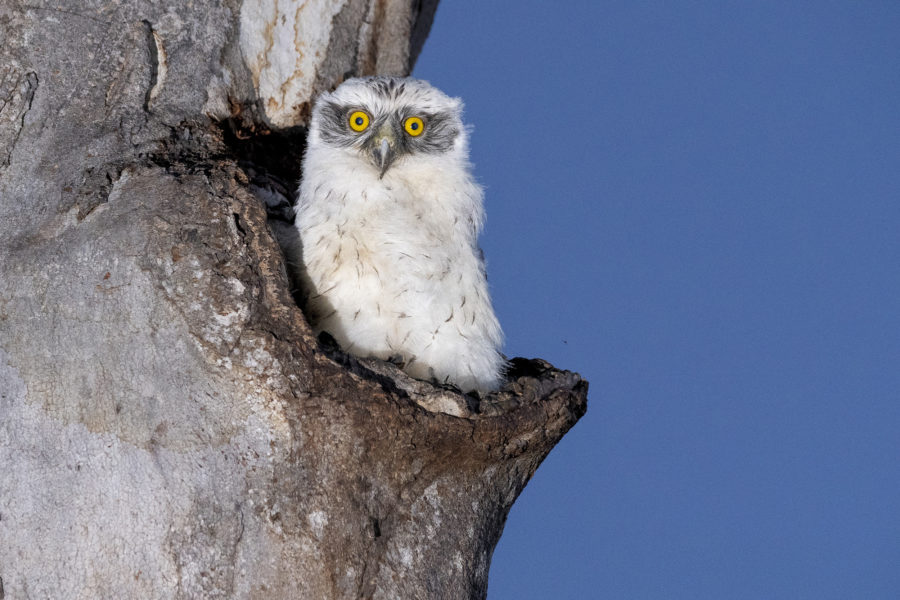
The Australian bush hums with unseen life—a symphony of rustling leaves, distant calls, and the occasional piercing gaze of a predator perched in the canopy. Among these silent guardians, the Powerful Owl (Ninox strenua) reigns as a titan of the night, its presence both feared and revered. To witness one of these owls is to glimpse the raw, unfiltered pulse of Australia’s forest ecosystems, where every feathered breath shapes the balance of life and death. But what truly lies beneath their haunting calls and piercing yellow eyes? How does this apex predator influence the very forests it calls home?
The Silent Architects of Forest Dynamics
Powerful Owls are not mere inhabitants of the forest—they are its architects, sculpting the landscape through their predatory prowess. Unlike smaller birds that flit between branches, these owls command the upper strata of the canopy, their massive talons capable of subduing prey as large as possums and gliders. Their hunting grounds span vast territories, forcing them to traverse dense woodlands with an almost regal indifference to the chaos below. This mobility ensures that no corner of their domain remains untouched by their influence.
Their presence alone deters overpopulation of mid-sized mammals, preventing the kind of ecological collapse seen in ecosystems where apex predators have been extirpated. In regions where Powerful Owls thrive, understory vegetation flourishes, as herbivore populations remain in check. Without these silent sentinels, forests would buckle under the weight of unchecked browsing, their understories reduced to barren stretches of chewed saplings and trampled undergrowth. The owl’s role is not just predatory—it is regulatory, a keystone species whose absence would unravel the entire tapestry of life.
The Nocturnal Choreography of Predation
Dusk descends, and the forest exhales. The Powerful Owl emerges from its daytime roost, its mottled plumage blending seamlessly with the bark of ancient eucalypts. Its flight is a whisper, a ghostly glide between trees, its talons poised like daggers. Prey rarely hears its approach—until it’s too late. The owl’s hunting strategy is a masterclass in efficiency: a sudden, silent descent, followed by a crushing grip that ends the struggle in an instant.
But predation is more than mere sustenance; it is a choreography of survival. The owl’s diet—primarily arboreal mammals like ringtail possums and sugar gliders—ensures that energy flows upward from the forest floor to the canopy. This vertical transfer of biomass sustains not just the owl, but the entire food web. When an owl consumes a possum, it doesn’t just feed itself; it redistributes nutrients through its scat, fertilizing the soil and enriching the very trees that shelter its prey. In this way, the owl is both executioner and gardener, a paradoxical force that nurtures even as it consumes.
Cultural and Ecological Reverence
To the First Nations peoples of Australia, the Powerful Owl is more than a predator—it is a cultural icon, woven into Dreamtime stories and totemic lore. Its haunting call, often described as a mournful wail, is said to carry messages between the living and the spirit world. Yet, beyond mythology, the owl’s ecological significance cannot be overstated. Its decline in fragmented landscapes is a harbinger of environmental distress, a canary in the coal mine for forest health.
Urban sprawl, logging, and climate change have encroached upon the owl’s habitat, reducing its once-vast territories to isolated pockets. Where forests are cleared, the owl vanishes, and with it, the delicate balance it maintains. The loss of these owls doesn’t just mean fewer predators—it means forests stripped of their silent regulators, their understories overrun by unchecked herbivores, their canopies left to wither. The Powerful Owl is not just a species in decline; it is a living barometer of the forest’s vitality.
The Invisible Threads of Interdependence
Consider the sugar glider, a tiny marsupial that darts through the night, its membrane stretched between limbs like a living kite. To the Powerful Owl, it is a meal. But to the forest, the glider is a pollinator, a seed disperser, a link in an intricate web of dependencies. When the owl hunts the glider, it doesn’t just end a life—it triggers a cascade. Fewer gliders mean fewer seeds dispersed, fewer flowers pollinated, and a gradual impoverishment of the forest’s biodiversity.
This interdependence extends to the trees themselves. Eucalypts, the backbone of Australia’s forests, rely on a balance of herbivory and predation to maintain their health. Without the owl’s regulatory pressure, possums and gliders would devour saplings before they could mature, leaving the forest with an aging, dying canopy. The owl’s presence ensures that the forest remains dynamic, a living entity where youth and age coexist in perpetual renewal.
The Future of the Powerful Owl and Its Forests
The Powerful Owl’s future hinges on the choices we make today. Will we preserve the ancient woodlands that sustain it, or will we allow them to be felled for profit? Will we recognize its ecological value, or will we relegate it to the status of a relic, a ghost of a once-thriving wilderness?
Conservation efforts must go beyond protecting individual owls—they must safeguard the entire ecosystem. This means preserving old-growth forests, restoring degraded habitats, and mitigating the impacts of climate change. It means recognizing that the owl is not just a predator, but a linchpin, a force that holds the forest together. Without it, the forest would not just lose a species—it would lose its soul.
The Powerful Owl is a reminder that nature is not a static backdrop, but a living, breathing entity, where every creature, no matter how silent or unseen, plays a vital role. To protect it is to protect the forest itself—a forest that hums with life, where every rustle in the leaves is a story, and every piercing gaze is a guardian of balance.