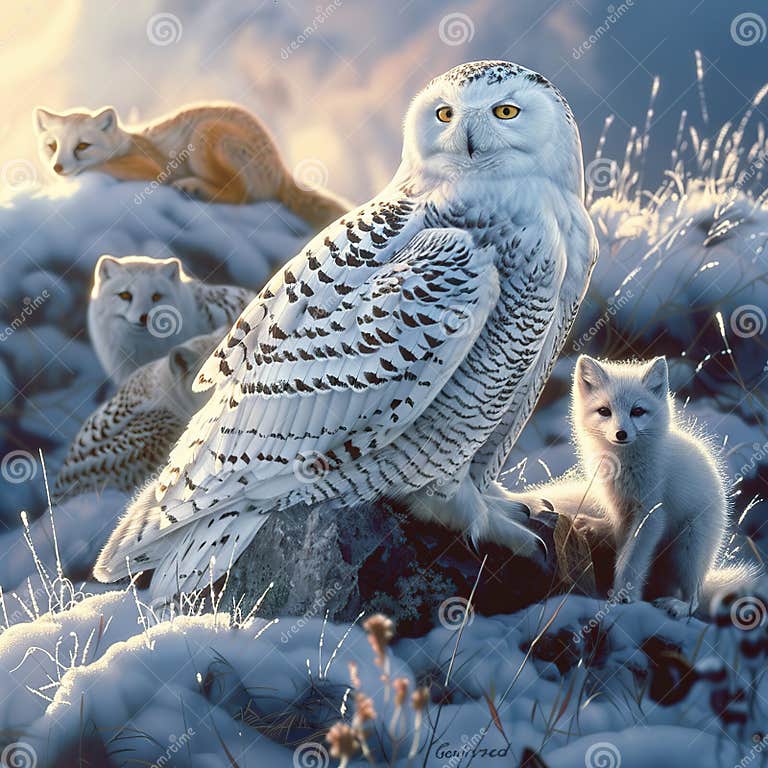
The Arctic tundra is a realm of stark beauty and relentless competition, where survival is not a right but a daily negotiation. Beneath the endless horizon of ice and snow, two of the tundra’s most charismatic predators—snowy owls and arctic foxes—engage in a silent, ceaseless struggle for sustenance. This is not a battle of claws and fangs alone, but a nuanced dance of strategy, timing, and environmental cunning. To witness their rivalry is to glimpse the raw, unfiltered mechanics of nature’s balance, where every meal is a triumph and every missed opportunity a potential death sentence.
The Tundra’s Crucible: A Stage for Survival
The Arctic tundra is not for the faint of heart. It is a landscape of extremes, where temperatures plummet below -50°C and the sun may vanish for months on end. Yet, life persists. The snowy owl, clad in a cloak of white feathers that blends seamlessly with the frozen terrain, is a master of this unforgiving environment. Its keen eyes, capable of spotting a lemming from half a kilometer away, are a testament to evolutionary precision. The arctic fox, smaller but no less resilient, relies on a different set of tools: a keen nose, lightning reflexes, and an uncanny ability to exploit the owl’s discarded scraps.
This is a world where every calorie counts. The tundra does not reward laziness. It demands adaptability. For the snowy owl, survival hinges on its ability to hunt in the perpetual twilight of the Arctic winter. For the fox, it is about outsmarting a predator that could easily turn the tables. Their competition is not just for food—it is a battle for dominance in a land where the stakes are life and death.
Hunting Grounds: The Battlefield of the Tundra
The tundra’s hunting grounds are a patchwork of frozen lakes, windswept ridges, and snow-laden shrubs. Here, the snowy owl stakes its claim to the high vantage points, perching atop rocks or mounds of snow to survey its domain. Its hunting strategy is one of patience and precision. It waits. It watches. Then, in a blur of motion, it descends upon its prey with talons outstretched, a silent executioner in a world of white.
The arctic fox, meanwhile, operates on a different frequency. It is a scavenger by necessity, a thief of opportunity. While the owl hunts from above, the fox prowls the underbrush, its ears twitching at the faintest rustle of movement. It is not above stealing an owl’s kill when the opportunity arises, a tactic that speaks to the fox’s ingenuity. Yet, this is not a one-sided rivalry. The owl, too, is not above stealing from the fox, a reminder that in the tundra, no predator is safe from the ambitions of another.
The tundra’s food web is a delicate web of give-and-take, where every interaction is a potential turning point. The lemmings, voles, and other small mammals that sustain both predators are not mere pawns in this game—they are the currency of survival. When their populations boom, both owl and fox thrive. When they crash, the tundra’s predators must adapt or perish.
The Silent Language of the Tundra: Communication and Conflict
Communication in the tundra is a language of signals, not words. A snowy owl’s hoot carries across the frozen expanse, a territorial declaration that warns rivals to keep their distance. The arctic fox, in turn, communicates through scent markings and body language, a silent dialogue that speaks volumes to those who know how to listen. These signals are not just about territory—they are about hierarchy, about who gets first dibs on the next meal.
Conflict between the two species is rare but telling. When an owl and a fox cross paths, the tension is palpable. The owl, with its superior size and strength, may attempt to drive the fox away from a kill. The fox, however, is not without its defenses. It may feign submission, only to strike when the owl’s guard is down. This is not mindless aggression—it is a calculated risk, a gamble on the fox’s part that the owl will underestimate its cunning.
The tundra’s predators are not just competitors; they are reluctant allies in a shared struggle. When food is scarce, they may even tolerate each other’s presence, a fragile truce born of necessity. Yet, this truce is always temporary. The moment food becomes abundant, the old rivalries resurface, and the cycle of competition begins anew.
The Impact of Climate Change: A Shifting Landscape
The Arctic is warming at an unprecedented rate, and with it, the tundra’s delicate balance is unraveling. Shrinking sea ice, melting permafrost, and shifting prey populations are forcing both snowy owls and arctic foxes to adapt—or face extinction. For the owl, dwindling lemming populations mean longer, hungrier winters. For the fox, the encroachment of southern species into its territory means increased competition for food and space.
These changes are not just ecological—they are cultural. The snowy owl, once a symbol of Arctic resilience, is now a harbinger of a changing world. The arctic fox, too, faces an uncertain future as its habitat shrinks and its prey becomes scarcer. The tundra’s predators are not just victims of climate change—they are its messengers, warning us of the fragility of the ecosystems we often take for granted.
Yet, there is hope. The tundra is a land of second chances. If we act now, we can preserve the delicate balance that has sustained these predators for millennia. It is not just about saving the snowy owl or the arctic fox—it is about saving the tundra itself, a land of ice and snow that is as vital to the planet’s health as the rainforests of the tropics.
The Future of the Tundra: A Call to Action
The rivalry between snowy owls and arctic foxes is more than a spectacle of nature’s cruelty—it is a reminder of the interconnectedness of all life. Every meal they take, every territory they defend, every adaptation they make is a thread in the tapestry of the tundra’s survival. To ignore their struggle is to ignore the warning signs of a planet in crisis.
We must ask ourselves: What kind of world do we want to leave for future generations? A world where the Arctic is a barren wasteland, devoid of its charismatic predators? Or a world where the snowy owl still soars above the frozen tundra, and the arctic fox still prowls the underbrush, a testament to nature’s unyielding spirit?
The choice is ours. The tundra is waiting.