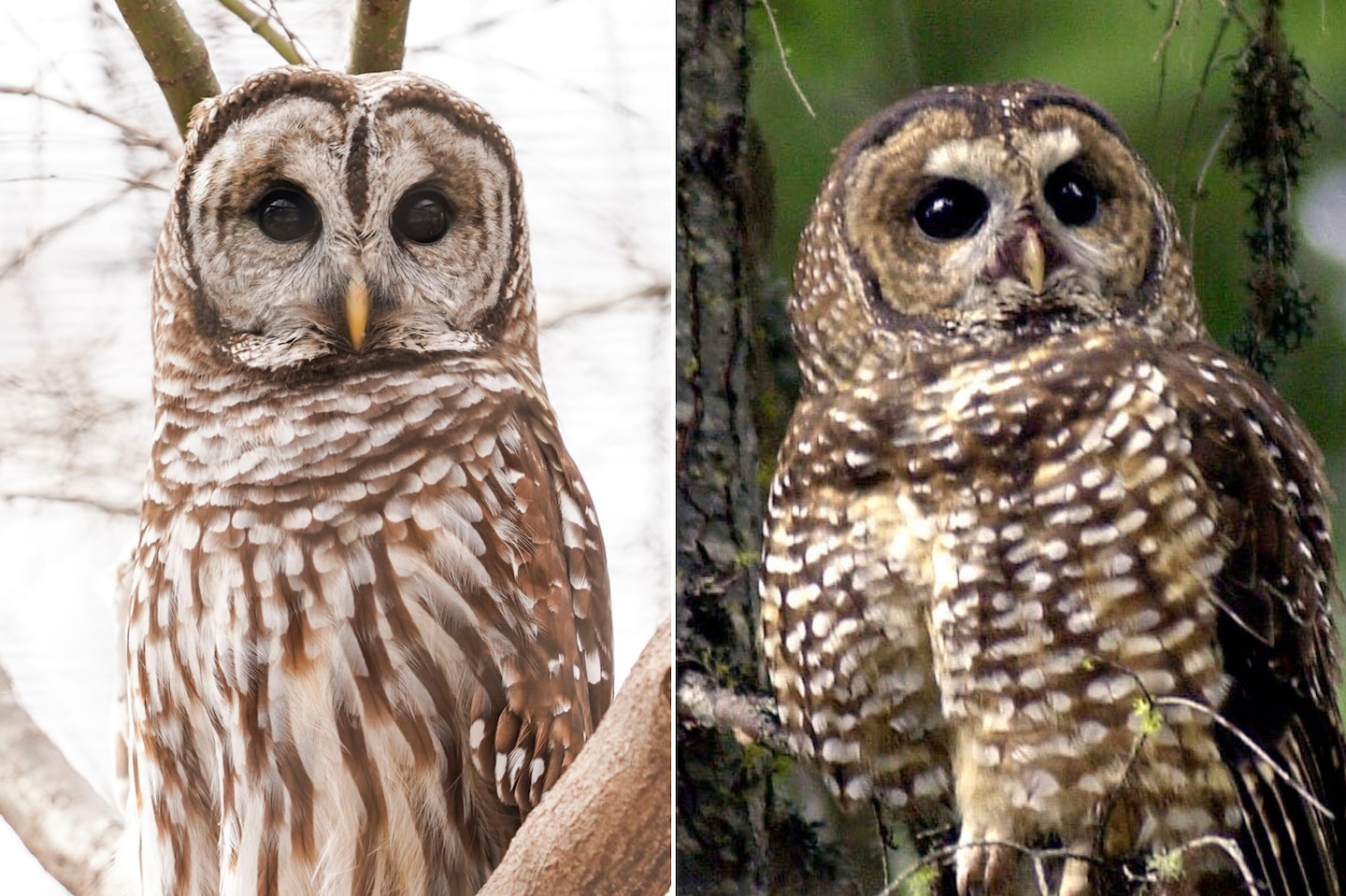
In the shadowed realms of ancient forests, where towering conifers whisper secrets and the air vibrates with nocturnal mystery, the spotted owl’s call unfurls like an emblem of the wild’s fragile beauty. These elusive birds have captivated the imaginations of naturalists and wildlife enthusiasts alike, not just for their striking plumage and endangered status, but for the intricate vocalizations that define their existence. Yet their calls resonate against a complicated backdrop — the presence of barred owls, whose invasive calls echo aggressively, often drowning out the delicate voices of the spotted owls. Understanding the nuanced world of their vocalizations promises a profound shift in perspective, revealing much more than mere sounds; it uncovers an ecological dialogue fraught with survival, identity, and the silent wars waged in shadow and silence.
The Acoustic Landscape: A Forest Symphony of Survival
Imagine standing within a dense Pacific Northwest forest at twilight, the crescendo of life ebbs and flows through layers of sound. Among this auditory tapestry, the spotted owl’s voice emerges with haunting subtlety — a series of low, rhythmic hoots that ripple through the dimming air, calling out to mates or staking territorial claims. Their calls serve as an ancient language, shaped by evolutionary pressures to penetrate the forest’s acoustical canvas without startling prey or alerting predators.
In contrast, barred owls communicate with a far more assertive vocal repertoire. Their calls are louder, more varied, and often described as “who cooks for you?” — a phrase that mimics the cadence of their typical hooting sequence. This vocal buzz competes heavily within the lush underbrush, creating a soundscape where the finer notes of the spotted owl are often overshadowed. The dynamics of this auditory competition underscore not only the biological rivalry between the two species but also the profound importance of vocalization in reproductive success and territory defense.
Spotted Owls: The Enigmatic and Measured Calls
The vocalizations of spotted owls are not mere calls; they are carefully calibrated communicative acts imbued with evolutionary finesse. Their primary call is an unhurried series of hoots, typically expressed as four to eight notes, spaced with deliberate pauses. This cadence tends to be softer, lower in pitch, and more rhythmic compared to the barred owl’s driving calls. It is a serenade optimized for shadowed forests, where whisper-like transmissions from high branches enable communication with mates or offspring without attracting unwanted attention.
Besides the standard hoot, spotted owls employ a range of secondary vocalizations — from soft whistles and truncating “barks” to subtle trills. These varied sounds serve functions granular as parent-offspring interactions or as alarm calls signaling danger. The multifaceted nature of the spotted owl’s vocal repertoire reflects a nuanced social structure, wherein communication is as much about subtlety and precision as about loudness.
Barred Owls: Vocal Dominance and Acoustic Intrusion
Barred owls, by contrast, project an expansive auditory arsenal that bursts through forest soundscapes with commanding presence. Their hoots are richer in overtones, rhythmically irregular, and often louder, traveling greater distances. This sonic dominance provides them with an edge in territorial disputes, effectively masking the more elusive calls of the spotted owl.
The cadences of barred owls are often described as complex phrases — sequences that mimic conversational exchanges — thus facilitating robust social interaction within their groups. This vocal versatility aids in their aggressive expansion into spotted owl territories, making them not only acoustic competitors but ecological usurpers.
Comparative Acoustic Analysis: Discrepancies That Define Survival
Scientific analyses have illuminated key distinctions within the vocal patterns of these two species. Spotted owl hoots usually fall within a lower frequency range, around 200 to 500 Hz, and exhibit longer inter-hoot intervals, often more than one second. Barred owls’ hoots, by contrast, tend to occupy higher frequencies, from approximately 400 to 700 Hz, combined with shorter intervals and more variation in rhythm.
The implications of these differences transcend mere frequency or timing; they influence detectability, mate attraction, and competitive interactions. Barred owls’ louder and more varied calls make them sonically intrusive, often outcompeting spotted owls for auditory space within heavily forested ecosystems. This acoustic interference reduces the chances for spotted owls to find mates or defend territories, thereby threatening their continued survival.
Evolutionary and Ecological Significance of Vocal Divergence
The divergence in vocalizations between spotted and barred owls is a testament to the intricate pressures of evolution. Spotted owls, adapted to older, denser forests with stable ecosystems, evolved calls that emphasize stealth and subtle communication. Their survival strategy leans heavily on remaining cryptic and minimizing detection.
Barred owls, native to more varied habitats, evolved a more aggressive vocal style suited for open and semi-open woodlands. Their invasive encroachment into the spotted owl’s realm has resulted in vocal competition that starkly illustrates the fragility of ecological niches and the vulnerabilities introduced by environmental change and species migration.
The Unheard Conversations: Implications for Conservation
Understanding the vocal distinctions between these owls is vital not only for bioacoustic science but also for conservation efforts. Traditional monitoring employs vocal surveys, relying on auditory detection to estimate populations and behaviors. However, overlapping vocal frequencies and the dominance of barred owl calls complicate these efforts.
Modern conservationists must decode these vocal subtleties, using advanced acoustic technologies to distinguish the spotted owl’s quieter, low-frequency hoots from the barred owl’s noisy dominance. This acoustic discernment is paramount to crafting habitat protections, managing interspecies competition, and guiding controversial interventions that attempt to give the spotted owl a fighting chance.
Shifting Perspectives: From Sound to Survival
The tale of the spotted owl’s and barred owl’s calls invites us to reconsider what we hear in the wild. These vocalizations are more than mere notes; they are threads woven into an ecological narrative of persistence, intrusion, and resilience. They challenge us to listen deeply, to grasp the delicate balance maintained in the forest’s acoustic chamber, and to recognize that survival is frequently determined not by sight, but by sound.
As voices collide in the dusky canopy, the spotted owl’s plaintive and measured hoots remind us of the quiet magnificence that thrives on subtlety and restraint. Their calls beckon us towards a renewed curiosity — a prompt to protect not just a species, but the symphony of life itself that sings in the twilight of the ancient forest.