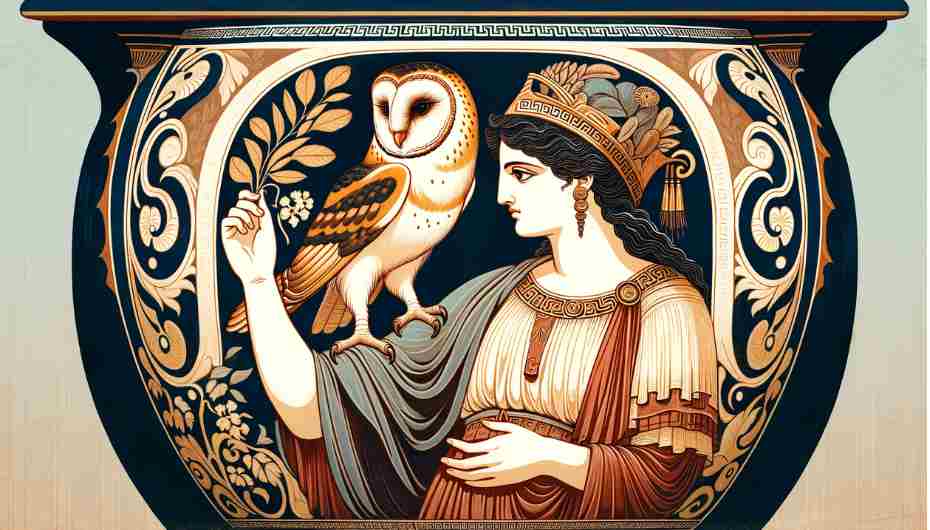
What if the key to Athena’s wisdom wasn’t hidden in dusty scrolls or whispered in Delphi’s shadows, but perched silently on a gnarled olive branch, watching with eyes that see beyond the veil of mortal understanding? The owl, that enigmatic creature of the twilight, was no mere bird to the ancient Greeks—it was a living emblem of divine insight, a feathered oracle that bridged the chasm between the mundane and the mystical. To unravel the threads of this sacred bond is to step into a world where wisdom is not merely sought but *embodied*, where the night itself becomes a canvas for revelation.
The Owl as Athena’s Chosen Messenger: A Bond Forged in the Ashes of Time
Imagine, if you will, the dawn of the Olympian pantheon, when the gods carved their legacies into the bones of the earth. Athena, the goddess of wisdom, warfare, and craftsmanship, needed a symbol that could encapsulate her essence—something that could peer into the abyss of human folly and still remain unshaken. Enter the owl, that nocturnal sentinel with eyes like polished obsidian, capable of piercing the darkest corners of ignorance. The Greeks didn’t merely *choose* the owl; they *elevated* it. This was no accidental pairing. The owl’s ability to navigate the night mirrored Athena’s role as a guide through the labyrinth of mortal confusion. But here lies a playful paradox: while the owl was Athena’s sacred bird, it was also a creature of the underworld, a denizen of Hades’ realm. How, then, did the goddess of light reconcile with a creature so deeply entwined with the unseen? The answer lies in the owl’s dual nature—its gaze was not just piercing; it was *omniscient*. To the ancient mind, wisdom was not a gentle stream but a storm, and the owl was the lightning that illuminated its path.
The Owl’s Gaze: A Mirror to Human Ambition and Folly
Picture an Athenian citizen, standing in the agora, their heart heavy with the weight of a decision that could alter the course of their life. They glance upward, and there, perched on the temple’s pediment, is the owl—silent, unblinking, a silent judge of their choices. The owl was not just a symbol; it was a *mirror*. In its gaze, mortals saw their own reflections—flawed, ambitious, and often blind to their shortcomings. The Greeks understood that true wisdom begins with the humility to recognize one’s own ignorance, and the owl, with its unflinching stare, was the perfect teacher. Yet, this was no gentle lesson. The owl’s presence was a challenge, a dare to rise above base instincts. To the warrior, it whispered of strategy; to the philosopher, of deeper truths; to the commoner, of the futility of greed. The owl did not coddle. It *revealed*. And in doing so, it forced mortals to confront the raw, unfiltered reality of their existence.
The Owl in Myth and Ritual: From Sacred Offerings to Ominous Omens
But the owl’s role in Greek culture was not confined to symbolism alone. It was woven into the very fabric of their myths and rituals, often in ways that sent shivers down the spines of even the most devout. Consider the tale of the owl’s first appearance to Athena. Some versions claim it was a gift from the goddess herself, a creature transformed from a mortal who had dared to spy on her sacred rites. Others speak of the owl as an ancient spirit, older than the gods, that chose Athena as its vessel. Whatever the myth, the owl’s presence was never passive. It was a harbinger—sometimes of blessings, other times of doom. In Athens, the sight of an owl before battle was both a blessing and a warning. Would the warriors see it as a sign of Athena’s favor, or would they interpret its hoot as a foreboding of their impending doom? The owl, in its duality, refused to be tamed. It was a riddle wrapped in feathers, a living paradox that kept the Greeks on their toes, forever questioning the nature of fate.
The Owl’s Paradox: A Creature of Light and Shadow
Herein lies the owl’s greatest enigma: it was a bird of the night, yet it was the sacred companion of the goddess of wisdom—a deity associated with the dawn of enlightenment. How could a creature that thrived in darkness be the emblem of a goddess who brought clarity? The answer, perhaps, lies in the ancient Greek understanding of wisdom as something that does not merely banish darkness but *understands* it. The owl did not fear the night; it *mastered* it. It saw what others could not, not because it was blind to the shadows, but because it had learned to navigate them. This was the essence of Athena’s wisdom—to not turn away from the unknown, but to study it, to dissect it, and to emerge with knowledge that could light the darkest paths. The owl, then, was not a contradiction but a complement. It was the yin to Athena’s yang, the silence to her strategy, the unseen force that made her divine vision possible.
The Owl’s Legacy: From Ancient Temples to Modern Symbols
Even as the centuries turned and the old gods faded into myth, the owl’s influence endured. It became a symbol not just of Athena, but of wisdom itself, adorning coins, pottery, and temples long after the last Olympian had been consigned to legend. The Greeks had understood something profound: wisdom is not a destination but a journey, and the owl was the eternal traveler, guiding humanity through the labyrinth of existence. Today, the owl remains a potent symbol, though often stripped of its sacred context. We see it in logos, in literature, even in the emblems of academic institutions. But how many of us pause to consider the weight of its gaze? How many remember that this bird, with its unblinking eyes and silent flight, was once the very embodiment of divine insight? The owl’s legacy is a challenge to us—a reminder that true wisdom is not found in the easy answers, but in the willingness to stare into the abyss and ask, *What do you see?*
The Owl’s Unspoken Challenge: Can We Bear Its Gaze?
And so, we come to the heart of the matter. The owl was not merely a symbol; it was a test. A test of courage, of humility, of the willingness to confront the truths we so often avoid. In a world that prizes speed over depth, noise over silence, and distraction over reflection, the owl’s message is more urgent than ever. Can we, like the ancient Greeks, learn to see the owl not as a mere creature of the night, but as a mirror held up to our own souls? Can we, in our rush to accumulate knowledge, remember that wisdom is not measured in facts alone, but in the courage to face the unknown? The owl does not offer comfort. It offers clarity—and clarity, as the Greeks knew, is a double-edged sword. It cuts through illusion, but it also lays bare our vulnerabilities. To embrace the owl’s wisdom is to accept that enlightenment is not a destination, but a lifelong pilgrimage, one that demands we walk through the dark to find the light.