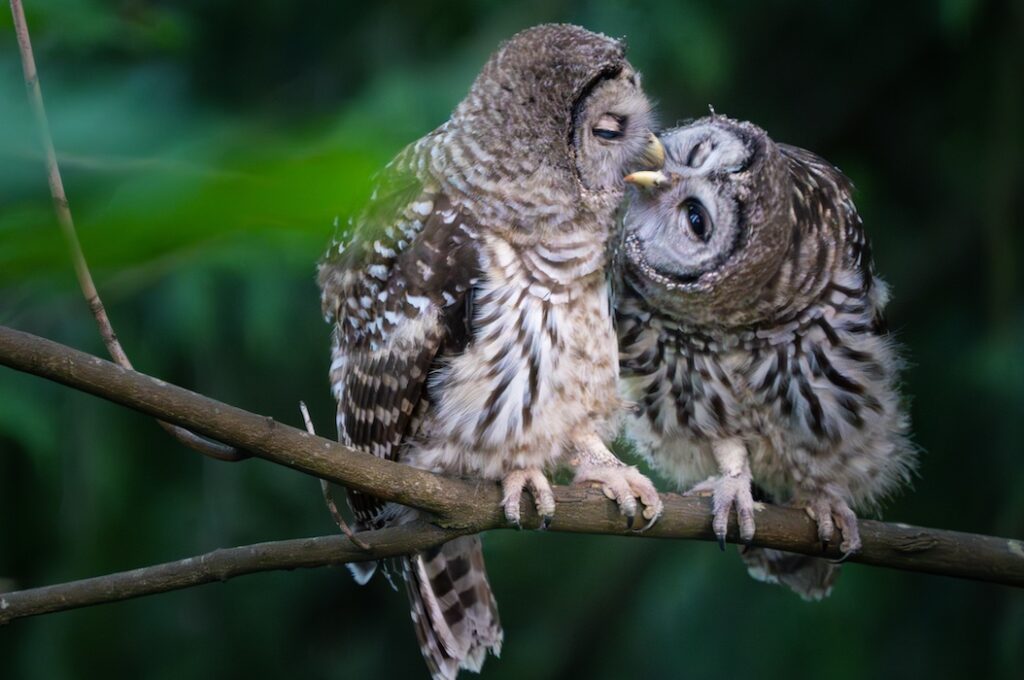
The barred owl, with its soulful eyes and rhythmic hoots, has long been a fixture in the symphony of North American forests. But what happens when this charismatic creature becomes the unwitting architect of ecological discord? The U.S. Fish and Wildlife Service’s Barred Owl Management Plan isn’t just another bureaucratic maneuver—it’s a high-stakes gambit that forces us to confront a thorny paradox: Can we save one species by culling another? And more importantly, at what cost to the very ecosystems we’re trying to protect?
The Barred Owl’s Rise: A Tale of Adaptation and Displacement
Once upon a time, the barred owl was a denizen of eastern woodlands, its haunting calls echoing through dense, ancient forests. But as human hands reshaped the landscape—clearing forests, planting crops, and building cities—the barred owl’s domain expanded westward with alarming efficiency. By the mid-20th century, it had muscled its way into the Pacific Northwest, a region already teeming with its cousin, the northern spotted owl. The barred owl’s adaptability became its greatest weapon: it thrives in fragmented habitats, outcompetes its spotted relative for food and nesting sites, and even hybridizes with it, diluting the genetic purity of a species already teetering on the edge of survival.
This ecological coup wasn’t an overnight phenomenon. It was a slow-motion invasion, a biological avalanche set in motion by climate change, deforestation, and the barred owl’s uncanny ability to exploit human-altered landscapes. Now, the northern spotted owl—already a poster child for conservation woes—faces an existential threat. The question isn’t whether the barred owl is to blame, but whether we can afford to let it rewrite the rules of the forest.
Ethics in the Crosshairs: Can We Justify Culling for Conservation?
Here lies the crux of the dilemma: Is it ethical to cull one species to save another? Conservation biology has long grappled with this question, but the barred owl plan thrusts it into the spotlight with brutal clarity. On one side, we have the northern spotted owl, a species so deeply intertwined with old-growth forests that its decline symbolizes the broader collapse of biodiversity. On the other, we have the barred owl—a relative newcomer, yes, but one that didn’t ask to be here. Is it fair to punish an animal for thriving in a world we’ve altered beyond recognition?
The utilitarian argument is straightforward: If removing barred owls gives the spotted owl a fighting chance, then the ends justify the means. But ethics rarely fit into neat equations. What about the barred owl’s intrinsic right to exist? What about the cascading effects of removing a top predator from an ecosystem? And who gets to decide which species deserves salvation—the one that’s been here for millennia, or the one that’s simply following nature’s most basic imperative: adapt or perish?
This isn’t just a scientific debate; it’s a philosophical one. Conservation isn’t just about saving species—it’s about defining what we value in nature. Do we prioritize the survival of the rare and the endemic, or do we embrace the inevitability of change, even when it comes at a cost?
The $1.35 Billion Question: Is the Plan Feasible—or Even Effective?
Even if we set aside the ethical quagmire, the Barred Owl Management Plan presents a logistical nightmare. At an estimated cost of $1.35 billion, it’s one of the most ambitious—and expensive—wildlife management initiatives in U.S. history. But will the money be well spent? The plan hinges on a two-pronged approach: lethal removal and habitat restoration. The first is straightforward, if grim. The second is far more complex.
Habitat restoration isn’t just about planting trees; it’s about recreating the intricate web of old-growth forests that once dominated the Pacific Northwest. It’s about ensuring that when barred owls are removed, the spotted owl has a fighting chance in a landscape that can sustain it. But forests don’t grow overnight. Even if we pour billions into reforestation, the barred owl’s vacuum effect—where its absence creates opportunities for other invasive species—could undermine our efforts before the first spotted owl fledgling takes flight.
And then there’s the question of unintended consequences. What happens when we disrupt the balance of an ecosystem that’s already in flux? Could removing barred owls inadvertently benefit other invasive species, like the European starling or the house sparrow? Could it accelerate the decline of species we haven’t even considered yet? Conservation is a game of chess, not checkers—and every move has ripple effects we can’t predict.
The Human Factor: Who Decides—and Who Bears the Burden?
Behind the science and the ethics, there’s the human element. Who gets to decide which species lives and which dies? The U.S. Fish and Wildlife Service? Scientists? The public? The answer is messy, because conservation isn’t a democracy—it’s a negotiation between competing interests, limited resources, and imperfect knowledge.
For some, the plan is a necessary evil. For others, it’s a betrayal of the wild, a capitulation to the idea that nature is something we can—and should—control. And for the communities living in the shadow of these forests—tribal nations, loggers, hikers, and homeowners—the plan isn’t just an abstract debate. It’s a disruption to their way of life, a reminder that even the most well-intentioned conservation efforts come with trade-offs.
What’s more, the plan raises uncomfortable questions about who bears the burden of conservation. Is it fair to ask rural communities to shoulder the economic and cultural costs of saving a species they may never see? Is it ethical to prioritize biodiversity in a region where people are already struggling to make ends meet? Conservation isn’t just about saving owls—it’s about saving the human communities that depend on these forests, too.
A Glimmer of Hope: Can We Find a Middle Path?
Despite the doom and gloom, there’s a sliver of optimism. The barred owl management plan isn’t just about culling; it’s about coexistence. What if, instead of waging war on the barred owl, we focused on creating landscapes where both species could thrive? What if we invested in habitat corridors, in reforestation, in strategies that allow spotted owls to reclaim their territory without resorting to lethal force?
This isn’t a pipe dream. In parts of the Pacific Northwest, conservationists are experimenting with non-lethal deterrents, like broadcasting barred owl calls to discourage them from settling in spotted owl territories. Others are exploring the potential of captive breeding programs to bolster spotted owl populations. These approaches aren’t silver bullets, but they offer a glimmer of a different path—one where we don’t have to choose between two species, but instead find a way to let both coexist.
The barred owl management plan is a test of our values, our ingenuity, and our willingness to confront the uncomfortable truths of conservation. It forces us to ask: What kind of world do we want to live in? A world where we play god, deciding which species deserve to survive? Or a world where we accept that nature is messy, unpredictable, and beyond our control—and find ways to thrive within that chaos?
The barred owl’s hoot may be haunting, but the real question is whether we can listen—and learn—before it’s too late.