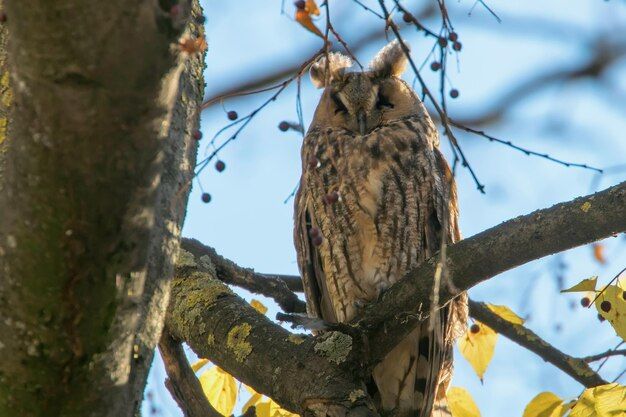
In the hushed twilight of nocturnal ecosystems, where the boundaries between predator and prey blur into a dance of survival, the long-eared owl emerges as a silent architect of ecological balance. These enigmatic birds, with their feathered “horns” and piercing amber gaze, are not merely inhabitants of the night—they are the unseen regulators of rodent populations, their presence a testament to nature’s intricate web of checks and balances. But what happens when these winged sentinels falter? The consequences ripple through the underbrush, reshaping the very fabric of their habitats. This is the story of how long-eared owls, often overlooked in the grand tapestry of biodiversity, hold the power to redefine the dynamics of rodent control, and why their conservation is not just an ecological imperative but a narrative of resilience against the tides of environmental change.
The Silent Predators: How Long-Eared Owls Master the Art of Rodent Eradication
Long-eared owls (*Asio otus*) are the unsung heroes of pest management, their hunting prowess honed over millennia of evolutionary refinement. Unlike their more vocal cousins, these owls rely on stealth and precision, their plumage blending seamlessly with the dusk-lit foliage as they perch motionless, ears attuned to the faintest rustle of a vole’s footsteps. Their diet is a testament to their efficiency: voles, mice, and shrews form the bulk of their meals, with a single owl capable of consuming up to 2,000 rodents in a single year. This voracious appetite is not mere gluttony—it is a calculated strategy, a biological bulwark against the explosive growth of rodent populations that could otherwise decimate crops and spread disease.
Their hunting technique is a masterclass in patience and adaptability. Long-eared owls employ a sit-and-wait strategy, their keen hearing detecting the ultrasonic squeaks of prey even through layers of snow or dense undergrowth. Once located, they strike with a silent descent, talons outstretched like daggers, their wings muffled by specialized feathers that dampen sound. This method minimizes energy expenditure while maximizing success rates, a stark contrast to the brute-force tactics of larger raptors. In doing so, they prevent the overpopulation of rodents, which would otherwise lead to overgrazing, soil degradation, and the spread of zoonotic diseases—each a domino that could topple entire ecosystems.
The Domino Effect: How Rodent Populations Shape Ecosystems Beyond the Nest
To understand the long-eared owl’s impact, one must first grasp the ripple effects of rodent overpopulation. Rodents are not mere pests; they are keystone species whose behaviors dictate the health of their environments. When left unchecked, voles and mice can strip vegetation bare, their burrowing activities altering soil composition and water retention. This, in turn, affects plant diversity, which cascades into the decline of insect populations and, ultimately, the birds and mammals that depend on them. The long-eared owl, by curbing these populations, acts as an ecological stabilizer, ensuring that no single species dominates the landscape.
Consider the humble field vole (*Microtus agrestis*), a primary prey item for long-eared owls. In the absence of predation, voles reproduce at alarming rates, their numbers swelling to densities that overwhelm local plant life. The result? A monoculture of grazed-down grasses, a wasteland for ground-nesting birds and small mammals. But when owls patrol the night, vole populations remain in check, allowing wildflowers and shrubs to thrive. This fosters biodiversity, creating habitats for pollinators, songbirds, and even larger predators like foxes and badgers. The owl’s presence, therefore, is not just about rodent control—it is about preserving the mosaic of life that thrives in their absence.
The Invisible Hand: Long-Eared Owls and the Balance of Agricultural Landscapes
Agriculture, with its vast monocultures and pesticide-laden fields, has long been a battleground between humans and rodents. Yet, long-eared owls offer a natural solution, their services rendered without the need for chemical interventions. Studies in Europe have shown that owl nest boxes placed in farmlands can reduce rodent damage by up to 50%, a boon for farmers seeking sustainable pest management. These birds do not discriminate between “good” and “bad” rodents; they target whatever is abundant, ensuring that no single species becomes a plague.
But their role extends beyond mere pest control. In regions where rodenticides are still used, owls face a deadly paradox: they consume poisoned prey, leading to secondary poisoning and population declines. This is a stark reminder of humanity’s shortsightedness—our attempts to dominate nature often backfire, leaving the very allies we need in peril. The long-eared owl’s struggle against rodenticides is a microcosm of a larger crisis: the unintended consequences of human intervention. By protecting these owls, we safeguard not just their future, but the health of the lands we cultivate.
The Unseen Threats: What Happens When Long-Eared Owls Disappear?
The decline of long-eared owl populations is a canary in the coal mine for nocturnal ecosystems. Habitat loss, driven by deforestation and urban sprawl, strips these birds of their hunting grounds. Climate change further exacerbates their plight, altering prey availability and nesting sites. In some regions, their numbers have dwindled to the point where rodent populations are no longer kept in check, leading to outbreaks of hantavirus, leptospirosis, and other diseases. The absence of these owls does not just mean more mice—it means a breakdown in the delicate equilibrium that sustains life.
Consider the case of the European countryside, where traditional farming practices once provided ideal hunting grounds for long-eared owls. Today, intensive agriculture and the loss of hedgerows have fragmented their habitats, forcing them into smaller, less productive territories. The result? A surge in vole populations, which in turn leads to increased crop damage and the resurgence of zoonotic diseases. This is not a hypothetical scenario—it is a reality unfolding in real time, a silent crisis that demands our attention.
The Call to Action: How We Can Champion the Long-Eared Owl’s Legacy
Protecting long-eared owls is not just about saving a species—it is about preserving the intricate balance of nature itself. Simple measures, such as installing nest boxes in farmlands or reducing rodenticide use, can make a profound difference. Conservationists are also advocating for the preservation of hedgerows and old-growth forests, which serve as critical hunting and nesting grounds. But the fight extends beyond habitat protection. It requires a shift in perspective, one that recognizes the value of predators not as adversaries, but as indispensable allies.
Imagine a world where long-eared owls are celebrated as the guardians of the night, their silhouettes a symbol of ecological harmony. Where farmers see them not as threats, but as partners in sustainable agriculture. Where children grow up knowing that the hoots echoing through the woods are not just eerie calls, but the sound of nature’s balance being maintained. This is the future we must strive for—a future where the long-eared owl’s influence is not just acknowledged, but revered.
The long-eared owl’s story is one of quiet strength, of a predator whose true power lies not in brute force, but in the delicate art of balance. By understanding and protecting these birds, we do more than save a species—we preserve the very essence of the ecosystems that sustain us all.