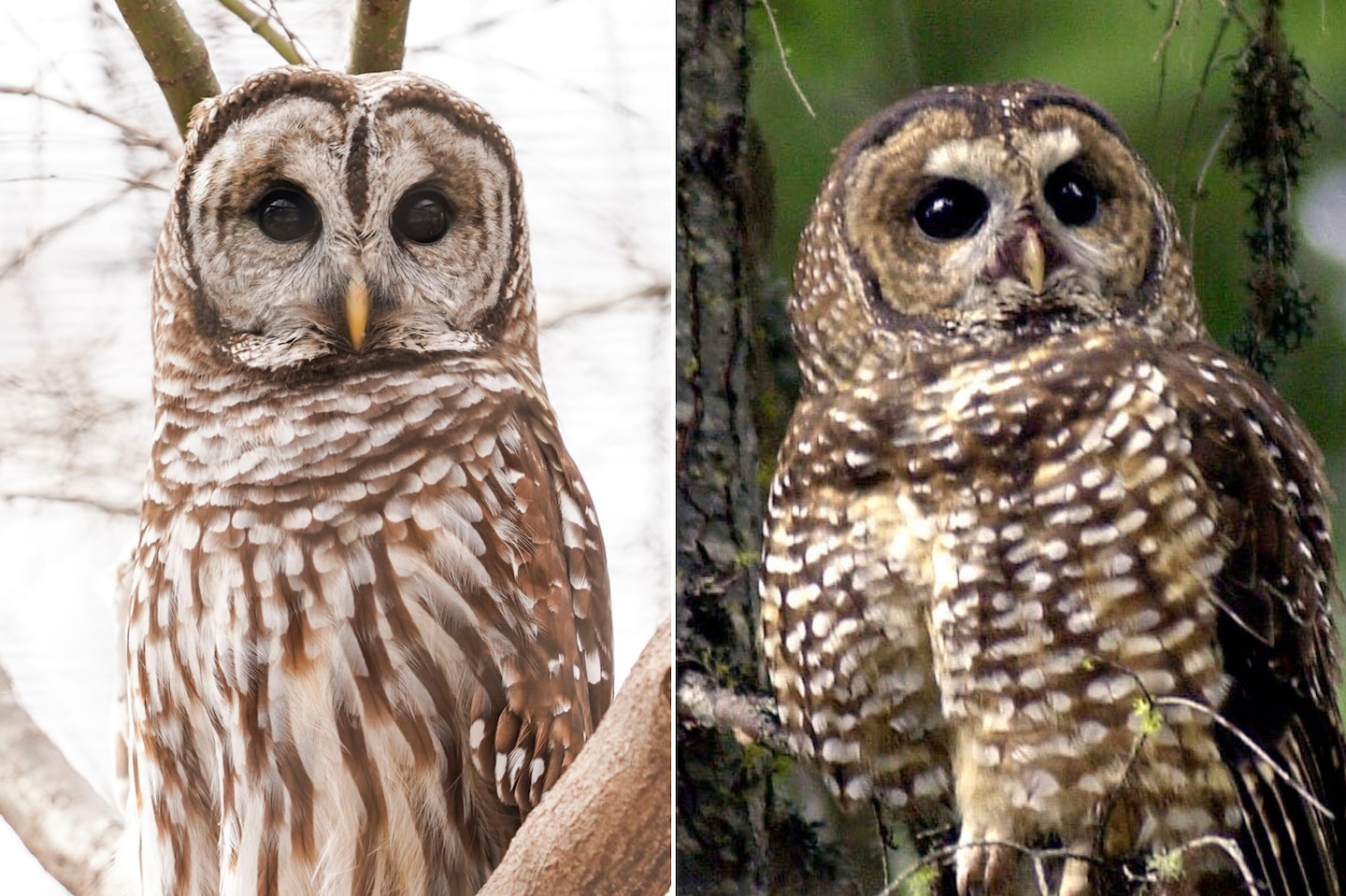
The barred owl, a creature of dusk and shadow, has long been a silent witness to the quiet unraveling of ancient forests. Once confined to the eastern woodlands, this adaptable interloper has expanded its domain westward, encroaching upon the dwindling habitats of the spotted owl—a species already teetering on the edge of extinction. The hybridization between these two owls is not merely a biological curiosity; it is a crucible in which the future of biodiversity is being forged. Genetic research, with its unparalleled precision, is now peeling back the layers of this ecological enigma, revealing a narrative far more intricate than mere competition or displacement. What emerges is a story of adaptation, resilience, and the unforeseen consequences of human-induced environmental change.
The Genetic Tapestry: Unraveling the Threads of Hybridization
At the heart of this ecological drama lies the genetic code, a language written in nucleotides and expressed in phenotypes. Hybridization between barred and spotted owls is not a recent phenomenon, but its scale and implications have only now come into sharp focus thanks to advances in genomic sequencing. Researchers are no longer confined to the limitations of morphology; they can now trace the flow of genes across generations, mapping the subtle exchanges that blur the lines between species. The barred owl’s genome, with its robust adaptability, has begun to infiltrate the spotted owl’s genetic fabric, creating a mosaic of hybrid lineages that challenge traditional notions of species boundaries. This genetic permeability is not a flaw in nature’s design but a testament to its fluidity—a reminder that evolution is not a linear path but a labyrinth of interconnected possibilities.
Evolution in Real Time: The Barred Owl’s Silent Takeover
The barred owl’s expansion into the West is a case study in ecological opportunism. Unlike its spotted cousin, which is a relic of ancient coniferous forests, the barred owl thrives in a variety of habitats, from dense woodlands to fragmented landscapes. Its vocalizations, once a rarity in the Pacific Northwest, now echo through the same trees where the spotted owl once reigned supreme. Genetic research has uncovered that this invasion is not just a matter of habitat overlap but of genetic assimilation. The barred owl’s genes are not merely coexisting with those of the spotted owl; they are reshaping them. This phenomenon, known as introgressive hybridization, is rewriting the genetic legacy of the spotted owl, leaving conservationists to grapple with a troubling question: Can a species survive when its very essence is being diluted?
The Paradox of Adaptation: When Survival Comes at a Cost
Adaptation is the cornerstone of evolution, yet in the case of the barred and spotted owl hybridization, it presents a paradox. The barred owl’s genetic resilience has allowed it to exploit new environments, but this very resilience may come at the expense of the spotted owl’s long-term viability. Genetic studies have revealed that hybrid offspring often exhibit traits that are better suited to changing climates—hardier, more versatile, and more likely to survive in degraded habitats. Yet, this advantage is a double-edged sword. The more the barred owl’s genes permeate the spotted owl population, the more the latter risks losing its unique adaptations to old-growth forests. Conservationists are left to ponder: Is the hybridization a natural evolutionary process, or is it an unnatural acceleration of genetic erosion, driven by human-induced habitat fragmentation and climate change?
The Molecular Lens: How Genomics is Redefining Conservation Strategies
The tools of genetic research are transforming conservation from a reactive endeavor into a predictive science. By analyzing the genomes of hybrid owls, researchers can identify specific genes that confer adaptability or vulnerability, allowing for targeted interventions. For instance, genetic markers linked to disease resistance or thermal tolerance could be used to guide breeding programs or habitat restoration efforts. Moreover, genomics is enabling scientists to track the spread of hybridization in real time, identifying hotspots where intervention might be most effective. This molecular lens is not just illuminating the past; it is providing a roadmap for the future, one where conservation strategies are as precise as they are compassionate. The question is no longer whether we can save the spotted owl, but how we can preserve the integrity of its genetic heritage in a world where hybridization is an inevitability.
The Ethical Quandary: To Intervene or to Observe?
As genetic research sheds light on the complexities of hybridization, it also forces us to confront an ethical dilemma: Should we intervene to preserve the spotted owl’s genetic purity, or should we allow nature to take its course? The answer is not straightforward. On one hand, the spotted owl is a flagship species, a symbol of the ancient forests that once stretched from the Pacific Northwest to the Sierra Nevada. Its decline is not just an ecological loss but a cultural one, a reminder of the fragility of wilderness in the face of human expansion. On the other hand, the barred owl’s adaptability may be a sign of nature’s resilience, a testament to the ability of species to evolve in the face of adversity. The ethical imperative here is not to choose between purity and adaptation but to ask what kind of future we want to create. Do we want a world where species are preserved in amber, or one where they are allowed to evolve, even if it means blurring the lines between them?
The Broader Implications: Hybridization as a Mirror of Global Change
The story of the barred and spotted owl is not an isolated one. It is a microcosm of a global phenomenon, where human activities are reshaping the genetic landscape of the planet. Climate change, habitat fragmentation, and invasive species are all driving hybridization events that challenge our understanding of biodiversity. In the Amazon, jaguars are hybridizing with pumas in response to shrinking habitats. In the Arctic, polar bears are mating with grizzlies as sea ice melts. These events are not anomalies; they are symptoms of a planet in flux. Genetic research is our most powerful tool for understanding these changes, but it also demands that we ask deeper questions about our role in shaping the future of life on Earth. Are we stewards of nature, or are we its architects? The answer will determine not just the fate of the spotted owl, but the fate of countless other species caught in the crosscurrents of change.
The Path Forward: A Future Written in Genes and Intentions
The genetic research into barred and spotted owl hybridization is more than a scientific endeavor; it is a call to action. It challenges us to rethink our relationship with nature, to move beyond the binary of preservation and intervention, and to embrace a more nuanced, adaptive approach to conservation. The future of the spotted owl may not lie in isolation but in coexistence, where its genes are allowed to mingle with those of the barred owl in a way that preserves the essence of both. This is not a surrender to inevitability but a recognition of the fluidity of life. The barred owl’s genes are not a threat; they are a reminder that evolution is not a destination but a journey. And as we stand at the precipice of this new era of genetic understanding, we must ask ourselves: What kind of journey do we want to take?