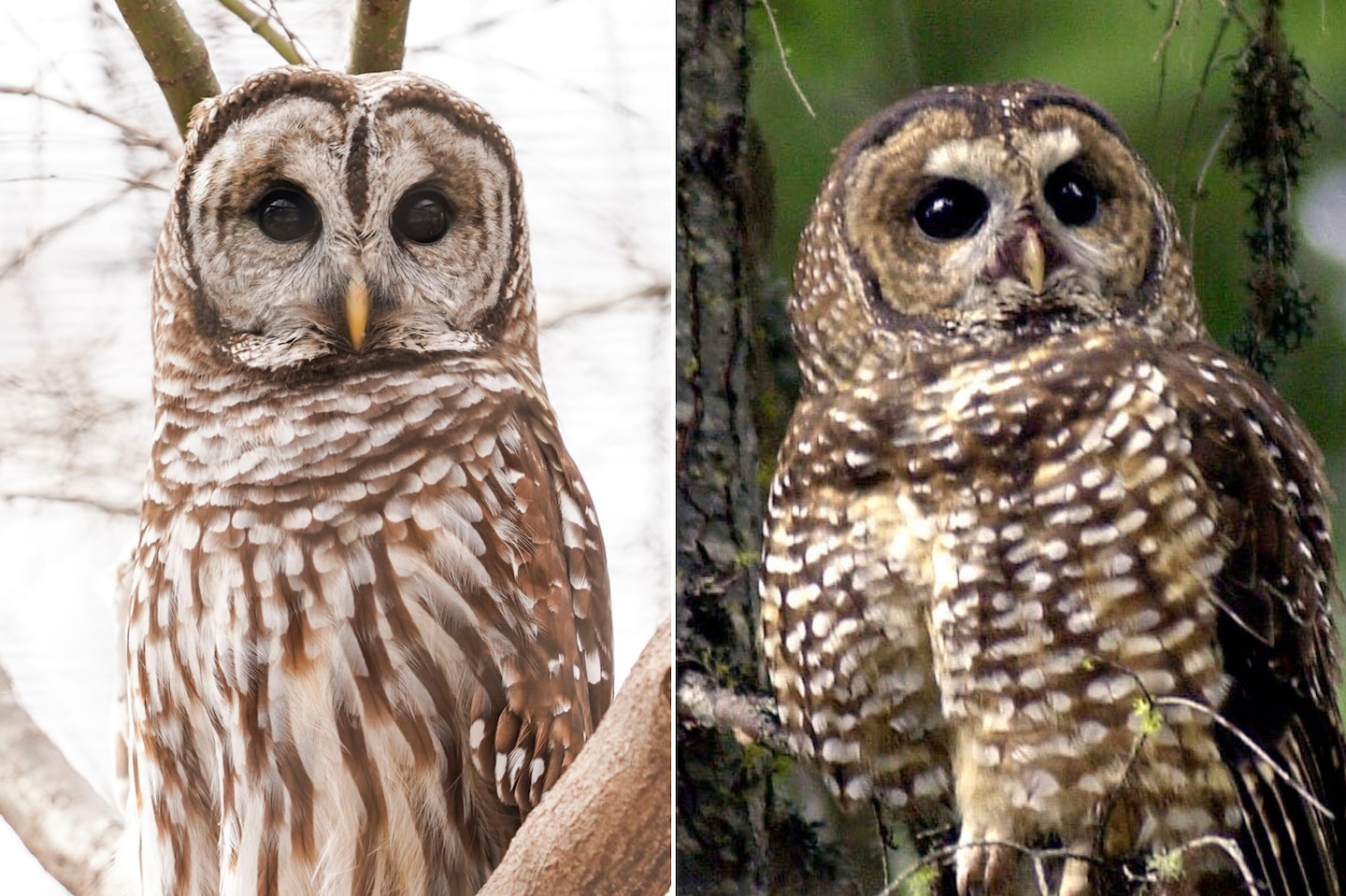
The barred owl, a creature of dusk and shadow, has become an unlikely antagonist in the quiet drama of the Pacific Northwest’s ancient forests. With piercing yellow eyes and a voice that echoes like a barking dog through the twilight, this adaptable raptor has expanded its range with unsettling efficiency, encroaching upon the territory of its beleaguered cousin—the northern spotted owl. In response, wildlife managers have embarked on a controversial campaign: the culling of 450,000 barred owls over the next three decades. The goal is clear: to rescue the spotted owl from the brink of extinction. But as the first data trickles in, a pressing question lingers in the misty canopy—does this drastic measure actually work?
The Unseen War in the Canopy
Beneath the emerald vault of old-growth forests, a silent war rages. The barred owl, once confined to eastern North America, has surged westward with a voracious appetite for territory and prey. Unlike its spotted relative, which clings to the remnants of ancient woodlands, the barred owl thrives in fragmented landscapes, even nesting in suburban parks. Its adaptability has made it a master of ecological opportunism—a trait that now threatens to unravel decades of conservation efforts for the spotted owl, a species already teetering on the edge due to habitat loss and competition.
Biologists describe the barred owl as a “hyper-generalist,” a predator that can exploit a wide array of habitats and food sources. Where the spotted owl once reigned supreme, the barred owl now dominates, its presence often signaling the decline of its smaller, more specialized counterpart. The irony is stark: the barred owl’s success is, in part, a consequence of human activity—deforestation, climate change, and fire suppression have reshaped the landscape in ways that favor the invader. The forest, once a sanctuary of balance, has become a battleground where the rules of coexistence have been rewritten by an unseen hand.
Numbers in the Mist: What the Early Data Reveals
The first glimpses of data from barred owl removal efforts are as tantalizing as they are ambiguous. In experimental zones where barred owls have been systematically culled, spotted owl populations have shown tentative signs of stabilization. Nesting success rates have ticked upward, and territorial occupancy has remained steady in areas where barred owls were once dominant. Yet, these improvements are not uniform. In some regions, the removal of barred owls has led to immediate rebounds in spotted owl numbers, while in others, the effects are fleeting, suggesting that the ecological web is far more intricate than a simple predator-prey dynamic.
One study, conducted over a five-year span in Oregon’s Willamette National Forest, recorded a 30% increase in spotted owl fledglings in areas where barred owl populations were reduced by 50%. The data hinted at a causal link, but researchers cautioned against premature celebration. The rebound, they noted, could be temporary—a fleeting respite before barred owls recolonize the vacated niches. The forest, it seems, is not a static stage but a living, breathing entity, where every removal sends ripples through the underbrush, altering the behavior of other species in ways that are difficult to predict.
Critics of the culling program point to the lack of long-term data. While short-term gains are encouraging, the true test will come in a decade, when the full consequences of these interventions become clear. Will the spotted owl reclaim its ancestral domains, or will the forest, now altered by human intervention, favor a new order of dominance? The answers remain shrouded in the fog of uncertainty.
The Ethical Quandary: Can We Play Ecological Judge?
The decision to cull half a million barred owls is not merely a scientific calculation—it is a moral reckoning. Conservation, at its core, is an act of privileging one species over another, a choice that forces us to confront uncomfortable truths about our role in the natural world. Are we justified in playing ecological judge, jury, and executioner? The barred owl, after all, is not an invasive species in the traditional sense; it did not arrive by human hand. Its expansion is a natural response to environmental change, a testament to the resilience of life in the face of shifting climates and landscapes.
Yet, the spotted owl is a symbol of ecological fragility, a creature whose survival is intertwined with the health of old-growth forests. To save it, we must ask ourselves: what is the greater tragedy—the loss of a single species or the disruption of an entire ecosystem? The barred owl’s presence is not inherently evil; it is a symptom of a larger imbalance, one that humans have played a part in creating. The ethical dilemma, then, is not about the barred owl itself, but about our own complicity in the crisis. Can we, as stewards of the land, justify the sacrifice of one species to preserve another, knowing that our own actions have set this chain of events in motion?
This is not a question with easy answers. It forces us to grapple with the paradox of conservation: that our efforts to protect one life form often come at the expense of another. The barred owl, in its relentless expansion, reminds us that nature is not a static painting but a dynamic, ever-shifting tapestry. Our interventions, no matter how well-intentioned, are but temporary stitches in a fabric that is constantly unraveling and rewoven.
The Deeper Mystery: Why Does the Barred Owl Fascinate Us?
There is something almost mythic about the barred owl—a creature that seems to straddle the line between predator and prophet. Its haunting call, a rhythmic “Who cooks for you? Who cooks for you-all?” echoes through the forests like a ghostly incantation, evoking a sense of primal connection to the wild. Unlike the spotted owl, with its muted plumage and reclusive nature, the barred owl is bold, vocal, and unapologetically dominant. It is a survivor, a colonizer, a creature that thrives where others falter.
This fascination is not merely academic. It speaks to a deeper, almost subconscious fascination with the idea of the “other”—the creature that challenges our notions of order and hierarchy. The barred owl, in its relentless march westward, forces us to confront the fluidity of nature, the way boundaries are constantly redrawn in the face of change. It is a reminder that the natural world is not a static tableau but a living, breathing entity, one that defies our attempts to categorize and control it.
There is also a poetic irony in the barred owl’s rise. It is a creature of the east, a symbol of the ancient forests of Appalachia, yet it has found a new home in the mist-shrouded canyons of the Pacific Northwest. Its presence is a testament to the interconnectedness of ecosystems, a reminder that life, in all its forms, is constantly on the move. The barred owl, in its relentless expansion, is not just a competitor—it is a storyteller, a living narrative of adaptation and resilience.
The Path Forward: Beyond the Ax and the Arrow
If the culling of barred owls is a temporary Band-Aid, then what is the cure? The answer, as with most ecological crises, lies not in eradication but in restoration. The spotted owl’s decline is not solely the result of barred owl competition; it is a symptom of a larger failure to protect and preserve the old-growth forests that sustain it. The solution, then, must be multifaceted: aggressive habitat restoration, strategic reforestation, and perhaps most importantly, a reckoning with the human activities that have disrupted the balance of these ecosystems.
Some conservationists advocate for a more nuanced approach—one that combines limited culling with habitat enhancement. By creating corridors of old-growth forest and reducing fragmentation, we can provide the spotted owl with sanctuaries where it can thrive without constant competition. Others argue for a shift in focus, emphasizing the protection of spotted owl populations in areas where barred owls are less dominant, thereby preserving genetic diversity and resilience.
Yet, the most radical solution may be the simplest: acceptance. Perhaps the barred owl is not the villain of this story but a harbinger of change—a creature that has adapted to a world reshaped by human hands. In that case, the true challenge is not to fight the barred owl, but to learn from it. To understand that nature is not a museum to be preserved in amber, but a living, evolving entity that demands our respect and humility.
The forest, after all, does not belong to us. It is a shared inheritance, a tapestry of life that we are only beginning to understand. The barred owl, with its piercing gaze and relentless drive, is a reminder of that truth. It challenges us to see the world not as we wish it to be, but as it truly is—a place of constant change, of struggle and survival, where every creature, no matter how small or seemingly insignificant, plays a role in the grand symphony of life.