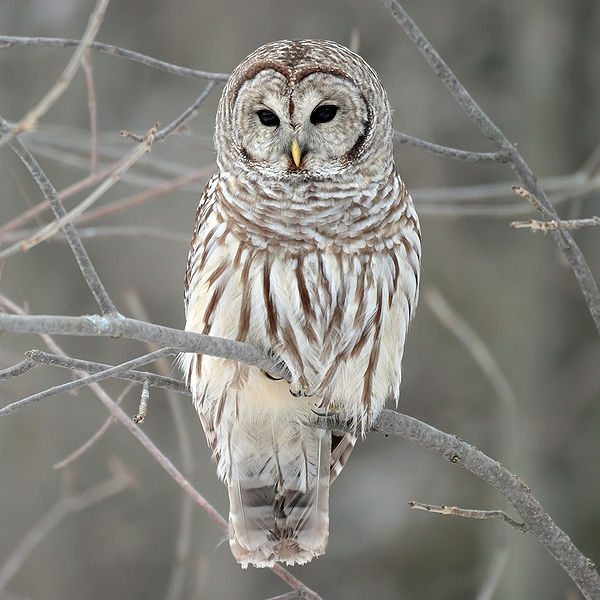
The Pacific Northwest’s ancient forests, draped in perpetual mist and cradling towering conifers, are not just landscapes of quiet majesty—they are battlegrounds of ecological transformation. At the heart of this upheaval stands an unassuming yet formidable predator: the barred owl (*Strix varia*). Once a denizen of eastern North America, this adaptable raptor has surged westward, its hoots now echoing through the same woodlands where spotted owls once reigned supreme. The barred owl’s arrival is not merely a shift in species dominance; it is a catalyst rewriting the very fabric of forest ecosystems. From cascading trophic effects to silent battles for territory, its presence is reshaping the Pacific Northwest in ways both visible and insidious. This is the story of how one owl’s expansion is altering the balance of an entire biome.
The Invasive Intruder: Barred Owls and Their Unchecked Expansion
Barred owls, with their soulful dark eyes and striped plumage, are not native to the Pacific Northwest. Their historical range was confined to the eastern United States, where they thrived in deciduous and mixed forests. Yet, in the late 20th century, a confluence of factors—deforestation in their original habitat, climate-induced range shifts, and perhaps even human-mediated introductions—propelled them westward. By the 1970s, barred owls had breached the Rocky Mountains, and by the 1990s, they were nesting in the heart of the spotted owl’s domain. This invasion was not a gradual migration but a rapid colonization, fueled by the barred owl’s dietary plasticity and competitive prowess. Unlike the spotted owl, which is a dietary specialist, barred owls are opportunistic feeders, consuming everything from small mammals to amphibians and even other birds. Their adaptability has allowed them to exploit niches left vacant by habitat fragmentation, turning the Pacific Northwest’s forests into a newfound paradise.
Trophic Cascades: The Ripple Effects of a Predator’s Arrival
The barred owl’s presence sends shockwaves through the food web, triggering trophic cascades that reverberate from the forest floor to the canopy. One of the most immediate impacts is the decline of native prey species. Barred owls, with their broader dietary habits, outcompete spotted owls for food, particularly in areas where prey is scarce. Studies have shown that where barred owls establish territories, populations of northern flying squirrels, woodrats, and other key prey items plummet. This decline has a domino effect: fewer prey means less food for spotted owls, accelerating their decline in regions where barred owls now dominate. But the cascades don’t stop there. The reduction in small mammal populations can alter seed dispersal patterns, as rodents play a critical role in distributing conifer seeds. In some areas, this has led to shifts in forest composition, with certain tree species struggling to regenerate while others, less dependent on rodent-mediated dispersal, gain a foothold. The barred owl’s presence is thus not just a predator-prey dynamic—it is a restructuring of the forest’s biological architecture.
Silent Battles: Territorial Displacement and the Plight of the Spotted Owl
For the northern spotted owl (*Strix occidentalis caurina*), the barred owl’s arrival is a death knell. These two owl species, though ecologically similar, are locked in a struggle for dominance that plays out in the quiet of the forest night. Spotted owls, already threatened by habitat loss and logging, now face an even greater foe: direct competition. Barred owls are more aggressive, often displacing spotted owls from prime nesting sites. In some cases, barred owls have been observed killing spotted owls, a behavior rarely seen between native predators. The result is a grim reality: where barred owls thrive, spotted owl populations dwindle. Conservationists have documented entire territories once held by spotted owls now occupied by barred owls, their hoots—once a symbol of the old-growth forest—now drowned out by the intruder’s more resonant calls. This displacement is not just a loss of biodiversity; it is a cultural erasure, a quiet extinction of a species that has called these forests home for millennia.
The Forest’s New Architects: How Barred Owls Redefine Habitat Use
Barred owls are not merely passive participants in this ecological drama; they are active architects of change. Their nesting habits, for instance, differ markedly from those of spotted owls. While spotted owls rely on large, old-growth trees with natural cavities, barred owls are more adaptable, nesting in a variety of structures, including abandoned woodpecker holes, squirrel dreys, and even artificial nest boxes. This flexibility allows them to exploit a wider range of habitats, from dense old-growth forests to fragmented woodlands and even suburban areas. Their presence can lead to the creation of new microhabitats, as their nesting activities alter the structure of the forest. For example, the accumulation of nesting debris—feathers, prey remains, and excrement—can enrich the soil, fostering the growth of nitrogen-loving plants. In some cases, barred owl territories become hubs of activity, with other species, such as corvids and small mammals, drawn to the resources they provide. Yet, this newfound dynamism comes at a cost: the loss of the old-growth specialists that once defined the Pacific Northwest’s forests.
Climate Change and the Barred Owl’s Unstoppable March
The barred owl’s expansion is not an isolated phenomenon but a symptom of broader environmental shifts. Climate change, with its warming temperatures and altered precipitation patterns, has created conditions that favor the barred owl over the spotted owl. Warmer winters reduce the energetic stress on barred owls, allowing them to survive in areas where they might otherwise perish. Meanwhile, the spotted owl, adapted to the cool, moist climates of the Pacific Northwest, struggles to adapt to these changes. The barred owl’s ability to thrive in a wider range of temperatures and habitats gives it a competitive edge, ensuring its continued dominance. This climate-driven shift underscores a harsh truth: the Pacific Northwest’s forests are not static ecosystems but dynamic, ever-changing landscapes where the rules of survival are being rewritten in real time.
Conservation Dilemmas: Can We Turn Back the Tide?
The barred owl’s invasion presents conservationists with a profound dilemma. Traditional approaches to protecting endangered species—such as habitat restoration and legal protections—are proving insufficient in the face of this aggressive competitor. Some have advocated for culling barred owl populations to relieve pressure on spotted owls, a controversial but increasingly discussed strategy. Proponents argue that without intervention, the spotted owl faces imminent extinction in parts of its range. Opponents, however, caution that such measures are ethically fraught and may not address the root causes of the barred owl’s success. Others suggest translocating barred owls to areas where they are less likely to compete with spotted owls, though the long-term success of such efforts remains uncertain. The debate is a microcosm of the broader challenges facing conservation in an era of rapid ecological change: how do we balance the needs of native species with the realities of invasive competitors, and what sacrifices are we willing to make to preserve the status quo?
The Future of the Forest: A New Normal
The barred owl’s presence in the Pacific Northwest is not a temporary blip but a permanent fixture of the region’s ecological future. As the climate continues to warm and habitats continue to fragment, barred owls will likely expand their range further, reshaping forests in ways we are only beginning to understand. For some, this may be a cause for despair—a loss of the old, the familiar, the wild. For others, it is an opportunity to witness the raw power of nature’s adaptability, a testament to the resilience of life in the face of change. Yet, whatever the perspective, one thing is clear: the barred owl’s story is not just about a single species. It is about the interconnectedness of life, the fragility of ecosystems, and the relentless march of time. The forests of the Pacific Northwest will never be the same. The question is whether we, as stewards of this land, will accept this new normal—or fight to restore the old.