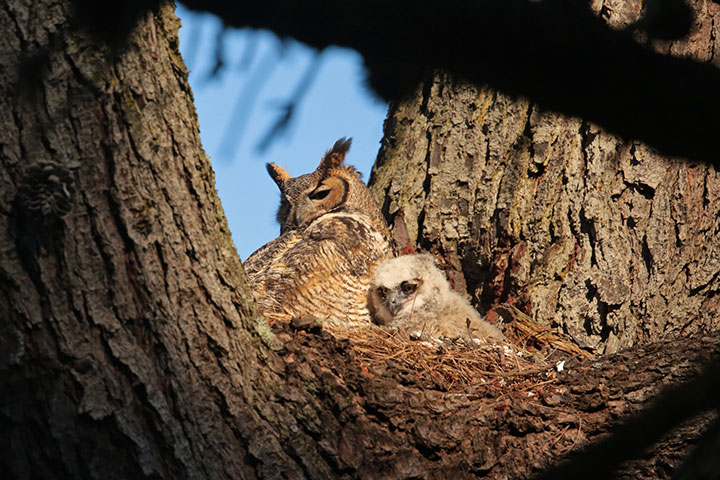
In the shadowed embrace of towering ancient trees, a master of disguise dwells—a creature whose very existence seems interwoven with the fabric of old-growth forests. The spotted owl, with its elusive demeanor and cryptic plumage, beckons a reconsideration of how we perceive camouflage in the natural world. More than mere concealment, their presence embodies an exquisite symphony of adaptation, survival, and ecological resonance. What if the way this bird blends seamlessly into its arboreal sanctuary transforms our understanding of invisibility itself? This exploration promises a shift in perspective—ushering us into a realm where blending in is an art form honed by evolution, environment, and an intricate dance with light and shadow.
The Artistry of Plumage: Nature’s Masterstroke in Camouflage
The spotted owl’s feathers are an exquisite blend of muted earth tones—the deep umbers, sables, and ashen grays mirroring the mottled bark and dappled light of old-growth forests. But this is no random coloration. Each feather seems to have been painted with intention, creating a cryptic mosaic that disrupts the owl’s outline against gnarled branches and decomposing leaves. This phenomenon, known as disruptive coloration, confounds the perceptual faculties of predators and prey alike. The intricate speckles and streaks act like nature’s digital camouflage, breaking up the husk of the bird’s body, making it appear as an extension of the forest itself.
Beyond color, the texture of the spotted owl’s feathers adds another layer of camouflage. Their soft, velvety feathers minimize sound as the bird glides silently among the canopy, not only remaining unseen but also unheard. This tactile dimension to camouflage enriches the owl’s stealth, rendering it a spectral figure within its wooded bastion.
Old-Growth Forests: The Perfect Canvas for Concealment
These majestic forests are not merely backdrops but active participants in the spotted owl’s survival strategy. Old-growth forests provide a complex tapestry of light and shadow, diverse foliage, and multi-layered vegetation. Their ancient trees, crowned with lichen and moss, create irregular patterns that disrupt silhouettes, enabling the owl to vanish in plain sight.
The complex vertical stratification—from the understory to lofty crowns—offers myriad perches and crevices, each providing unique vantage points and concealment opportunities. In this labyrinth of life, the spotted owl’s familiar patterns merge with the interplay of filtered sunlight and textured bark, making detection a near-impossible task for even the keenest observer. Here, blending in transcends mere survival — it becomes a symbiotic relationship, a silent agreement between bird and forest forged over millennia.
Behavioral Camouflage: Movement as a Language of Invisibility
Camouflage is often perceived as solely visual; however, the spotted owl elevates it to a behavioral craft. Remaining motionless for extended periods, the owl mimics the stillness of gnarled tree limbs and mossy projections. When perched, their elongated body posture and intermittent subtle shifts correspond with the sway of branches in the forest breeze—further blurring the line between living being and landscape feature.
Their flight patterns enhance this illusion. Silent, deliberate, and low to the canopy, the owl’s movements avoid abrupt contrasts with the environment. This harmonization between behavior and surroundings is a silent narrative of survival—a language where stillness and motion converge to evade detection.
Ecological Implications: Camouflage as a Keystone of Survival
More than mere avoidance of predators, the spotted owl’s camouflage directly impacts its hunting efficacy and reproductive success. As an apex nocturnal predator within its niche, the owl relies on stealth to ambush prey such as flying squirrels and woodrats. The ability to remain unseen ensures successful predation, vital in the competitive, resource-rich tapestry of old-growth ecosystems.
Moreover, the protection conferred by effective camouflage reduces energy expenditure otherwise spent on escape behaviors, ultimately influencing longevity and fecundity. Camouflage extends its significance beyond the individual; it shapes population dynamics and habitat stability. When the owl’s camouflage falters—often due to habitat disruption—entire ecological equilibriums tremble, underscoring the inseparability of concealment and conservation.
The Enigmatic Evolution of the Spotted Owl’s Camouflage
The spotted owl’s cryptic plumage is the result of deep evolutionary wisdom. Over thousands of generations, natural selection has fine-tuned plumage patterns and hues to mirror the unique compositions of mature forests. Genetic diversity within populations manifests in slight variations of coloration and pattern, a testament to their adaptive plasticity.
Interestingly, the evolutionary marriage between owl and habitat is so intimate that shifts in forest composition—due to logging or climate change—may drive new selective pressures on their camouflage. This dynamic evolutionary landscape poses urgent questions about the owl’s future and challenges our strategies to protect both the bird and its sanctuary.
Shifting Perspectives: What the Spotted Owl Teaches Us About Invisibility
To glimpse the spotted owl in its habitat is to experience an epiphany about visibility and existence. Its camouflage demands we reconsider invisibility not as mere absence or evasion, but as a complex interplay of form, function, and environment. The spotted owl embraces camouflage as an embodied wisdom, a lived experience where survival and beauty coalesce.
In the intersection of biology and aesthetics, the owl’s subtle artistry invites humans to slow down, to attune eyes and hearts to the hidden narratives of the forest. It nudges us to perceive invisibility less as a flaw or mystery, and more as an exquisite ecological strategy—one that sustains not only an individual species but an entire forest’s whispered story.
Conclusion: Embracing the Subtle Marvel of Forest Camouflage
The spotted owl’s ability to meld into old-growth forests is a profound testament to nature’s complexity and genius. Through finely honed feathers, behavioral cues, and evolutionary artistry, this enigmatic bird orchestrates invisibility amidst the vibrant chaos of ancient woodlands. To understand their camouflage is to appreciate a larger ecological narrative—one where survival is entwined with artistry, where the unseen holds unparalleled power.
Let the spotted owl challenge your perception and kindle curiosity about the hidden marvels of the natural world. In their faded spots and whispered wings lies a promise: that the forest’s secrets remain just beyond the veil of visibility, waiting to transform how we comprehend the subtle crafts of life.