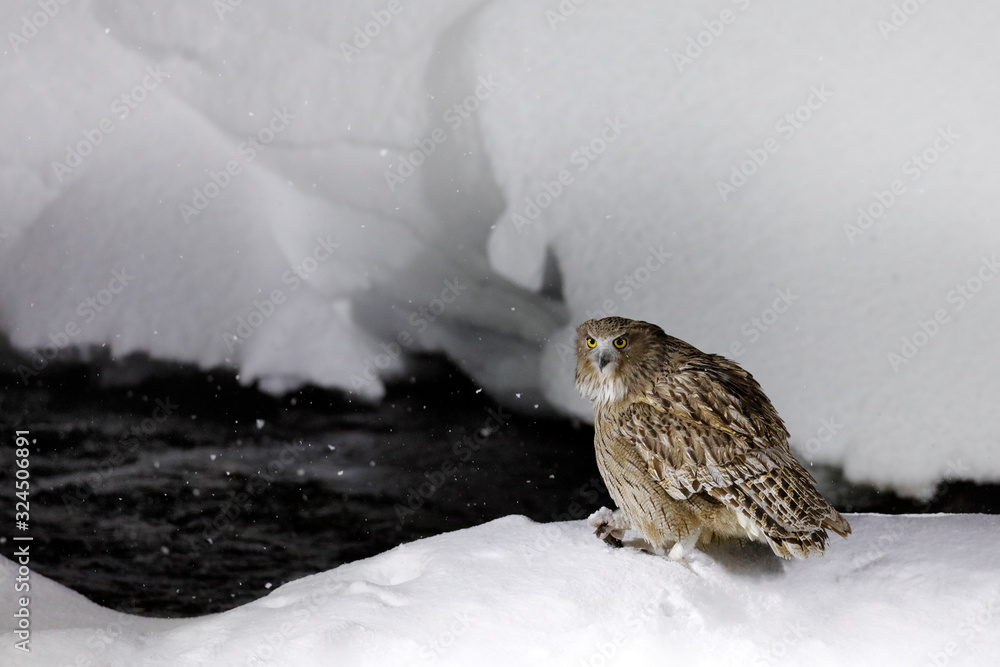
What if I told you that a bird, cloaked in the hush of twilight and the whisper of ancient forests, once teetered on the edge of oblivion—only to be coaxed back from the abyss by the quiet determination of humans? This is the tale of Japan’s Blakiston’s fish owl, a creature so elusive that its very presence feels like a secret shared between the land and the riverbanks it haunts. With feathers the color of damp moss and eyes that gleam like polished river stones, this owl is not just a bird; it is a living relic, a guardian of vanishing wilderness. But how does one rescue a species from the brink when its survival hinges on threads as fragile as the ice that clings to Hokkaido’s rivers in winter? The answer lies in a blend of scientific ingenuity, community devotion, and a dash of serendipity.
The Enigma of the Blakiston’s Fish Owl: A Phantom of the Taiga
Imagine standing on the banks of a snow-laced river in Hokkaido, where the air hums with the creak of frozen branches and the distant call of a great horned owl echoes like a ghostly lament. This is the domain of the Blakiston’s fish owl (*Bubo blakistoni*), a titan among owls, with a wingspan that could eclipse a dinner plate and talons built for snatching slippery prey from icy waters. Yet, despite its imposing presence, this owl remains one of nature’s most enigmatic creatures—a master of stealth, its existence often reduced to fleeting glimpses and the occasional footprint pressed into the snow.
Unlike its more familiar cousins, the Blakiston’s fish owl is a creature of paradox. It thrives in the dense, old-growth forests that fringe rivers and wetlands, yet it is as much a denizen of the water as the land. Its diet—fish, crustaceans, and the occasional amphibian—demands a habitat where the forest and the river are inextricably linked. But here lies the first challenge: what happens when those rivers are dammed, their banks straightened, and their forests felled? The owl’s world, already a fragile tapestry, begins to unravel.
The Silent Decline: When Shadows Grow Fainter
The 20th century was unkind to the Blakiston’s fish owl. Industrialization crept across Hokkaido like a creeping mist, swallowing forests and diverting rivers in its wake. Logging operations reduced ancient woodlands to stumps, while dams silenced the once-vibrant rhythms of seasonal floods. The owls, dependent on undisturbed riverside territories, found their hunting grounds shrinking and their nesting sites disappearing. By the 1980s, their population had dwindled to fewer than 100 individuals—a whisper of what it once was.
Worse still, the owls faced an insidious foe: human indifference. In a land where progress was measured in concrete and steel, the needs of a nocturnal fisher were easily overlooked. Conservationists sounded the alarm, but the owl’s plight was drowned out by louder, more immediate concerns. It wasn’t until the 1990s, when the owl was officially designated a National Natural Monument, that its survival became a matter of national importance. Yet, even then, the road to recovery was fraught with obstacles—habitat loss, pollution, and the lingering shadow of climate change.
The Turning Point: When Science Meets Serendipity
Rescuing the Blakiston’s fish owl required more than just good intentions; it demanded a marriage of science and serendipity. Enter the researchers who, armed with radio transmitters and infrared cameras, began to unravel the owl’s secrets. They discovered that these birds are not just solitary hunters but creatures of habit, returning to the same nesting sites year after year. This loyalty, while endearing, also made them vulnerable—if a nesting tree was felled, the owls had nowhere else to go.
But here’s where the story takes a delightful twist. In a stroke of luck, conservationists found that the owls were not as rigid in their preferences as once thought. By installing artificial nest boxes—essentially giant wooden barrels suspended in trees—they provided a lifeline. The owls, ever adaptable, took to these man-made sanctuaries with surprising enthusiasm. It was a small victory, but one that hinted at a larger truth: sometimes, all a species needs is a little nudge to reclaim its future.
The Power of Community: When Villages Become Guardians
Yet no conservation effort can succeed without the people who share the owl’s domain. In the rural villages of Hokkaido, where the owl’s haunting calls are woven into the fabric of local folklore, a quiet revolution was underway. Farmers, fishermen, and schoolchildren became the owl’s unlikely protectors. They planted native trees along riverbanks, reduced pesticide use, and even installed nest boxes on their own land. In one village, the annual “Owl Festival” became a celebration of the bird’s return, with locals donning owl masks and sharing stories of their feathered neighbors.
This grassroots movement was not just about saving a species; it was about reclaiming a cultural identity. For generations, the Blakiston’s fish owl had been a symbol of the wild, untamed heart of Hokkaido. To lose it would be to lose a piece of the land’s soul. And so, the people of Hokkaido rolled up their sleeves, proving that conservation is not just the work of scientists in labs, but of entire communities standing together.
The Road Ahead: Can the Owl Outrun the Clock?
Despite these successes, the Blakiston’s fish owl’s future remains precarious. Climate change looms large, threatening to alter the delicate balance of its habitat. Rivers that once froze solid in winter now flow unpredictably, while warmer temperatures disrupt the fish populations the owls depend on. Meanwhile, the pressures of development continue to encroach on the owl’s last strongholds. Can the owl outrun the clock?
The answer may lie in a blend of old and new strategies. Expanding protected areas, restoring riverine forests, and even exploring the potential of captive breeding programs are all on the table. But perhaps the most crucial element is time—time for the owls to repopulate their territories, time for the forests to regrow, and time for humans to remember that we are not separate from nature, but a part of it. The Blakiston’s fish owl is not just a survivor; it is a reminder that redemption is possible, even in the face of overwhelming odds.
A Final Whisper: Why This Story Matters
So, why does the tale of the Blakiston’s fish owl resonate so deeply? Because it is a story about second chances. It is about a bird that, against all odds, has clawed its way back from the brink. It is about the power of human ingenuity and the quiet courage of those who refuse to let a species vanish. And perhaps most importantly, it is a story that asks us to look around—to see the wild things that still cling to existence in the cracks of our modern world.
Next time you find yourself in the shadow of a snow-dusted forest, listen closely. You might just hear the echo of an owl’s call—a call that says, against all hope, life endures. And maybe, just maybe, it’s a call to us all.