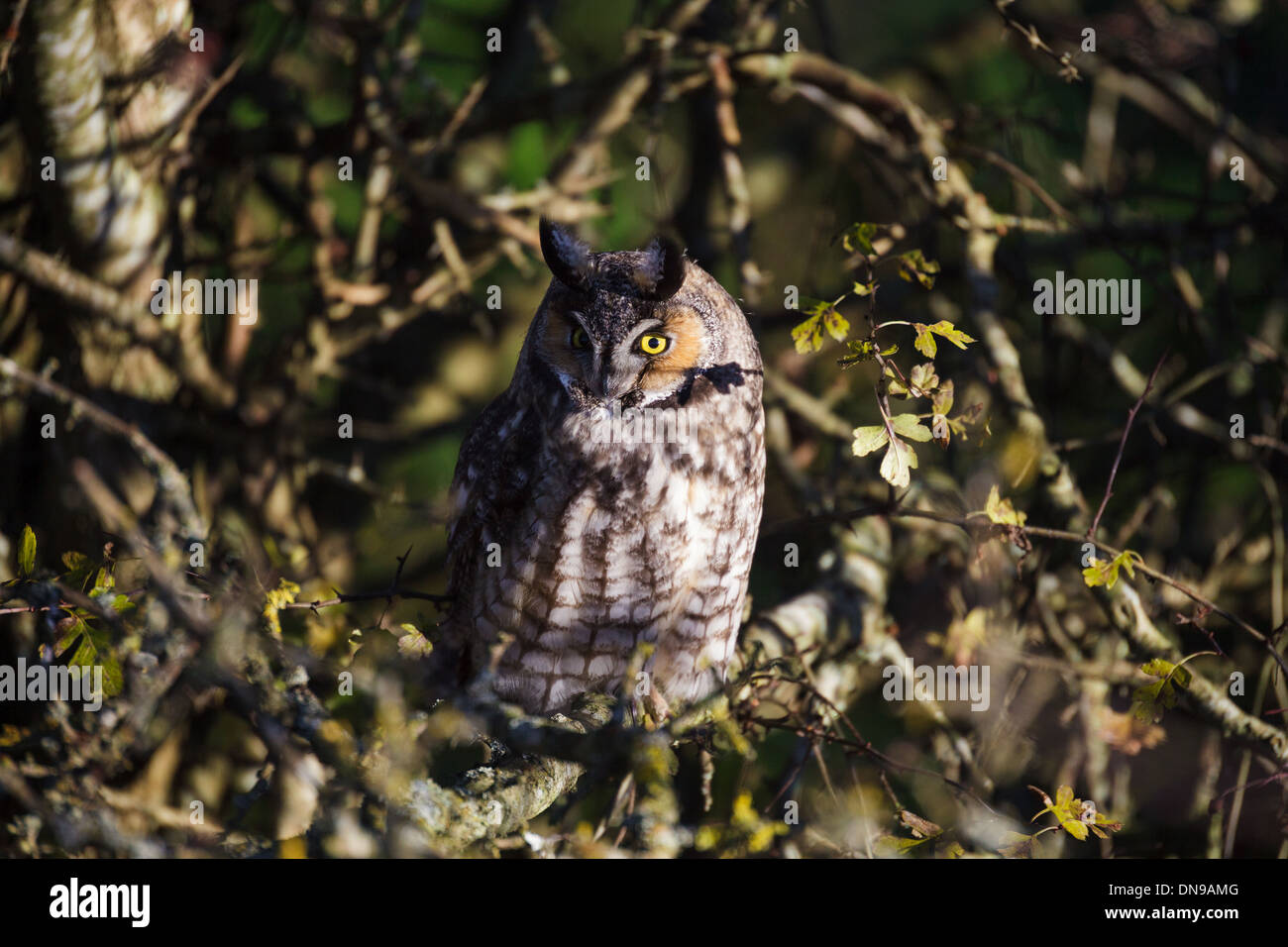
The long-eared owl, a spectral sentinel of the twilight world, glides through the imagination like a whisper on the wind. Its russet plumage, streaked with dark vermiculations, dissolves into the gnarled branches of its arboreal haunts, rendering it nearly invisible to both prey and predator alike. This master of camouflage does not merely hide—it becomes one with the landscape, a living paradox of stillness and stealth. To witness one perched in the fading light of dusk is to glimpse a creature that has perfected the art of vanishing, not through magic, but through millennia of evolutionary refinement. What compels us so deeply about this enigmatic bird? Is it the quiet poetry of its existence, or the profound mystery that cloaks its every movement?
The Art of Disappearance: How Camouflage Shapes Survival
The long-eared owl’s camouflage is not merely a trick of color—it is a symphony of form and function. Its elongated ear tufts, though not true ears, break up the outline of its head, blending seamlessly into the vertical lines of tree bark. The intricate pattern of its feathers, a tapestry of warm browns and grays, mimics the dappled shadows of a forest floor or the mottled bark of an ancient oak. Even its eyes, golden and piercing, seem to absorb light rather than reflect it, further obscuring its presence.
This camouflage is not static; it is a dynamic response to the owl’s environment. In winter, when the world is draped in snow, the owl’s plumage lightens, a subtle shift that ensures it remains a ghostly silhouette against the white expanse. Such adaptability speaks to a deeper intelligence—one that perceives not just the world as it is, but as it will be. The owl does not merely survive; it anticipates, its very being a testament to the relentless pressure of natural selection.
The Nocturnal Virtuoso: A Life in the Shadows
To call the long-eared owl nocturnal is to understate its mastery of the dark. It is a creature of the crepuscular realm, thriving in the liminal hours of dawn and dusk when the veil between day and night is thinnest. Here, in the half-light, it hunts with a precision that borders on the supernatural. Its flight is silent, a feathered phantom gliding between branches, its wings designed to slice through the air without betraying its presence.
The owl’s hearing is equally extraordinary. Its facial disc, a concave arrangement of feathers, funnels sound with eerie efficiency, allowing it to pinpoint the rustle of a vole beneath a blanket of snow. This auditory acumen is not just a tool—it is a sixth sense, a way of navigating a world where sight is a fleeting luxury. In the silence of the night, the long-eared owl listens to the heartbeat of the forest, and in that rhythm, it finds its prey.
The Silent Predator: A Study in Efficiency
Few predators embody the principle of economy like the long-eared owl. It does not chase; it waits. It does not expend energy; it conserves it. With a wingspan that belies its slender frame, it can launch itself from a perch with a suddenness that leaves its victims stunned. Its talons, curved and razor-sharp, strike with a force that crushes bone in an instant. Yet, for all its lethality, the owl is a creature of restraint. It does not kill wantonly; it takes only what it needs, a philosophy of survival that has sustained it for millennia.
This efficiency extends to its diet. While it primarily preys on small mammals—voles, mice, and shrews—it is not above indulging in the occasional bird or insect, a testament to its adaptability. The owl’s digestive system is a marvel of evolutionary engineering, capable of extracting every last nutrient from its meal before regurgitating the indigestible remains in the form of a pellet. In this way, it leaves no trace, a silent testament to its presence.
The Solitary Sage: A Life of Quiet Intensity
The long-eared owl is not a social creature. It is a loner, a wanderer of the night who stakes out territories vast and solitary. During the breeding season, pairs form, but even then, their bond is one of necessity rather than companionship. The male’s courtship display—a series of deep, resonant hoots—echoes through the forest like a call to arms, a declaration of intent in a world where silence is survival.
Nesting habits are equally enigmatic. Unlike many birds, the long-eared owl does not build its own nest. Instead, it commandeers the abandoned abodes of other creatures, be they crows, squirrels, or even other owls. This opportunism speaks to a pragmatic intelligence, a willingness to adapt rather than struggle against the constraints of its environment. The female lays her eggs in the dead of winter, a gamble that ensures her offspring will hatch when prey is most abundant. It is a strategy of calculated risk, one that has ensured the owl’s persistence through the ages.
The Cultural Enigma: Symbolism and Human Fascination
Across cultures, the long-eared owl has been both revered and reviled. In ancient Rome, it was an omen of impending doom, its hoots a harbinger of death. In Native American traditions, it is a guardian of sacred knowledge, its silent flight a metaphor for wisdom gained through observation. Modern symbolism often portrays it as a creature of mystery, a silent observer of the human world, its golden eyes reflecting secrets untold.
What is it about this bird that captivates us so? Perhaps it is the paradox of its existence—both predator and prey, both visible and invisible, both ancient and ever-present. It is a creature that exists in the margins, a silent witness to the cycles of life and death. In a world that often feels chaotic and loud, the long-eared owl offers a reminder of the power of stillness, of patience, of the quiet strength that lies in adaptation.
The Future of a Phantom: Conservation in a Changing World
Despite its mastery of camouflage, the long-eared owl faces threats that even its evolutionary brilliance cannot outmaneuver. Habitat loss, climate change, and the indiscriminate use of pesticides have all taken their toll. The owl’s reliance on undisturbed forests and open hunting grounds makes it particularly vulnerable to human encroachment. Yet, there is hope. Conservation efforts, from the establishment of protected areas to the reduction of harmful chemicals, have begun to reverse some of the damage.
The long-eared owl is not just a survivor—it is a symbol of resilience. Its ability to adapt, to thrive in the face of adversity, is a lesson for us all. In protecting this enigmatic bird, we do more than preserve a species; we honor the quiet strength of the natural world, a world where even the most elusive creatures play a vital role.