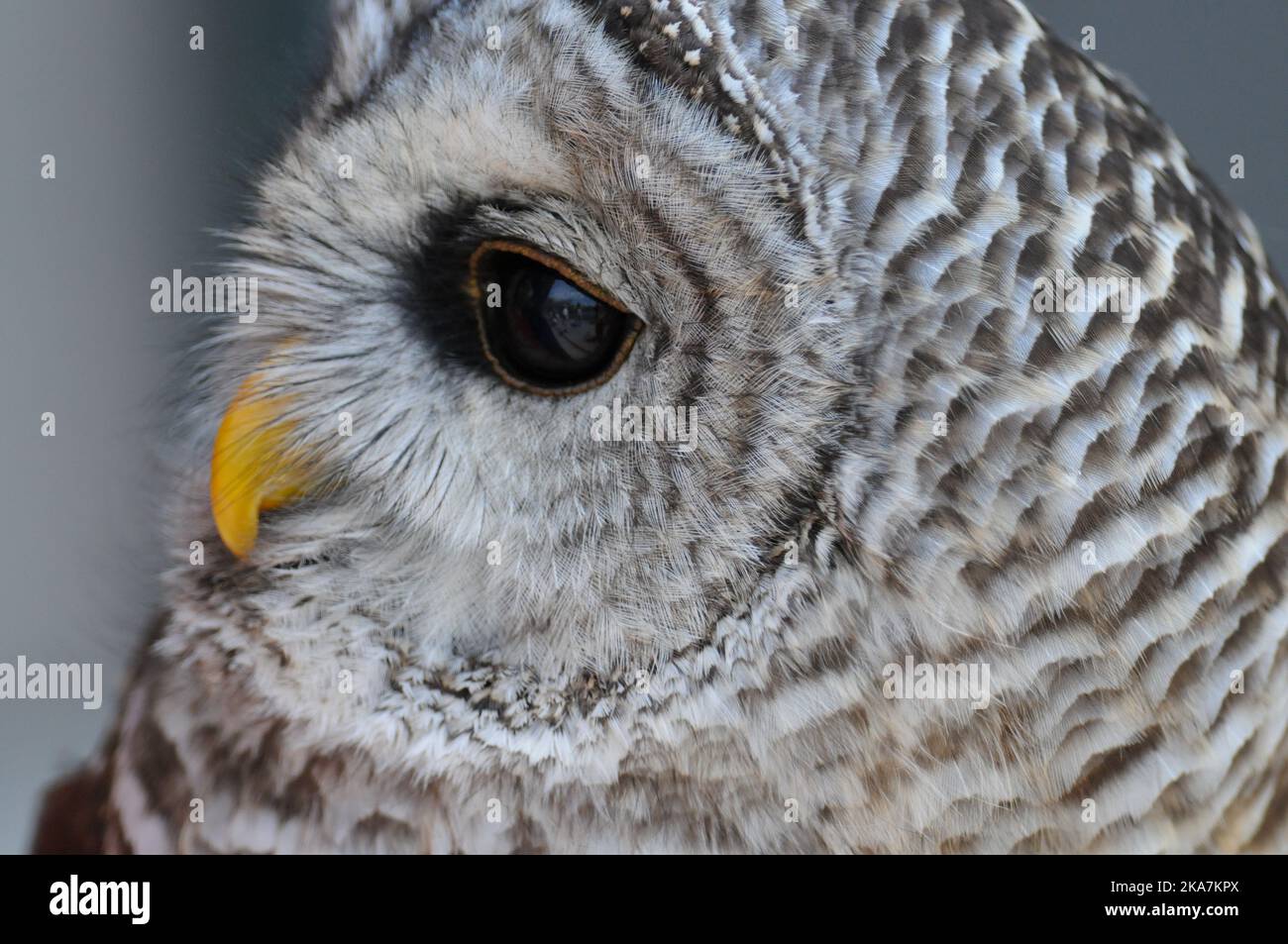
In the grand theatre of the natural world, migration is the ballet of survival—a rhythmic dance choreographed by the changing seasons. Many avian species script their journeys across skies in sweeping arcs, painting ephemeral lines upon the horizon. Yet, amidst this vivid pageantry, the Barred Owl moves with an enigma that resists facile classification. Does this haunting raptor, cloaked in mottled shades of dusk, partake in the migratory ritual that so defines many of its kin? The question invites us into a deeper exploration, seeking to unravel the mysteries cloaked beneath its silent wings.
The Barred Owl’s Ecological Canvas
The Barred Owl (Strix varia) inhabits a verdant mosaic of forests, where whispering leaves and shadowy branches form the backdrop to its nocturnal existence. This species is primarily a denizen of mature woodlands—especially those saturated with old-growth trees and watery realms such as swamps and river bottoms. Its home ranges are etched less by broad seasonal passports and more by the intimate geography of thriving habitats that supply abundant prey and shelter. Unlike nomadic wanderers, the Barred Owl’s ecology is a delicate balance between territorial fidelity and opportunistic adjustment.
These owls are territorial sentinels, often maintaining consistent home territories year-round. Unlike migratory birds that sketch sweeping arcs across hemispheres, the Barred Owl’s movements tend to be more localized. For this nocturne predator, the forest remains a steadfast realm rather than a transient playground. Their preference for dense canopy cover, intertwined with the ebb and flow of small mammal populations, anchors them firmly within a predictable territorial framework.
Examining Seasonal Movements: Partial Migration and Dispersal
Bird migration is seldom a binary act of doing or not doing; it exists on a spectrum. Barred Owls exemplify this subtlety. While they are not classical long-distance migrants, evidence points to some populations exhibiting partial migration or irregular dispersal. In northern parts of their range, especially where winters become brittle with frost and snow, some individuals may undertake short-distance movements in search of more favorable conditions.
Rather than a sweeping exodus, these movements could be likened to a cautious shifting of chess pieces—a calculated relocation to optimize survival prospects. Juvenile Barred Owls, upon fledging, often disperse extensively from natal territories, colonizing new areas and creating a dynamic flux within local populations. This dispersal is crucial for genetic vitality and territorial balance but is distinct from seasonal migration defined by changes in environmental necessity.
Climatic Influence and Habitat Availability
Environmental nuance profoundly shapes the Barred Owl’s choices. Unlike charismatic migrators drawn to the whispers of thermals and magnetic forces, Barred Owls are intimately tethered to microhabitats that provide stable prey access and roosting sites. Seasonal hardships in deeper northern latitudes—prolonged cold snaps, snow accumulation, and frozen water sources—can impose pressures that encourage modest, sometimes sporadic, relocations.
Yet, these shifts are rarely regimented. Rather, they are reactive sessions—a survival cipher written in real-time by the availability of small mammals like voles, shrews, and squirrels. When prey becomes scarce beneath the blanket of winter’s grasp, owls may drift towards more hospitable environs but typically within a circumscribed range. This behavior contrasts sharply with the sweeping migratory flights that characterize species pushed to exchange entire ecosystems with the seasons.
The Barred Owl’s Non-Migratory Mystique
What lends the Barred Owl its unique allure is its inscrutable connection to place—a stoic embodiment of permanence in a world framed by flux. The owl’s haunting calls resonate through forest shades year-round, a spectral reminder that not all creatures heed the migratory summons. This steadfastness cultivates a certain ecological protagonism, marking the Barred Owl as a sentinel of its habitat rather than a mere traveler.
This quality elevates the bird beyond mere biology, infusing it with symbolic resonance. The Barred Owl becomes an avatar of constancy amidst change, a nocturnal oracle rooted in the heartwood of the forest. Its presence whispers tales of endurance and adaptation that are subtler than migration, yet equally compelling.
Human Impact and Changes in Range
Shifts in climate patterns and habitat alteration due to human activity subtly influence the Barred Owl’s distribution and movement behaviors. Urban expansion and deforestation fragment habitats, compelling some populations to adjust their territories in response to resource availability. Conversely, the Barred Owl has displayed a remarkable capacity to adapt, sometimes colonizing suburban woodlots and parklands.
These anthropogenic effects may inadvertently mimic migratory tendencies by encouraging localized movements. The bar is lower: movements are not motivated by instinctive seasonal cues but by pragmatic responses to changing landscapes. This dynamic underpins the ever-evolving relationship between Barred Owls and their environments, emphasizing resilience over ritualized migration.
Conclusion: The Barred Owl’s Seasonal Dance Is One of Staying
The Barred Owl’s story challenges the archetype of avian migration as a grand, sweeping journey across continents. Instead, it elucidates a more nuanced ballet—one of rootedness, localized dispersals, and subtle movements governed by the pulse of environmental availability. They do not chase the calendar; they negotiate the landscape, anchored by a profound connection to place.
In the end, the Barred Owl’s “migration” is less a voyage and more a whispered conversation with the forest—one that speaks of survival through steadfastness, adaptation without surrender, and a haunting beauty forged in permanence. Their seasonal dance, quiet yet evocative, invites us to reconsider what it truly means to move with the changing world.