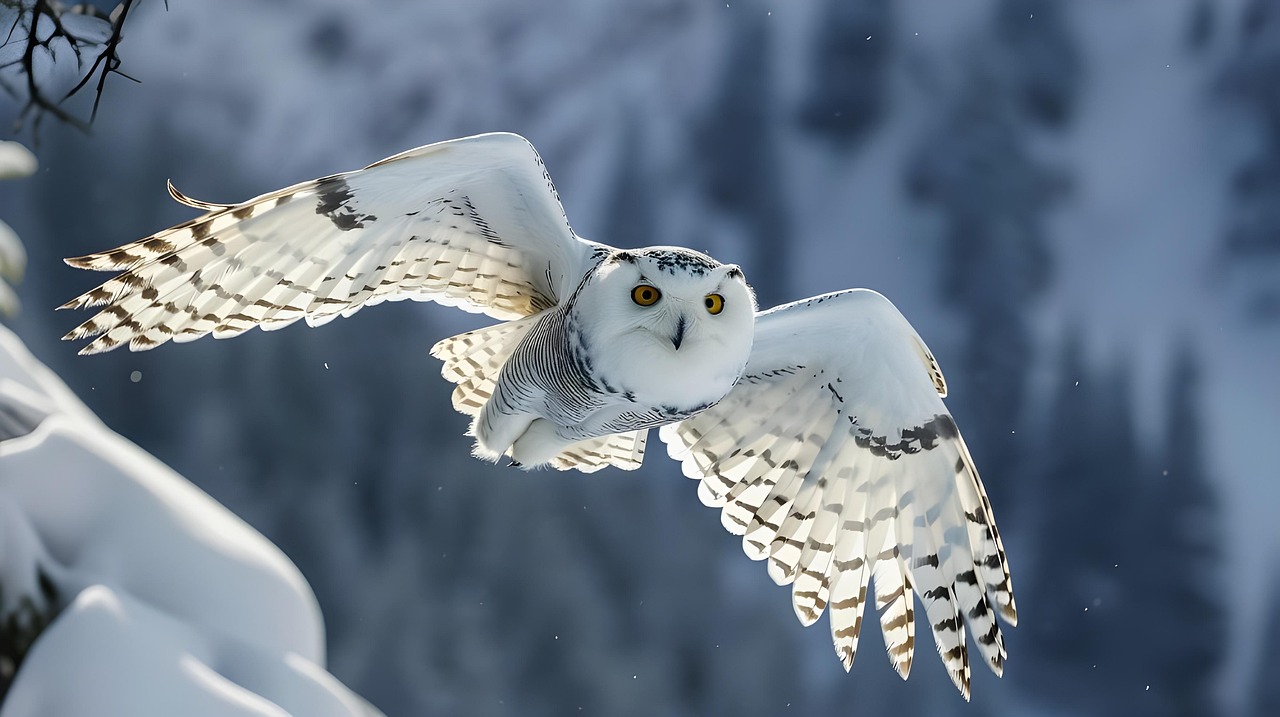
In the vast, windswept tundras where the Arctic whispers to the sky, the snowy owl emerges as a spectral sentinel—a creature of silent wings and piercing gaze. For centuries, these majestic birds have been harbingers of ecological shifts, their irruptions—sudden, unpredictable surges in population—puzzling scientists and nature enthusiasts alike. But what if we could peer into the future, not with a crystal ball, but with the cold, precise calculations of artificial intelligence? The fusion of climate data and machine learning is not just a technological marvel; it is a paradigm shift, a way to rewrite the narrative of nature’s most enigmatic wanderers.
The Silent Symphony of Snowy Owls and Climate
Snowy owls, those ethereal denizens of the far north, are not mere passive observers of their environment. They are dancers in a delicate ballet, choreographed by the whims of climate. Their irruptions—those dramatic, often cyclical invasions into southern latitudes—are not random acts of wanderlust. They are survival strategies, desperate migrations in response to the ebb and flow of prey populations, the capricious dance of lemmings beneath the snow. But climate is the unseen conductor of this symphony, its fluctuations dictating the rhythm of life and death in the Arctic.
Consider the lemming, the snowy owl’s primary sustenance. A single owl may consume over 1,600 lemmings in a year, a feast dictated by the lemming’s own population cycles. When lemming numbers crash, owls are forced to venture south, their irruptions a desperate gamble for survival. But what triggers these lemming crashes? The answer lies in the intricate web of climate variables—temperature, snow depth, precipitation—that shape the Arctic’s frozen ecosystem. Here, AI steps in, not as a replacement for nature’s wisdom, but as a translator, deciphering the silent language of climate into a language we can understand.
AI as the New Oracle: Predicting the Unpredictable
The promise of AI in ecological forecasting is not just about crunching numbers; it is about uncovering patterns hidden in the noise. Traditional models, though valuable, often stumble in the face of the Arctic’s complexity. They struggle to account for the nonlinear relationships between climate variables, the lagged effects of environmental changes, or the cascading impacts of a single disrupted season. Enter machine learning—a tool that thrives in the chaos, sifting through terabytes of climate data to identify the subtle signals that precede an owl irruption.
Imagine a neural network trained on decades of climate records, from the ebb of Arctic sea ice to the whisper of wind patterns across the tundra. This network doesn’t just predict the future; it learns from the past, recognizing that a particularly harsh winter in the Arctic may not immediately trigger an irruption, but a series of mild winters followed by a sudden freeze could. It understands that the timing of snowmelt isn’t just a date on a calendar—it’s a ticking clock for lemming populations, and thus, for snowy owls. The result? A predictive model that doesn’t just forecast irruptions but explains why they happen, offering a window into the future of these birds.
The Data Deluge: Feeding the AI Beast
Of course, no AI model is stronger than the data it’s fed. The Arctic is a data desert in many ways, its vastness and harsh conditions making long-term, high-resolution observations a challenge. But the tide is turning. Satellite imagery now captures the pulse of the tundra in real-time, while remote sensors track temperature, humidity, and snow depth with unprecedented precision. Citizen science initiatives, from birdwatchers to Indigenous communities, contribute anecdotal but invaluable insights, painting a richer picture of owl movements.
Yet, the true power of AI lies in its ability to integrate these disparate data streams. A model might combine satellite data on snow cover with ground-based observations of lemming populations, cross-referencing them with historical climate records to identify the perfect storm of conditions that precedes an irruption. It’s not just about more data; it’s about smarter data, the kind that reveals the hidden connections between a warming Arctic and the owls that call it home.
From Prediction to Preservation: The Ethical Imperative
But with great power comes great responsibility. The ability to predict snowy owl irruptions is not just an academic triumph; it’s a call to action. Conservationists can use these predictions to preemptively protect critical habitats, ensuring that when owls arrive en masse, they find sanctuary rather than scarcity. Farmers and land managers can prepare for the ecological ripple effects of an irruption, from increased predation on ground-nesting birds to the sudden demand for prey in southern ecosystems.
Yet, the ethical stakes run deeper. As climate change accelerates, the Arctic is transforming at a pace that outstrips the ability of many species to adapt. Snowy owls, already vulnerable to habitat loss and human encroachment, face an uncertain future. AI-driven predictions offer a lifeline, but they also raise questions: How do we balance the need for data with the imperative to protect these birds from the very scrutiny that might expose their weaknesses? Can we use these insights to advocate for stronger climate policies, or will they merely become another tool for exploitation?
The Unseen Consequences: AI’s Role in Ecological Storytelling
Beyond the practical applications, AI is rewriting the way we tell the story of snowy owls. For centuries, their irruptions have been framed as mysteries, events shrouded in folklore and superstition. But AI strips away the mysticism, replacing it with a narrative of cause and effect. It invites us to see these birds not as wandering spirits, but as living barometers of a changing planet. This shift in perspective is profound—it transforms the snowy owl from a symbol of the wild unknown into a tangible, measurable force of nature.
Consider the language we use. Instead of saying, “The owls came because of the harsh winter,” we can now say, “The owls came because a 3.2-degree increase in Arctic temperatures over the past decade reduced snowpack, destabilizing lemming populations and triggering a cascade of ecological responses.” The difference is not just semantic; it’s a revolution in how we perceive our place in the natural world. We are no longer passive observers of nature’s whims. We are participants in its story, and AI is our guide.
The Future: A New Dawn for Snowy Owls and Humanity
The fusion of AI and climate science is more than a technological leap; it is a cultural one. It challenges us to rethink our relationship with nature, to move beyond the romanticized notion of the wild and embrace a future where humans and wildlife coexist in a delicate, data-informed balance. For snowy owls, this future could mean the difference between survival and extinction. For humanity, it offers a chance to rewrite our ecological legacy—not as conquerors of nature, but as stewards of its most fragile wonders.
As we stand on the precipice of this new era, one thing is clear: the snowy owl’s story is far from over. With AI as our ally, we can peer into the fog of uncertainty and glimpse the outlines of what’s to come. And perhaps, in doing so, we’ll find not just a way to predict the future, but a way to shape it—for the owls, for the Arctic, and for all of us who call this planet home.