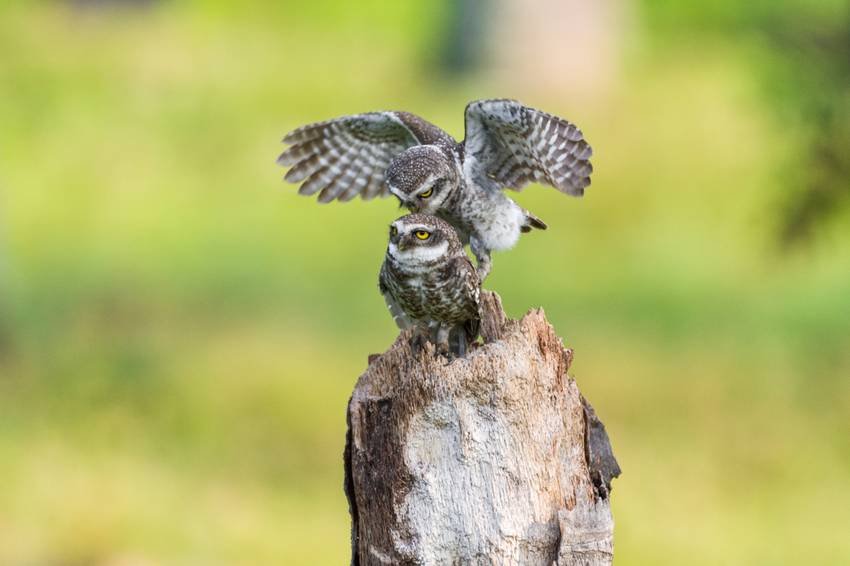
Owls, the enigmatic sentinels of the night, evoke a sense of awe and curiosity. Their silent flight, piercing gaze, and haunting calls have captivated humankind for millennia. A common observation that fuels this fascination pertains to their reproductive prowess: How many offspring do these avian predators produce in a year? The answer, as with many aspects of owl biology, is nuanced and dependent on a confluence of factors.
I. Clutch Size: A Starting Point
The most direct measure of an owl’s reproductive output is its clutch size, referring to the number of eggs laid in a single nesting attempt. This parameter exhibits considerable interspecies variation. Smaller owl species, such as the Elf Owl (Micrathene whitneyi), may lay only 1-3 eggs per clutch. Conversely, larger species like the Great Horned Owl (Bubo virginianus) are known to lay clutches of 2-5 eggs, and occasionally even more under exceptionally favorable conditions. The Snowy Owl (Bubo scandiacus), an Arctic denizen, holds the record for the most dramatic fluctuations in clutch size, ranging from 3 to 11 eggs depending on the lemming population, their primary food source.
II. Brood Frequency: Monogamy and Multiple Attempts
While clutch size provides a snapshot of potential offspring, the frequency with which owls attempt to breed in a year significantly influences their annual reproductive success. Most owl species are monogamous, forming pair bonds that may last for several years or even life. These pairs typically raise only one brood per year. However, in some instances, particularly after the loss of a first clutch due to predation or environmental factors, a pair may attempt a second nesting. Furthermore, under exceptionally bountiful conditions, some species may even raise two successful broods in a single breeding season, though this is a relatively uncommon occurrence.
III. Environmental Influences: The Role of Resource Availability
The availability of food resources is arguably the most critical factor governing owl reproduction. Owls are opportunistic predators, and their breeding decisions are intimately linked to the abundance of their prey. In years of scarcity, owls may forgo breeding altogether or lay smaller clutches with lower hatching success. Conversely, when prey populations are flourishing, owls are more likely to breed, lay larger clutches, and exhibit higher fledgling survival rates. This dynamic interplay between predator and prey is a fundamental principle of ecology, readily observable in owl populations worldwide. Consider, for example, the aforementioned Snowy Owl. Their reproductive success is directly and inextricably linked to lemming cycles. A lemming boom translates to a bonanza of owlets.
IV. Habitat Quality: Nest Site Limitations and Territory Defense
Beyond food availability, the quality of the habitat also plays a crucial role in owl reproduction. Suitable nesting sites are essential for successful breeding. Owls utilize a variety of nest sites, including tree cavities, abandoned raptor nests, ground scrapes, and artificial structures. The availability of these sites can be a limiting factor, particularly in areas with extensive habitat modification or deforestation. Furthermore, owls are territorial birds, fiercely defending their breeding territories against intruders. The size and quality of a territory can influence the availability of resources and the success of nesting attempts. A prime territory equates to enhanced foraging opportunities and reduced competition.
V. Mortality Rates: From Egg to Independence
Even with optimal clutch size and environmental conditions, not all owlets survive to adulthood. Owl chicks are vulnerable to a variety of threats, including predation, starvation, disease, and exposure to harsh weather. Mortality rates are often highest during the early stages of development, when chicks are entirely dependent on their parents for food and warmth. As owlets mature and begin to fledge, they become more adept at hunting and evading predators, but they still face significant risks. The cumulative effect of these mortality factors significantly reduces the number of offspring that ultimately reach reproductive age.
VI. Species-Specific Strategies: Adapting to Ecological Niches
Each owl species has evolved unique reproductive strategies tailored to its specific ecological niche. For example, the Burrowing Owl (Athene cunicularia), a ground-dwelling species, lays a relatively large clutch of 6-11 eggs, reflecting the higher predation risk associated with nesting on the ground. In contrast, the Northern Hawk Owl (Surnia ulula), a diurnal hunter in boreal forests, typically lays smaller clutches of 3-7 eggs, as they can hunt more frequently and efficiently during daylight hours. These species-specific adaptations highlight the remarkable diversity and resilience of owls in the face of varying environmental challenges.
VII. A Realistic Estimate: Beyond the Ideal Scenario
Therefore, a precise, universal answer to the question of how many offspring owls produce in a year is impossible to provide. While a pair might lay 4-5 eggs, perhaps even twice, only a fraction of those offspring are likely to survive to adulthood. Considering factors like environmental conditions, habitat quality, predation, and disease, a more realistic estimate would be that a breeding pair of owls successfully raises 1-3 offspring per year, on average. This number can fluctuate dramatically depending on the specific species and the prevailing environmental circumstances.
In conclusion, the reproductive output of owls is a complex and dynamic process influenced by a multitude of interacting factors. From clutch size and brood frequency to environmental conditions and mortality rates, the life cycle of these magnificent birds is a testament to the intricate web of life in the natural world. Their ability to adapt to varying environmental challenges and maintain their populations is a testament to their resilience and ecological importance. Understanding these factors not only satisfies our curiosity but also underscores the need for conservation efforts to protect owl populations and their habitats for future generations.