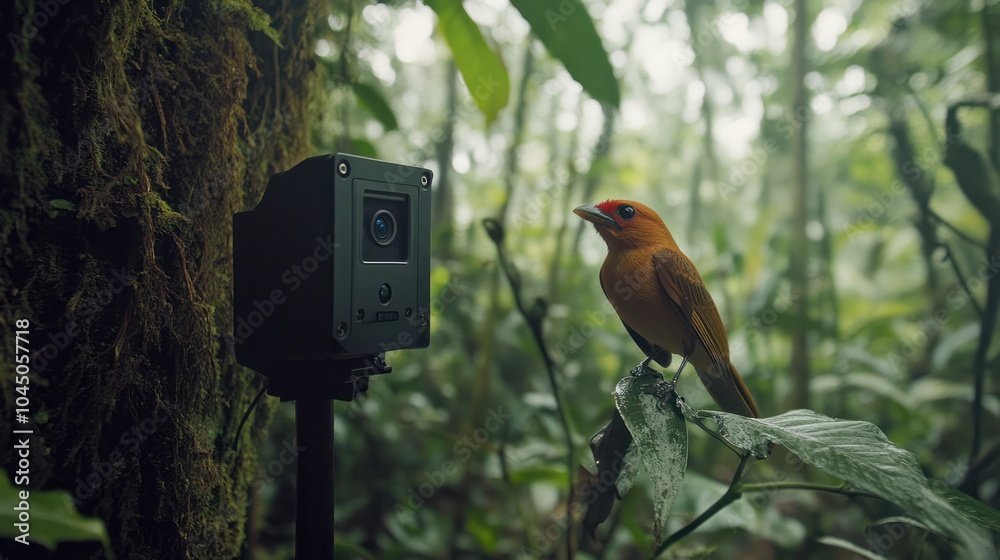
The night belongs to the unseen, the unheard, the creatures that move like whispers through the underbrush of our collective awareness. Among these, owls reign as silent sovereigns—masters of stealth, architects of shadow, their presence felt more than seen. Camera traps, those unblinking sentinels of the wild, have begun to peel back the layers of mystery surrounding these enigmatic birds, revealing not just their elusive forms but the intricate tapestry of their lives. What unfolds in the grainy glow of infrared footage is nothing short of a revelation: a world where survival is a dance, where every interaction is a negotiation, and where the boundaries between predator and prey blur into something far more nuanced. The fascination isn’t merely with the spectacle of an owl in flight or the thrill of capturing a rare species on film—it’s with the unspoken stories these images tell, the silent dialogues between creatures that challenge our understanding of intelligence, communication, and coexistence in the natural world.
The Veil of Darkness: How Camera Traps Unlock the Owl’s Nocturnal Realm
Owls are creatures of the crepuscular and nocturnal hours, their lives unfolding in a realm where human eyes falter. The traditional methods of observation—patient waiting, binoculars, or even trail cameras with visible light—often yield little more than fleeting glimpses. But camera traps, with their motion sensors and infrared capabilities, have shattered this barrier. They don’t just record; they bear witness to the owl’s hidden choreography. A barred owl’s slow, deliberate descent onto a branch, the barn owl’s ghostly glide over a field, or the eagle owl’s territorial display—each movement is captured in stark, unfiltered detail. What emerges is a portrait of an animal that doesn’t just navigate the dark; it thrives within it, using the cover of night to hunt, communicate, and assert dominance. The camera trap doesn’t just document these behaviors—it forces us to confront our own limitations, to acknowledge that the natural world operates on frequencies we’ve only begun to tune into.
Territorial Tapestries: Mapping the Owl’s Invisible Boundaries
To an owl, the forest is not a homogenous expanse but a mosaic of territories, each marked by scent, sound, and the occasional physical sign. Camera traps have revealed how these boundaries are not static lines but dynamic zones of tension and negotiation. A great horned owl’s repeated visits to a particular tree, the way it perches just so, its gaze fixed on the horizon—these are not random acts but deliberate declarations of ownership. Similarly, the interactions between neighboring owls, whether through vocalizations or physical confrontations, paint a picture of a society governed by unspoken rules. The camera trap captures these moments with an almost clinical precision, yet the underlying drama is unmistakable. What we see is not just a bird defending its space but a creature engaged in a perpetual struggle to assert its place in an ecosystem that doesn’t always welcome it. The fascination lies in recognizing that these territorial displays are not mere instinctual reflexes but complex social behaviors, a reminder that even in the animal kingdom, power is a language.
Courtship in the Shadows: The Elusive Rituals of Owl Romance
Few things in nature are as poetic—or as elusive—as the courtship rituals of owls. The male’s gift of prey, the synchronized flights of a pair, the soft hoots that carry through the night like a secret shared between lovers—these are moments that camera traps have managed to preserve, if only in fragments. The footage often shows the male presenting his catch to the female, a gesture that transcends mere sustenance to become a symbol of devotion. Yet, these interactions are not always harmonious. The female’s occasional rejection, the male’s persistence, the way she tests his worth—all of it is captured in the cold, unfeeling lens of the camera. What emerges is a narrative of courtship that is as much about power as it is about affection. The owl’s world is one where love is a negotiation, where trust is earned through patience, and where survival often hinges on the strength of a bond. The camera trap doesn’t just record these rituals; it invites us into a realm where romance is a survival strategy, where every gesture is a calculated move in a game that spans generations.
The Language of Hoots: Decoding Owl Communication Through Footage
Owls are not silent creatures, despite the popular myth. Their vocalizations—hoots, screeches, hisses—are a complex language, a symphony of meaning that camera traps have begun to decode. The deep, resonant hoots of a male great horned owl, the eerie tremolo of a barn owl, the sharp, staccato calls of a screech owl—each sound carries a message, a warning, or an invitation. What the camera trap reveals is not just the variety of these calls but their context. A male’s hooting in the dead of night, for instance, might be a territorial proclamation, while the female’s response could signal acceptance or rejection. The footage often captures these exchanges in real time, allowing researchers to correlate specific calls with particular behaviors. Yet, the mystery remains: How much of this language is innate, and how much is learned? The camera trap doesn’t provide all the answers, but it does offer a glimpse into a world where communication is as much about subtlety as it is about volume. The fascination lies in the realization that owls, like humans, have a language that evolves, adapts, and conveys more than mere survival—it conveys identity, status, and intent.
Parenting in the Perilous Dark: The Hidden Struggles of Owl Rearing
Raising young in the wild is a perilous endeavor, and for owls, the challenges are compounded by the darkness that shrouds their nests. Camera traps have peeled back this veil, revealing the tender yet brutal realities of owl parenting. The footage shows a mother owl brooding over her chicks, her feathers fluffed against the cold, her eyes scanning the shadows for threats. The male, meanwhile, is often seen bringing food, his deliveries timed to coincide with the female’s brief absences. But the footage also captures the darker side of this existence—the sibling rivalry, the occasional predation by larger birds, the way the chicks must learn to hunt almost from the moment they fledge. What emerges is a portrait of resilience, of a species that has evolved to thrive in a world where every advantage is hard-won. The camera trap doesn’t just document these moments; it forces us to confront the fragility of life in the wild, where even the most skilled hunters must contend with the unpredictability of nature. The fascination lies in the realization that owl parenting is not just about nurturing but about equipping the next generation with the tools to survive in a world that is, at best, indifferent.
The Owl’s Gaze: What Their Eyes Reveal About Their World
There is something unsettling about the way an owl looks at the camera—a gaze that seems to pierce through the lens and into the observer. This is not mere anthropomorphism; it’s a reflection of the owl’s extraordinary visual acuity. Camera traps, particularly those with high-resolution infrared, capture the intensity of this gaze, the way the owl’s eyes reflect the faintest glimmer of light, the way its pupils dilate in response to movement. What we see is not just a bird but a creature that perceives the world in a way we can only imagine. The owl’s eyes are adapted for low-light vision, allowing it to detect the slightest flicker of prey in the darkness. But the footage also reveals something more: the owl’s gaze is not passive. It is a tool of predation, a means of assessing threats, a way of communicating with others of its kind. The camera trap captures this gaze in all its complexity, forcing us to acknowledge that the owl’s world is one where sight is not just a sense but a weapon, a shield, and a bridge to understanding.
The Future of the Hunt: How Camera Traps Are Reshaping Owl Conservation
The implications of camera trap technology extend far beyond mere observation. In a world where habitats are shrinking and species are disappearing, these silent observers are becoming invaluable allies in conservation. By documenting owl behavior, researchers can identify critical habitats, track population trends, and even uncover the impacts of climate change on these birds. The footage often reveals unexpected interactions—owls preying on invasive species, for instance, or adapting to urban environments in ways that defy conventional wisdom. What emerges is a picture of resilience, of a species that is far more adaptable than we might assume. Yet, the technology is not without its challenges. The sheer volume of data generated by camera traps can be overwhelming, and the interpretation of footage requires a nuanced understanding of owl behavior. The fascination lies in the potential of these tools to not just document the natural world but to actively shape its future. The camera trap is more than a device; it is a bridge between human curiosity and the urgent need to protect the creatures that share our planet.