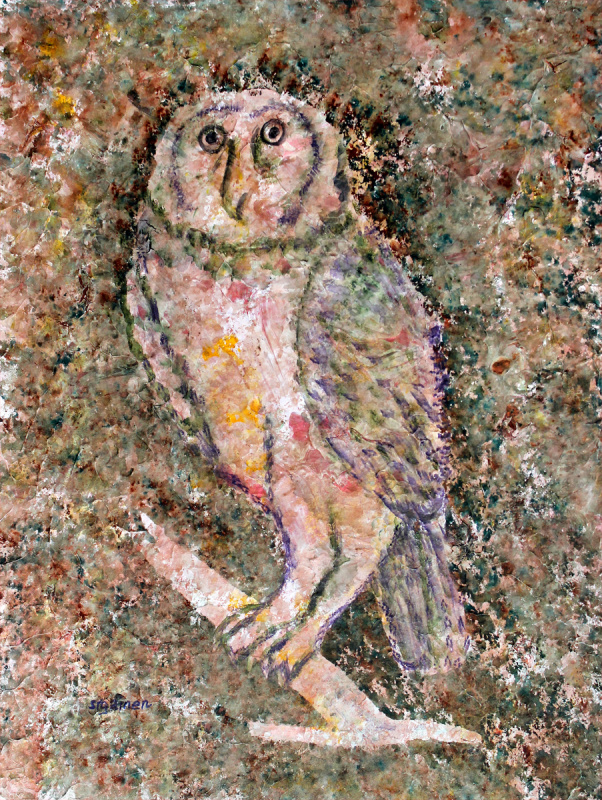
The owl, that enigmatic creature of the night, has long captivated the human imagination. From the flickering shadows of prehistoric caves to the luminous screens of modern galleries, its presence in visual art is as persistent as it is profound. But what is it about this bird that has inspired millennia of artistic devotion? And more intrigued still—why does its portrayal remain so fiercely contested, even today?
The Owl as Ancient Muse: Cave Paintings and Primordial Symbolism
In the dim glow of torchlight, our ancestors etched the owl’s silhouette onto cave walls, not merely as a representation of nature, but as a vessel of meaning. These early depictions—found in sites from Lascaux to Chauvet—were not mere sketches; they were incantations, imbued with the weight of survival and the mystery of the unseen. The owl, with its unblinking gaze and silent flight, became a guardian of secrets, a silent witness to the rituals of ancient peoples. But was it revered or feared? The ambiguity lingers, a tantalizing enigma that haunts every brushstroke.
These primordial artists did not merely capture the owl’s form; they distilled its essence. The creature’s association with wisdom, death, and the supernatural was not imposed—it emerged organically from the interplay of human psyche and natural observation. The owl’s nocturnal habits made it a liminal being, existing between worlds. In art, this duality was not suppressed but celebrated, a paradox that would echo through the ages.
Classical Echoes: The Owl in Greco-Roman and Medieval Art
As civilizations rose and fell, the owl’s symbolic resonance evolved. In ancient Greece, it became the sacred companion of Athena, goddess of wisdom, its image stamped onto coins and carved into temples. Yet even here, the owl was not a passive symbol. It was a living paradox—a creature of the night that illuminated the path to enlightenment. The Romans, ever pragmatic, adopted this iconography, but with a twist: the owl also became a harbinger of doom, its hoot a forewarning of impending disaster.
Medieval Europe inherited this duality, weaving the owl into the fabric of Christian and folk traditions. In illuminated manuscripts, it perched at the margins, a silent observer of human folly. Was it a demonic familiar or a divine messenger? The ambiguity persisted, a testament to the owl’s chameleonic nature. Artists of the era did not resolve the tension—they amplified it, using the bird’s image to explore the boundaries between the sacred and the profane.
The Renaissance Reckoning: From Allegory to Aesthetic Mastery
The Renaissance brought a seismic shift. No longer content with mere symbolism, artists like Albrecht Dürer and Leonardo da Vinci dissected the owl with scientific precision. Dürer’s *The Owl* (1508) is a masterclass in anatomical fidelity, yet it retains an eerie vitality, as if the bird might take flight from the page. Leonardo, ever the visionary, studied owls not just for their form but for their flight mechanics, laying the groundwork for a new era of artistic inquiry.
Yet even as realism flourished, the owl’s symbolic baggage refused to fade. In allegorical works, it remained a cipher—sometimes a fool, sometimes a sage. The challenge for Renaissance artists was not just to depict the owl accurately, but to reconcile its dual nature: to render it both lifelike and laden with meaning. The tension between observation and interpretation became a crucible, forging a new language of visual storytelling.
Romanticism and the Owl’s Gothic Allure
The 19th century saw the owl’s resurgence as a Gothic icon. Romantic artists like Francisco Goya and Caspar David Friedrich harnessed its brooding presence to explore the sublime and the uncanny. Goya’s *The Sleep of Reason Produces Monsters* (1799) features an owl perched ominously on a sleeping figure, a silent indictment of human folly. Friedrich’s *Wanderer Above the Sea of Fog* (1818) omits the owl, but its absence is palpable—a void where wisdom and dread intersect.
This era elevated the owl from mere symbol to psychological archetype. It became a mirror for human anxieties, a creature that embodied the unknown. Artists did not just paint the owl; they weaponized its image, using it to probe the darker recesses of the human mind. The challenge here was not technical mastery, but emotional resonance—how to make the owl’s gaze feel like a judgment, a warning, or a revelation.
Modernist Metamorphoses: Abstraction and the Owl’s Reinvention
The 20th century shattered conventions, and the owl was not spared. Modernist artists like Pablo Picasso and Joan Miró deconstructed its form, reducing it to jagged lines and fragmented shapes. Picasso’s *Owl* (1951) is a study in geometric violence, its features warped into something both familiar and alien. Miró, meanwhile, transformed the owl into a whimsical, almost childlike totem, stripping away its mythic weight to reveal its playful essence.
This period posed a unique challenge: how to retain the owl’s symbolic potency while embracing abstraction’s rejection of realism. The answer lay in distortion. By warping the owl’s form, artists forced viewers to confront not just the bird, but the act of perception itself. The owl became a Rorschach test, its meaning contingent on the observer’s gaze.
Contemporary Visions: The Owl in the Digital Age
Today, the owl thrives in the digital realm, its image proliferating across screens and social media. Artists like Banksy and Julie Mehretu have reimagined the owl as a commentary on surveillance, identity, and environmental collapse. Banksy’s *Owl* (2005) is a stenciled critique of consumerism, its wide eyes a silent accusation. Mehretu’s abstract canvases, meanwhile, use the owl’s form as a scaffold for exploring migration and displacement.
The challenge now is saturation. In an era of endless images, how does the owl retain its mystique? The answer may lie in its adaptability. The owl is no longer just a symbol—it is a meme, a protest sign, a corporate logo. It is both ancient and futuristic, a creature of the past and a harbinger of the unknown. The question we must ask is not what the owl represents, but what we project onto it—and why.
The Owl’s Unfinished Story: A Call to Artists and Viewers Alike
The owl’s journey through art is not a linear progression but a palimpsest, each layer overwriting yet never fully erasing the last. From cave walls to NFTs, it has been a silent partner in humanity’s quest for meaning. But its story is far from complete. The challenge for contemporary artists is not just to depict the owl, but to interrogate the act of depiction itself. What does it mean to render the unseen visible? How do we reconcile the owl’s dual nature—its wisdom and its menace, its beauty and its terror?
Perhaps the owl’s greatest power lies in its refusal to be pinned down. It is a shape-shifter, a trickster, a mirror. And in that refusal, it invites us to question not just art, but the very nature of perception. The owl does not offer answers. It offers only its gaze—and the challenge to meet it.