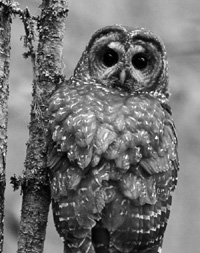
What if I told you that the silent wings of the spotted owl, once a symbol of the ancient forests of the Pacific Northwest, are now caught in a struggle not just against the chainsaw’s roar, but against an uninvited guest—one that arrived not by accident, but by the very hands that reshaped the land? The barred owl, a chatty, adaptable cousin from the east, has become an unlikely antagonist in the tragic tale of the spotted owl’s decline. But how did we get here? How did the logging practices of the past lay the groundwork for this ecological upheaval? Buckle up, because the story of the spotted owl is less a tale of nature’s cruelty and more a mirror held up to human ambition—and its unintended consequences.
The Ancient Canopy: A Kingdom Built by Time and Roots
Picture, if you will, a forest so old that its trees predate the pyramids of Egypt. These are the ancient coniferous cathedrals of the Pacific Northwest, where Douglas firs, western hemlocks, and Sitka spruces stretch skyward like the spires of a forgotten gothic cathedral. For millennia, these forests thrived in a delicate balance, their understories a tangled tapestry of ferns, mosses, and decaying logs—perfect nurseries for the spotted owl. This bird, with its piercing amber eyes and mottled plumage, evolved to be the silent sentinel of these ecosystems, a creature of shadows and stillness.
But the spotted owl’s domain was never just a wilderness. Indigenous peoples lived in harmony with these forests for generations, harvesting selectively and ensuring that the land remained intact. The true rupture came with industrial logging, a practice that treated ancient trees not as living entities but as mere timber, waiting to be felled. The old-growth forests, with their thick canopies and deep ecological memory, were reduced to stumps and slash piles. The spotted owl, a species that thrived in the quietude of undisturbed forests, found itself homeless in a landscape that had been violently rewritten.
From Clear-Cuts to Ecological Vacuums: The Logging Legacy
Logging didn’t just remove trees—it rewired the entire ecosystem. Clear-cutting, the most brutal form of timber extraction, left behind a wasteland where once stood a thriving, multi-layered forest. The spotted owl, a species that requires large, contiguous tracts of old-growth forest for nesting and hunting, was left with fragmented habitats that were too small to sustain its needs. But the damage didn’t stop there. The removal of these ancient trees disrupted the hydrological cycles, dried up streams, and altered the microclimates that supported a web of life beneath the canopy.
Worse still, logging created an ecological vacuum—a gaping void where complex, ancient relationships once thrived. Enter the barred owl, a generalist species from the deciduous forests of the eastern United States. Barred owls are opportunists, adaptable, and aggressive. They thrive in disturbed landscapes, where their broader dietary habits and competitive nature give them an edge. As the old-growth forests of the Pacific Northwest were carved into a patchwork of clear-cuts and second-growth stands, the barred owl found itself a new playground. And it didn’t take long for this interloper to start muscling out its spotted cousin.
The Barred Owl Invasion: A Domino Effect of Human Folly
Now, imagine the barred owl as the uninvited guest at a dinner party who refuses to leave. These birds, once rare in the Pacific Northwest, have become ubiquitous. They outcompete spotted owls for food and nesting sites, and in some cases, they’ve been observed directly attacking and killing their smaller, more specialized relatives. The barred owl’s adaptability is its superpower—it can nest in a variety of habitats, from dense forests to suburban backyards, while the spotted owl’s fate remains inextricably tied to the dwindling old-growth remnants.
But here’s the kicker: the barred owl’s rise is not just a natural phenomenon. It’s a direct consequence of human actions. By fragmenting the spotted owl’s habitat, we created the perfect conditions for the barred owl to flourish. It’s as if we paved a highway through a pristine wilderness and then wondered why the local wildlife started driving trucks instead of horses. The barred owl’s invasion is not an act of nature’s whimsy; it’s a symptom of our own ecological mismanagement.
Can We Turn Back the Clock? The Challenge of Ecological Restoration
So, what’s the solution? Do we cull barred owls to save the spotted owl? Do we replant ancient forests and hope for the best? The reality is far more complicated. Ecological restoration is a slow, painstaking process. Old-growth forests take centuries to mature, and even if we halted all logging tomorrow, the spotted owl’s recovery would be a marathon, not a sprint. Meanwhile, barred owls continue to multiply, their numbers bolstered by the very landscapes we’ve altered.
Some conservationists advocate for targeted barred owl removal, arguing that it’s a necessary intervention to give the spotted owl a fighting chance. Others warn that such measures are a slippery slope, opening the door to further human interference in natural systems. The challenge is not just scientific but ethical. How do we balance the needs of a threatened species with the unintended consequences of our own actions? And can we ever truly restore what we’ve destroyed, or are we doomed to forever play catch-up in a game where the rules keep changing?
The Bigger Picture: Lessons for a Planet in Crisis
The story of the spotted owl is not just about one bird or one forest. It’s a parable for our time, a cautionary tale about the fragility of ecosystems and the long shadow of human decisions. Every time we prioritize short-term gain over long-term sustainability, we risk creating ecological boomerangs—unintended consequences that come back to haunt us. The barred owl’s invasion is a reminder that nature abhors a vacuum, and when we disrupt one part of the web, the entire system can unravel in ways we never anticipated.
So, what’s the takeaway? Perhaps it’s this: the next time you see a clear-cut or a row of freshly planted saplings, ask yourself what kind of future you’re planting. Because the forests we destroy today are not just lost timber—they’re lost homes, lost species, and lost opportunities to learn how to live in harmony with the wild world. The spotted owl’s decline is not just a tragedy for conservationists; it’s a wake-up call for all of us. The question is, will we listen before it’s too late?