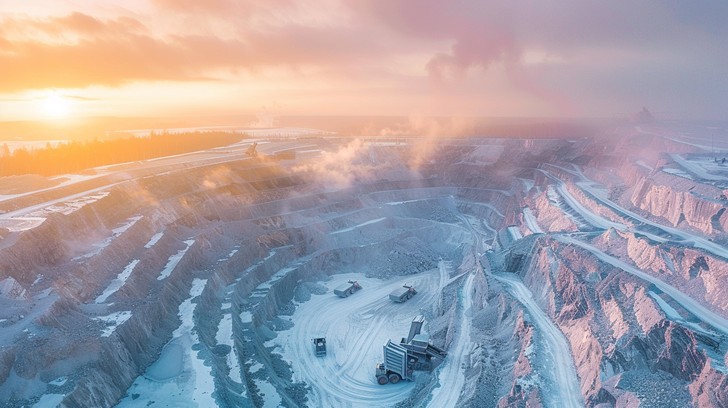
The Arctic tundra, a vast and seemingly desolate expanse, is a realm of delicate balance where life thrives against the harshest of odds. Among its most iconic inhabitants is the snowy owl, a creature of silent grace and fierce determination. Yet, beneath the pristine white canvas of snow and ice, a silent invasion is underway. Mining operations, with their relentless machinery and insatiable hunger for resources, are carving deep scars into the land. These disruptions are not merely physical; they are existential threats to the snowy owl’s nesting sites, a tragedy unfolding in slow motion.
The Fragile Ecosystem of the Arctic Tundra
The Arctic tundra is a paradox—a place of extreme cold and perpetual daylight in summer, where permafrost locks away carbon for millennia and life clings to the edge of survival. For the snowy owl, this landscape is not just a home but a sanctuary. The open expanses provide unobstructed views for hunting, while the sparse vegetation offers camouflage against predators. The nesting sites, often located on elevated mounds or ridges, are carefully chosen to avoid flooding and ensure visibility. Yet, this fragile equilibrium is being shattered by the encroachment of industrial might.
Mining operations introduce a cascade of disturbances. The removal of topsoil disrupts the delicate permafrost layer, leading to thawing and subsidence. Dust from mining activities blankets the surrounding vegetation, smothering the lichens and mosses that sustain the tundra’s food web. The noise of machinery drowns out the whispers of the wind, a sound so integral to the Arctic’s auditory landscape that even the snowy owl’s keen hearing is affected. The very air becomes tainted, as particulate matter settles on the snow, altering its albedo and accelerating melt—a death knell for a species adapted to a world of endless winter.
The Snowy Owl: A Species on the Edge
The snowy owl, *Bubo scandiacus*, is a master of adaptation. Its thick plumage, feathered legs, and keen eyesight make it a formidable hunter in a land where prey is scarce. Yet, its nesting habits are a testament to vulnerability. Females lay their eggs in shallow depressions on the ground, relying on the insulating properties of snow and vegetation to protect their clutch from the elements. The timing of nesting coincides with the brief Arctic summer, when the sun never sets, and food is marginally more abundant.
But what happens when the ground beneath these nests is no longer stable? When the rhythmic hum of excavators replaces the howl of the Arctic wind? The snowy owl’s nesting sites are being fragmented, their once-reliable territories now crisscrossed by roads and riddled with pits. The noise pollution alone is enough to drive these birds away, as their reliance on sound for communication and hunting is disrupted. Studies have shown that even low-frequency vibrations from mining can disorient wildlife, leaving them unable to navigate or find mates. For a species that has evolved over millennia to thrive in silence, the industrial cacophony is a death sentence.
The Human Cost of Unchecked Extraction
Behind the mechanical roar of mining lies a deeper, more insidious truth: the commodification of the Arctic. The tundra is not just a landscape; it is a living archive of Earth’s history, a repository of stories etched into the ice and stone. Yet, we treat it as a mere resource, a playground for human greed. The snowy owl, like so many other Arctic species, is a casualty of this extractive mindset. Its decline is not an isolated incident but a symptom of a larger disease—one that prioritizes short-term profit over long-term survival.
The irony is stark. The Arctic, often romanticized as a pristine wilderness, is being hollowed out for minerals that fuel our insatiable consumption. Rare earth elements, gold, and diamonds—these are the trophies of modern industry, extracted at the cost of ecosystems that have existed for eons. The snowy owl, a creature of myth and legend, is being erased from the Arctic’s canvas, its presence reduced to a footnote in environmental impact reports. And yet, its story is one we must heed, for it is a mirror held up to our own folly.
The Ripple Effects: Beyond the Nesting Sites
The impact of mining on snowy owl nesting sites is not confined to the immediate vicinity. The Arctic is a connected web of life, where the fate of one species reverberates through the entire ecosystem. Lemmings, the primary prey of snowy owls, are also affected by habitat disruption. As their populations decline due to mining-induced habitat loss, the owls face starvation. This, in turn, affects predators higher up the food chain, from Arctic foxes to wolves. The entire trophic cascade is thrown into disarray, a domino effect that begins with a single disturbance.
Moreover, the loss of snowy owls has cascading effects on the tundra’s vegetation. These owls are keystone predators, controlling rodent populations that would otherwise overgraze the sparse plant life. Without them, the delicate balance of the ecosystem tips, leading to overgrazing, soil erosion, and further degradation of the land. The Arctic is not a static place; it is a dynamic, ever-shifting tapestry of life and death. To disrupt one thread is to unravel the entire fabric.
A Call to Reckoning
The Arctic is not a frontier to be conquered; it is a sanctuary to be protected. The snowy owl’s plight is a warning, a siren call for us to reconsider our relationship with the natural world. Mining operations are not inevitable. They are choices—choices made by corporations and governments that prioritize profit over preservation. But these choices are not set in stone. There are alternatives: renewable energy sources, circular economies, and sustainable practices that do not come at the cost of entire species.
We must ask ourselves: What is the true value of the Arctic? Is it the minerals buried beneath its surface, or is it the irreplaceable biodiversity that thrives there? The snowy owl, with its piercing yellow eyes and silent flight, is a symbol of the Arctic’s soul. To lose it is to lose a part of ourselves—a part that recognizes the sacredness of wild places, the importance of balance, and the necessity of restraint. The Arctic is not a resource to be mined; it is a testament to life’s resilience, a reminder that even in the harshest of environments, beauty and wonder persist. And it is our duty to ensure that they do.