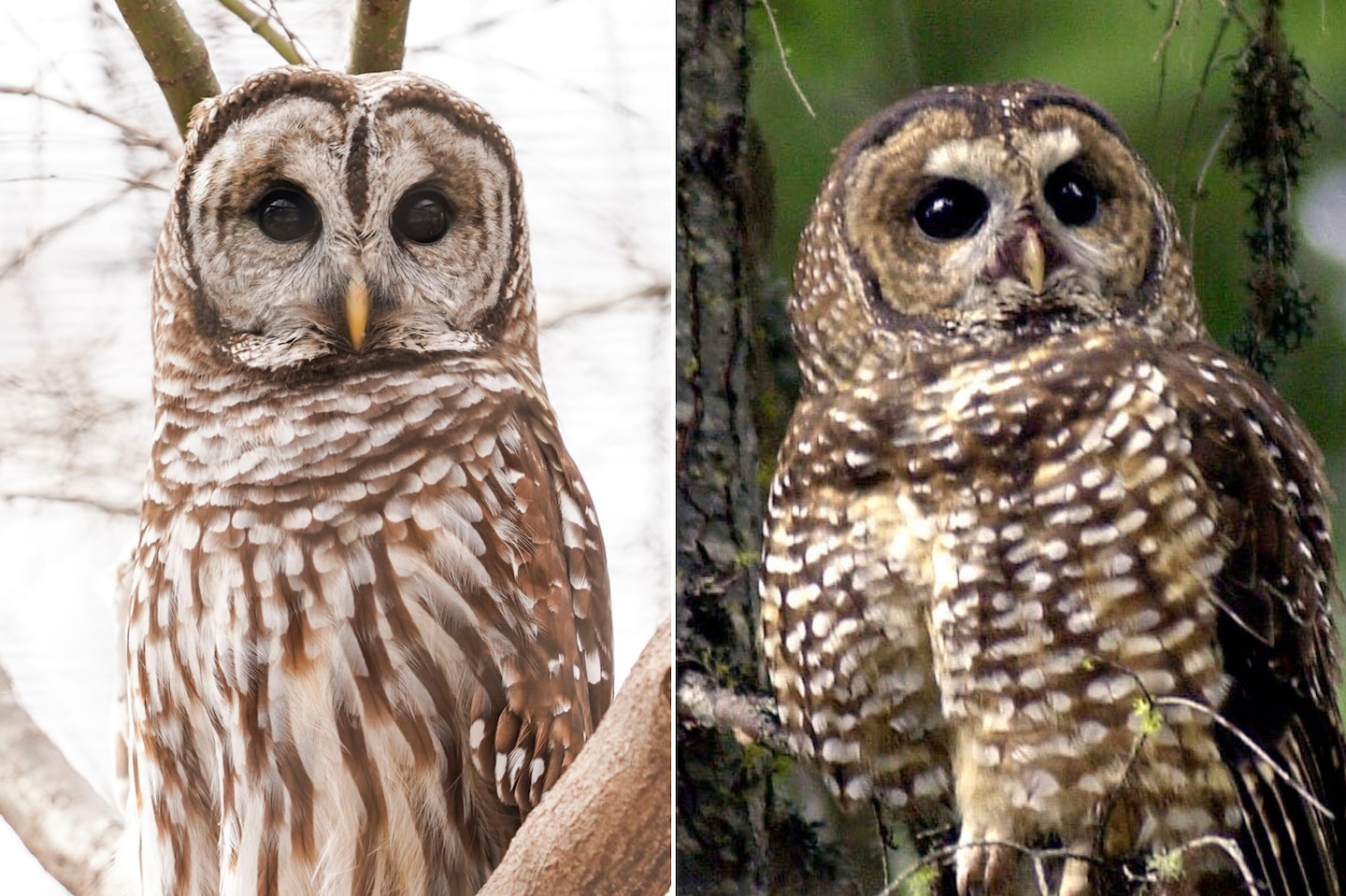
In the dense, shadowy cathedrals of the Pacific Northwest’s ancient forests, a silent battle unfolds. It is a contest as old as time itself—a struggle for survival played out beneath towering canopies and cloaked in twilight. Here, two owls engage in a duel not of claws and beaks alone, but of habitat, existence, and ecological dominance. The barred owl, a formidable interloper, has become an unyielding specter haunting the survival prospects of the spotted owl. To comprehend this avian rivalry is to enter a world where nature’s delicate balances teeter on the edge, and where the very essence of conservation is tested.
The Barred Owl: An Ecological Marauder
The barred owl, with its robust frame and piercing, dark eyes, embodies the archetype of an adaptable predator. Originally native to the eastern United States, this species has been quietly expanding its range westward, breaching the natural borders of the spotted owl’s domain. This expansion is not merely a geographic phenomenon—it is a profound ecological invasion.
Barred owls possess a voracious appetite and a generalist diet, allowing them to exploit a wide array of prey species. Their ability to thrive in diversified habitats—from dense old-growth forests to fragmented urban fringes—has endowed them with a competitive advantage. Unlike the more finicky spotted owl, barred owls show remarkable plasticity, adjusting their hunting techniques and territorial habits with a predator’s cunning. This means they not only usurp prime hunting grounds but also usurp the very survival of their more vulnerable counterparts.
Spotted Owls: The Endangered Emblem of Old-Growth Forests
The spotted owl, with its ghostly visage and haunting calls, is synonymous with the enigmatic beauty of old-growth forests. These owls have evolved to occupy a niche that is narrow and fragile. Dependent on dense, mature forests rich in biodiversity, they are specialists in both habitat and lifestyle. Their survival hangs precariously on the preservation of these ancient ecosystems.
Sadly, the spotted owl is more than just an ecological enclave; it is a symbol of vulnerability in the face of environmental upheaval. Habitat destruction and fragmentation from logging, urbanization, and climate pressures have eroded their strongholds, carving pulses of weakness into what once were vast wildernesses. In this fragile landscape, the barred owl’s encroachment strikes with devastating consequence.
Inter-Species Competition: A Clash of Shadows and Silence
When barred owls infiltrate spotted owl territory, the encounter is a collision of ecological titans. Unlike mere coexistence, this is a zero-sum game where one species’ gain equates sharply to the other’s loss. Barred owls are larger, more aggressive, and possess a competitive territorial instinct that displaces spotted owls from prime nesting sites and foraging areas.
The conflict transcends physical battles—it is a war fought through resource monopolization. Barred owls consume a broader range of prey, often overlapping with the limited diet of the spotted owl. This dietary overlap leads to direct competition for food, which intensifies during scarce seasons. With dwindling resources, the more adaptable barred owl thrives, while the spotted owl’s populations shrink under pressure.
The Ecological Consequences of Barred Owl Proliferation
Beyond the immediate threat to the spotted owl, the barred owl’s ascendancy engenders systemic disruptions across forest ecosystems. By displacing a specialist predator, the intricate tapestry of species interactions is distorted. The spotted owl’s role in controlling particular rodent populations is compromised, which may cascade through the trophic levels, altering vegetation dynamics and prey abundance.
The barred owl’s dominance thus acts as a fulcrum, tilting ecosystems toward homogenization. This shift reduces biodiversity and undermines the evolutionary heritage embedded in these forests. It embodies a form of biotic invasion that not only diminishes a species but redefines the very architecture of the habitat itself.
Conservation Controversies: Ethical Quandaries and Wildlife Management
Efforts to curb the boom of barred owls have ignited fiercely debated conservation strategies, most notably proposals to lethally remove hundreds of thousands of barred owls to safeguard the spotted owl. This approach raises moral and ecological questions that resonate beyond the immediate crisis.
Proponents argue that such measures are necessary triage to preserve the spotted owl’s dwindling populations and prevent their extinction. Critics counter with concerns about animal welfare, ecosystem ethics, and the potential unintended consequences of disrupting a now-established species. This dilemma encapsulates the broader tension within conservation biology—balancing intervention with preservation, control with compassion, and urgency with prudence.
The Path Forward: A Symbiosis of Science and Stewardship
Facing this monumental challenge demands more than binary choices—it calls for integrating advanced scientific insights with a nuanced understanding of ecosystem dynamics. Innovative management actions, such as habitat restoration, strategic removals, and controlled breeding, must be developed within an adaptive framework that respects ecological complexity.
Moreover, the story of barred and spotted owls is emblematic of human influence on biodiversity. Our activities have inadvertently rewritten the rules of this ancient contest. Therefore, fostering coexistence between these species—and ideally restoring balance—requires not only biological intervention but a profound shift in how we interact with the natural world.
In this twilight struggle between barred and spotted owls, we glimpse a microcosm of global conservation battles. It is a dramatic narrative of resilience and vulnerability, invasion and endurance, underscored by the haunting truth that the survival of one may come at the cost of another. Yet within this tension lies the potential for renewed hope, where science, ethics, and passion converge to safeguard the irreplaceable wonders of our forest realms.