In the twilight whispers of North America’s woodlands resides a pair of enigmatic raptors whose haunting calls paint the nocturnal soundscape—the Barred Owl and the Spotted Owl. At first encounter, their overlapping habitats and somewhat similar silhouettes might deceive even the keenest observers into presuming a singular identity. Yet, beyond their ghostly hoots and shadowed flights lies a world of nuanced physical distinctions that tell separate tales of evolution, survival, and adaptation. Embarking on a journey to unravel these differences promises not only to sharpen your insight but to transform the way you perceive these magnificent creatures forever.
Overall Size and Stature: The Silent Giants
Though both owls captivate with their stately presence, the Barred Owl commands a more robust and broad-shouldered silhouette. Averaging between 16 to 25 inches in length, with a wingspan that stretches nearly up to 43 inches, this owl embodies a bold corpulence that enhances its dominance in mixed forest habitats. The Spotted Owl, comparatively more slight and nimble, measures approximately 16 to 19 inches with a lesser wingspan extending between 39 to 42 inches. This subtle disparity in mass is not merely a trivial metric but echoes their differing hunting strategies and territorial needs, with the Barred Owl leveraging its bulk to assert territorial boundaries and the Spotted Owl favoring agility amid dense old-growth forests.
Plumage Patterns: Nature’s Artistry in Feathers
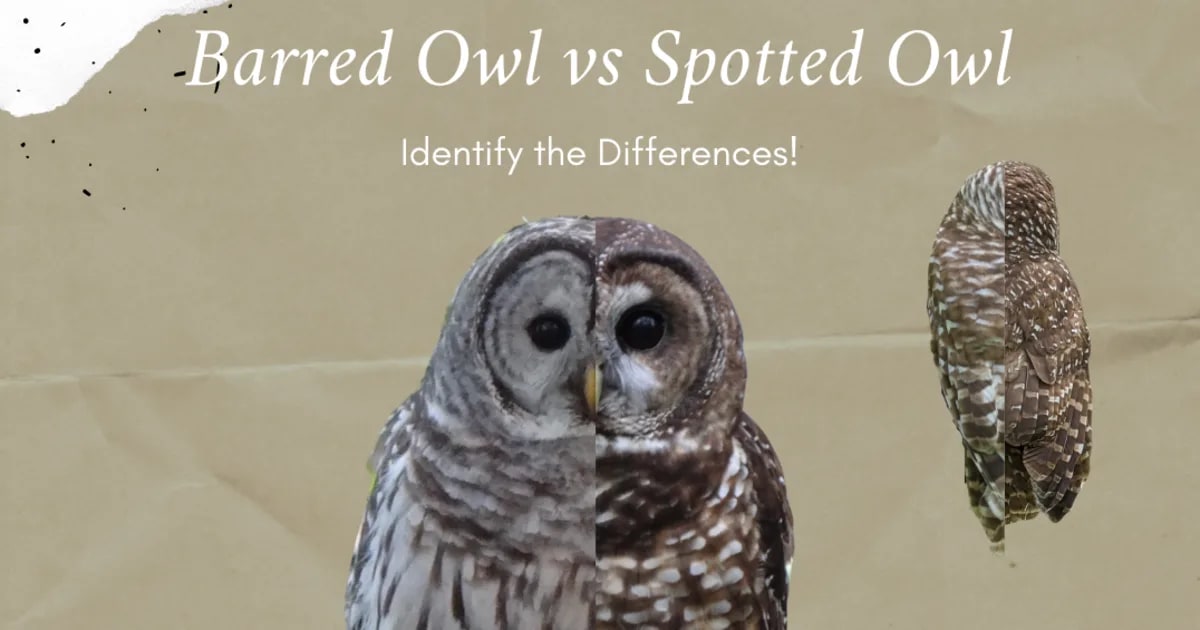
The plumage of these owls is where sublime craftsmanship becomes evident—each feather seemingly painted with nature’s brush to convey identity and purpose. The Barred Owl derives its name from the distinctive horizontal barring that graces its chest and belly. These bars, broad and well-defined, traverse across the feathers in a regimented pattern, lending a linear rhythm to its appearance. Complementing this is a mottled backdrop of brown and white, a camouflage well-suited for the dappled light of mixed woodlands.
In contrast, the Spotted Owl showcases an intricate tapestry of spots adorning its underparts, from the throat down to the abdomen. These rounded, discreet blemishes are scattered over a warm, tawny-buff background and imbue the bird with a less regimented, more organic patterning. Above, its back and wings wear a dark chocolate-brown hue, flecked with white spots that shimmer in twilight like scattered stars, perfectly designed to blend among moss-draped conifers and old-growth canopy shadows.
Facial Disks and Eye Color: Windows to Adaptation
The facial structure of owls is an evolutionary marvel, sculpted to funnel sound to their asymmetrically arranged ears. The Barred Owl boasts a striking facial disk, broad and rounded, encircling its dark, almost coal-black eyes. This somber ocular coloration contrasts sharply with the surrounding pale feathers, producing an intense, almost spectral gaze. The stark black eyes of the Barred Owl are thought to aid its nocturnal vision in low-light conditions, an adaptation that tightens its grip on the forest’s secretive nocturnal prey.
Meanwhile, the Spotted Owl presents a more subdued auditory framework with a facial disk that is somewhat heart-shaped, less pronounced than the Barred Owl’s robust circle. Its eyes reflect a captivating dark brown hue, warmer and less foreboding but no less effective. This subtle difference in eye coloration and disk shape mirrors their ecological divergence, with the Spotted Owl operating in the shaded understories of ancient forests, relying more heavily on stealth and acute hearing.
Legs and Talons: Tools of the Silent Hunt
Delving beneath the feathers to the legs and talons reveals further evidence of their predatory dichotomy. The Barred Owl is equipped with sturdy, feathered legs that conceal formidable talons, broad and powerful enough to grasp a variety of prey including mammals, amphibians, and even other birds. The feathering extends down to the toes, shielding and insulating against harsh elements while contributing to their predatory efficacy.
The Spotted Owl’s legs are similarly feathered but exhibit a slightly more slender architecture, a testament to its predilection for smaller prey and the necessity for agility in cluttered forest interiors. Its talons, though equally sharp, are adapted to seize small mammals and birds that reside in the dense canopy and understory, reinforcing its specialization within a narrower ecological niche.
Vocalization Features Linked to Physical Traits
While not a physical trait per se, the morphology of their syrinx and vocal anatomy influence their iconic calls, which are inextricably linked to their physical structure. The Barred Owl is renowned for its familiar “Who cooks for you? Who cooks for you-all?” call—a sonorous, rolling sequence that echoes through the woods. Its larger body and expanded chest cavity facilitate deeper, more resonant vocalizations.
Conversely, the Spotted Owl’s calls are more subdued, comprised of a series of low hoots that are spaced out and carry an eerie stillness befitting its reclusive nature. The differences in vocal output find roots in their physical differences—a reminder that structure and function are entwined inextricably in the natural world.
Feather Texture and Adaptations to Habitat
Both species possess feathers adapted for silent flight, but subtle differences in texture and layering reflect their ecological specializations. The Barred Owl’s feathers tend to be denser and more plush, offering insulation against the variable climates of mixed forests and riparian zones. Their wing feathers have soft fringes that dampen sound, optimizing stealth during nocturnal hunting.
The Spotted Owl’s plumage, while also silent in flight, is slightly sleeker. This subtle refinement enhances aerodynamic efficiency in thick, tangled forest environments where maneuverability is paramount. These textural nuances underscore the intimate relationship between feather morphology and environmental mastery.
Concluding Reflections: Seeing Beyond the Surface
When the next dusk sets the stage and the owls begin their symphony, it becomes apparent that their differences are a celebration of divergence rather than similarity. The Barred Owl and the Spotted Owl, though kindred spirits of the night, embody distinct adaptations wrought by their environments. Their physical traits—size, plumage, eyes, legs, and even feathers—are pages from a natural manuscript that chronicles their evolutionary stories.
To truly appreciate these nocturnal sentinels, one must look beyond superficial resemblance and embrace the subtle artistry that defines each species. In doing so, a profound appreciation emerges—not only for these two owls but for the intricate tapestry of life that colors the forests they inhabit.