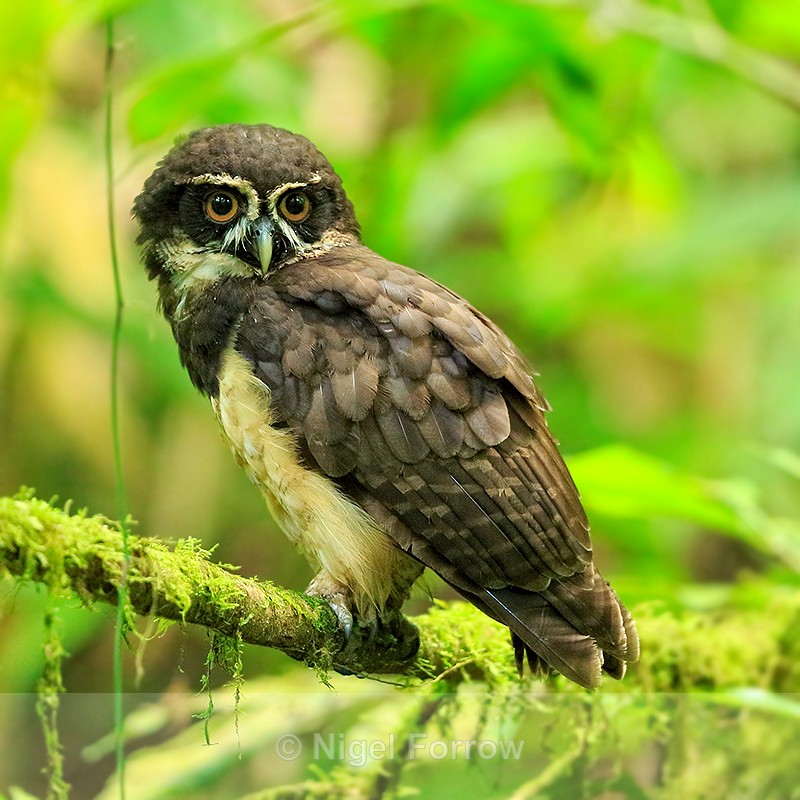
The Spectacled Owl, with its piercing amber gaze and distinctive facial disc, is more than just a nocturnal sentinel of Costa Rica’s rainforests—it is a living emblem of the delicate balance between human ambition and ecological preservation. As dawn breaks over the emerald canopies of Corcovado, this enigmatic raptor takes flight, its silent wings cutting through the humid air like a whisper from the wild. Yet, beyond its haunting beauty lies a story of survival, one that is inextricably woven into the fabric of ecotourism—a force that has become both shield and steward for species teetering on the edge of oblivion. In a world where biodiversity is hemorrhaging at an unprecedented rate, the Spectacled Owl’s fate is not merely a matter of ornithological interest; it is a litmus test for humanity’s capacity to coexist with the natural world.
The Spectacled Owl: A Nocturnal Monarch in Peril
Perched atop the trophic hierarchy of Costa Rica’s lowland rainforests, the Spectacled Owl (*Pulsatrix perspicillata*) commands an almost mythical presence. Its name, derived from the striking white “spectacles” encircling its deep-set eyes, lends it an air of intellectual gravitas, as if it were a scholar of the night, observing the forest’s secrets with unblinking scrutiny. Yet, this regal demeanor belies a precarious existence. Habitat fragmentation, driven by agricultural expansion and illegal logging, has carved the owl’s domain into isolated fragments, leaving populations marooned like islands in a sea of human encroachment. The owl’s reliance on old-growth forests for nesting and hunting makes it particularly vulnerable to deforestation, a silent crisis that unfolds far from the public eye. To witness one in the wild is to glimpse a creature suspended between myth and mortality—a fleeting apparition in an ecosystem under siege.
Ecotourism: The Double-Edged Sword of Conservation
Ecotourism, often hailed as a panacea for both conservation and economic development, is a paradox wrapped in green packaging. On one hand, it channels the wanderlust of travelers into a force for preservation, funding protected areas and incentivizing local communities to value their natural heritage. On the other, poorly managed tourism can trample the very ecosystems it seeks to protect, leaving behind a trail of disrupted wildlife and eroded habitats. The Spectacled Owl, with its low reproductive rate and specialized habitat requirements, is acutely sensitive to such disturbances. Yet, when wielded with precision, ecotourism can become a lifeline. Guided night walks in Corcovado, for instance, offer visitors a chance to encounter the owl in its element, while the revenue generated from these experiences funds anti-poaching patrols and reforestation initiatives. The key lies in striking a balance—where the owl’s presence becomes a beacon, drawing attention to the forest’s plight rather than its exploitation.
The Allure of the Owl: Why We Are Drawn to Its Mystery
There is something primal in our fascination with owls—a creature that embodies the unknown, the unseen, the whisper of the night. The Spectacled Owl, with its asymmetrical ear placement for pinpointing prey and its ability to rotate its head nearly 270 degrees, seems almost extraterrestrial in its adaptations. This mystique is not merely aesthetic; it taps into an ancient human reverence for nocturnal predators, creatures that blur the line between the tangible and the supernatural. Yet, our enchantment with the owl is not without consequence. The very act of seeking it out can disrupt its nocturnal routines, leaving it vulnerable to stress and reduced hunting efficiency. The challenge, then, is to cultivate awe without intrusion, to let the owl’s presence inspire conservation rather than exploitation. In doing so, we honor not just the species, but the intangible magic of the wild itself.
Community-Led Conservation: The Heartbeat of Ecotourism
No conservation effort can thrive without the heartbeat of local communities, whose lives are inextricably linked to the fate of the Spectacled Owl. In Costa Rica, indigenous groups and rural communities have long been the unsung guardians of biodiversity, their traditional knowledge offering insights that modern science often overlooks. Ecotourism, when rooted in community ownership, transforms these stewards into stakeholders in preservation. For instance, guiding tours led by local experts not only provides economic alternatives to deforestation but also fosters a sense of pride in protecting the owl’s habitat. Programs that integrate conservation with cultural heritage—such as storytelling sessions about the owl’s role in indigenous folklore—deepen the connection between people and place. The result is a symbiotic relationship where the owl’s survival is not just an ecological imperative but a cultural legacy.
The Economic Imperative: Why the Owl is Worth More Alive Than Dead
In the calculus of conservation, economics is often the deciding factor. A single Spectacled Owl, when alive, can generate thousands of dollars in ecotourism revenue over its lifetime, far outstripping the pittance earned from selling its feathers or capturing it for the pet trade. This “living asset” model is the cornerstone of sustainable ecotourism. Protected areas like Corcovado, which rely on visitor fees and donations, demonstrate that intact ecosystems are not just ecological treasures but financial ones as well. The owl, as an apex predator, is an indicator of a healthy forest—its presence signals a thriving ecosystem that can support a myriad of other species, from howler monkeys to scarlet macaws. By preserving the owl’s habitat, we safeguard an entire web of life, one that sustains not just wildlife but the communities that depend on it for their livelihoods.
The Silent Threats: Climate Change and the Owl’s Uncertain Future
Beneath the canopy’s emerald expanse, a more insidious threat looms: climate change. Shifting temperature patterns and erratic rainfall disrupt the delicate synchrony of the rainforest, affecting prey availability and nesting cycles for the Spectacled Owl. Droughts can parch the rivers that sustain its hunting grounds, while intense storms flatten the old-growth trees it relies on for nesting. Ecotourism, while a powerful tool, cannot single-handedly reverse these global trends. Yet, it can amplify the urgency of the message. By educating visitors about the owl’s plight in the context of climate change, ecotourism becomes a platform for advocacy, connecting local struggles to the broader fight against environmental degradation. The owl, in this sense, is not just a symbol of Costa Rica’s rainforests but a harbinger of the planet’s future.
A Call to Action: How You Can Become a Guardian of the Night
The fate of the Spectacled Owl is not sealed—it is a story still being written, one where each of us holds a pen. Supporting certified ecotourism operators, donating to conservation organizations, and advocating for policies that protect old-growth forests are tangible steps toward ensuring this nocturnal monarch endures. But perhaps the most profound action is simply to listen—to the rustle of leaves in the night, to the distant call of the owl, and to the quiet plea of the forest itself. In a world that often prioritizes speed over silence, the Spectacled Owl reminds us that some things are worth slowing down for. Its survival is not just a matter of conservation; it is a testament to our capacity for reverence, for restraint, and for the humility to recognize that we are but one thread in the vast tapestry of life.