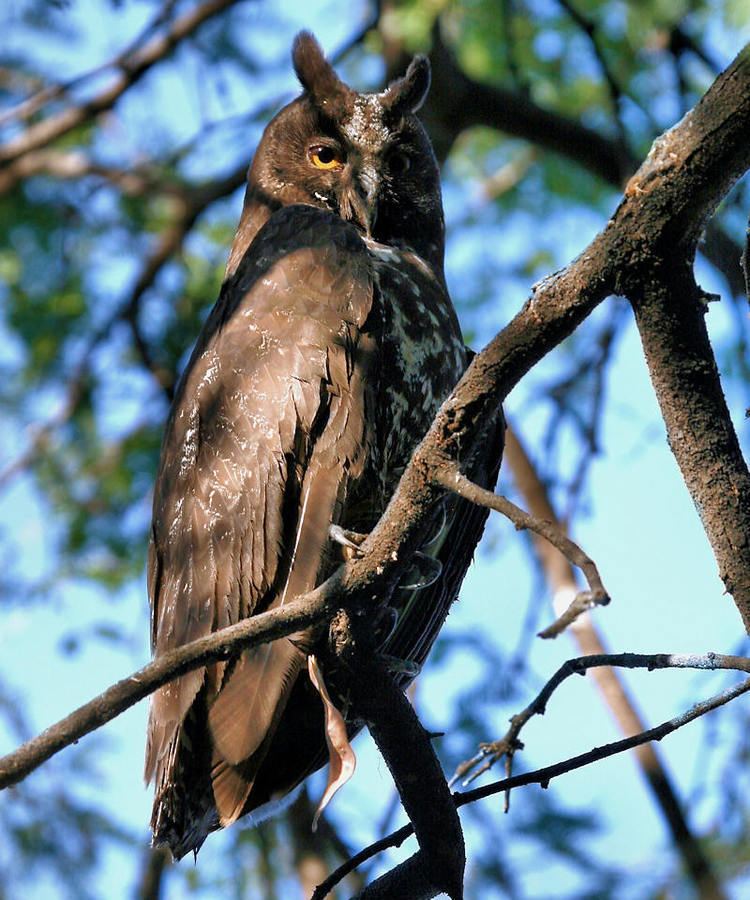
The Stygian owl, a creature cloaked in twilight’s deepest hues, is not merely a bird of the night—it is a living paradox, a whisper of the wild that thrives where shadows dare to dance. Its haunting gaze, framed by a crown of feathery horns, seems to peer through the veil of time itself, as if it holds secrets whispered by ancient forests. Yet, this enigmatic raptor faces a silent siege, not from the claws of predators, but from the encroaching specters of habitat loss and human expansion. In this cosmic tug-of-war between survival and oblivion, international cooperation emerges not as a mere policy, but as the last bastion of hope—a global covenant where nations, scientists, and stewards of the wild unite under the banner of preservation. To safeguard the Stygian owl is to weave a tapestry of interconnected destinies, where each thread, no matter how distant, strengthens the whole.
The Stygian Owl: A Twilight Enigma Wrapped in Feathers
Perched like a sentinel upon the gnarled branches of ancient woodlands, the Stygian owl (*Asio stygius*) is a master of camouflage and mystery. Its plumage, a symphony of dusky browns and velvety blacks, blends seamlessly with the dusk, rendering it nearly invisible to the untrained eye. But it is not merely its appearance that captivates—it is the aura of the uncanny that surrounds it. Legends whisper of its nocturnal serenades, a haunting melody that echoes through the valleys, as if the owl itself is a conductor of the night’s symphony. This bird is not just a species; it is a living emblem of the wild’s resilience, a creature that thrives in the liminal spaces where light and dark refuse to part ways. Yet, its very existence is now suspended in a delicate equilibrium, threatened by deforestation, agricultural sprawl, and the relentless march of progress. To protect it is to honor the fragile poetry of nature, where every creature, no matter how obscure, plays a vital role in the grand ballet of life.
Habitat Fragmentation: The Silent Erasure of the Owl’s Domain
Imagine a vast, unbroken tapestry of forest, where the Stygian owl glides like a shadow between the trees, its domain as boundless as the night sky. Now, picture that tapestry being torn apart, thread by thread, by the relentless hands of human industry. This is the reality facing the owl’s habitat—a fragmentation so insidious that it doesn’t just shrink the owl’s world; it fractures it into isolated islands of wilderness, each too small to sustain a population. Roads carve through ancient groves, plantations replace native flora, and the once-unbroken canopy becomes a patchwork of fragments, each too distant for the owl to traverse. The consequences are dire: isolated populations face genetic bottlenecks, inbreeding, and the cruel mathematics of extinction. International cooperation must act as the loom that restores the tapestry, stitching together protected corridors where the owl can once again roam freely, its wings carrying it across borders as effortlessly as the wind.
The Global Web: How Distant Nations Hold the Owl’s Fate in Their Hands
The Stygian owl does not recognize the arbitrary lines drawn on maps by humans. Its fate, however, is inextricably linked to the decisions made in capitals thousands of miles away. A logging ban in one country may drive deforestation into another, where protections are lax. A climate agreement in a distant land may alter the very weather patterns that sustain the owl’s habitat. This is the paradox of globalization: what happens in one corner of the world echoes in another, and the owl’s survival depends on a web of interconnected actions. International treaties, such as the Convention on Biological Diversity, serve as the threads that bind these actions together, ensuring that nations do not operate in isolation. Yet, true cooperation demands more than signatures on paper—it requires shared vision, pooled resources, and a willingness to prioritize the owl’s plight over short-term gains. In this global web, every nation is both a predator and a protector, and the owl’s future hangs in the balance of their collective choices.
Scientific Diplomacy: The Unlikely Alliance Between Researchers and Policymakers
In the hallowed halls of academia, researchers pore over data, their minds alight with the thrill of discovery. Yet, their findings often gather dust in journals, unseen by those who wield the power to enact change. The protection of the Stygian owl demands a bridge between science and policy—a bridge built not of steel, but of trust, persistence, and the unshakable belief that knowledge must serve a purpose beyond itself. Scientific diplomacy is the alchemy that transforms raw data into actionable policy. Researchers must don the mantle of advocates, translating the owl’s silent struggles into compelling narratives that resonate with policymakers. Satellite tracking reveals the owl’s migratory patterns; genetic studies uncover its vulnerabilities; ecological models predict the impact of climate change. Each piece of data is a puzzle piece, and when assembled, they form a portrait of urgency. International collaborations, such as those fostered by the IUCN’s Species Survival Commission, ensure that this knowledge transcends borders, uniting scientists in a shared crusade to safeguard the owl’s future.
Community Stewardship: The Unsung Heroes of the Owl’s Last Stand
No conservation effort can succeed without the heartbeat of local communities, whose lives are woven into the fabric of the land the Stygian owl calls home. These are the farmers who till the soil at dawn, the indigenous tribes who have guarded the forests for generations, the children who play among the trees and know the owl’s call by heart. Their knowledge is ancient, their connection to the land profound. Yet, too often, they are sidelined in the grand schemes of international conservation, treated as obstacles rather than allies. True cooperation demands that their voices be heard, their wisdom be valued, and their livelihoods be safeguarded alongside the owl’s habitat. Programs that incentivize sustainable agriculture, eco-tourism ventures that empower local guides, and educational initiatives that instill pride in the owl’s preservation—these are the seeds of a lasting alliance. When communities become stewards rather than spectators, conservation ceases to be an imposition and becomes a shared destiny.
The Power of Symbolism: Why the Stygian Owl Captivates the World’s Imagination
There is a magic in the Stygian owl that transcends biology—it is a symbol, a muse, a living metaphor for the wild’s tenacity and the fragility of its existence. In many cultures, owls are harbingers of wisdom, their nocturnal vigilance a reminder of the unseen forces that govern the world. The Stygian owl, with its ghostly presence and haunting call, embodies the mystery of the unknown, the allure of the untamed. This symbolism is a potent tool in the fight for its survival. When the owl becomes a global icon, its plight resonates far beyond the borders of its habitat. Conservation campaigns that leverage its mystique—art installations, documentaries, literary works—can ignite a spark in the hearts of people who have never set foot in its domain. The owl’s story becomes a mirror, reflecting humanity’s own relationship with nature: a dance between reverence and exploitation, between preservation and destruction. To save the Stygian owl is to save a piece of the world’s soul.
Conclusion: A Covenant for the Night
The Stygian owl does not ask for much—just the right to exist, to hunt, to raise its young in the quiet embrace of the old-growth forests. Yet, its survival is a test of humanity’s capacity for empathy, foresight, and collective action. International cooperation is not a luxury in this endeavor; it is a necessity, a covenant written in the language of shared responsibility. From the dense canopies of Central America to the policy chambers of distant nations, the owl’s fate is a thread that binds us all. To protect it is to acknowledge that we are not separate from nature, but a part of its grand, interconnected tapestry. The night may be dark, but it is not without hope. With every protected corridor, every reforested acre, every voice raised in its defense, we weave a future where the Stygian owl’s haunting call continues to echo through the ages—a testament to the wild’s enduring spirit and our own capacity for redemption.