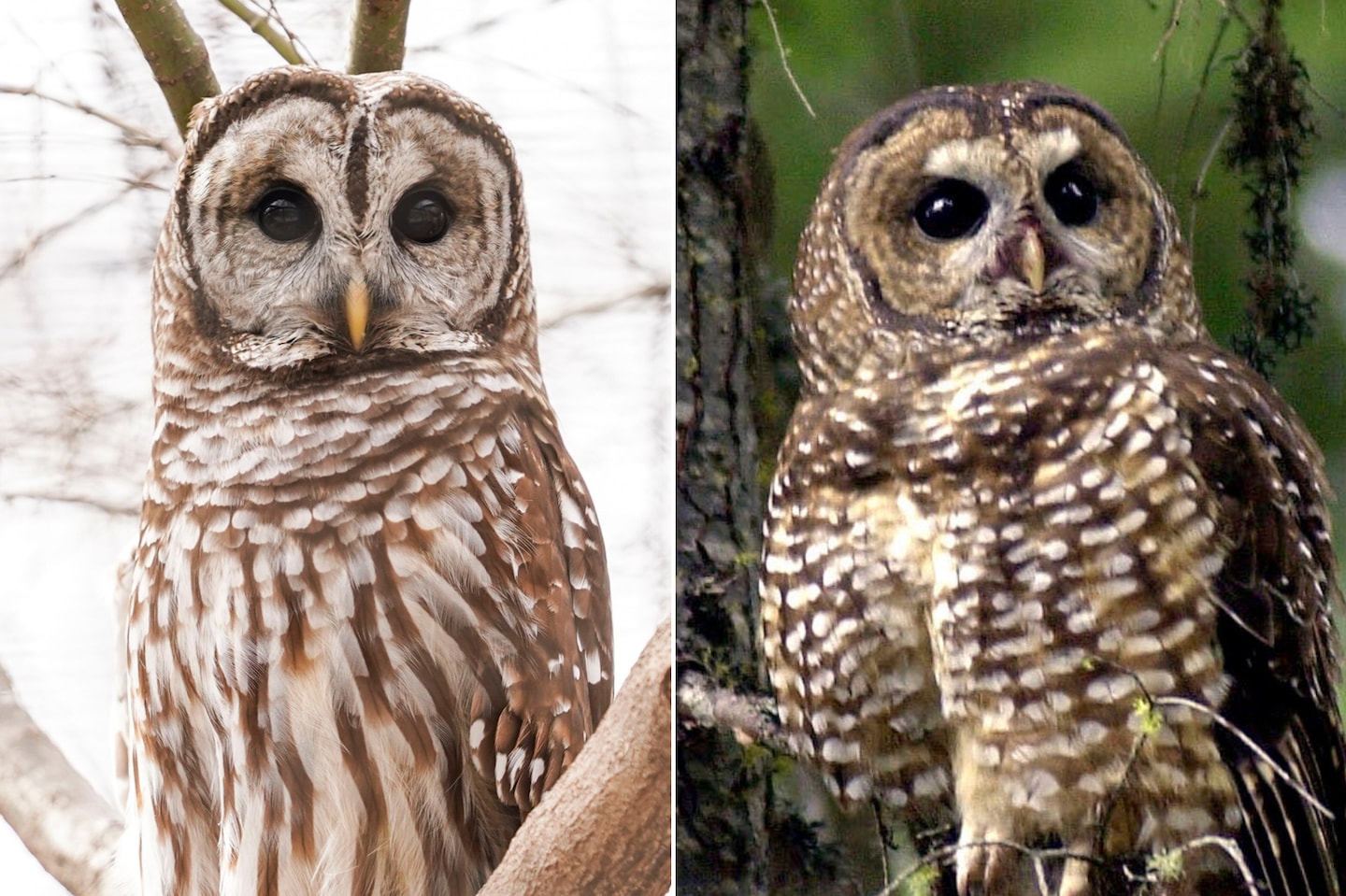
The barred owl, with its haunting, rhythmic call echoing through dense forests, has long captivated both scientists and laypeople alike. Its piercing yellow eyes and streaked plumage make it a striking figure in the avian world. Yet, it is not merely its appearance that draws attention—it is the intricate web of ecological relationships it inhabits, particularly its fraught coexistence with the spotted owl, a species teetering on the brink of extinction. Universities, as bastions of knowledge and innovation, have emerged as pivotal players in unraveling the complexities of this dynamic. Through rigorous research, they are not only shedding light on the ecological intricacies of these owls but also challenging long-held assumptions about conservation, interspecies competition, and the very nature of biodiversity.
The Ecological Theater: Barred and Spotted Owls in the Pacific Northwest
The Pacific Northwest’s old-growth forests are a stage where two owl species perform a delicate, often tense, ecological ballet. The spotted owl, a relic of ancient woodlands, has become a symbol of conservation struggles, its survival threatened by habitat loss and the encroachment of its larger, more adaptable cousin—the barred owl. Universities have taken center stage in this drama, deploying cutting-edge technologies like GPS tracking and bioacoustics to map the movements and behaviors of these birds. What emerges is not just a tale of competition but a revelation of how deeply interconnected these species are, their fates entwined in a struggle for dominance that mirrors the broader crises of habitat fragmentation and climate change.
Researchers have discovered that barred owls, originally confined to eastern North America, have expanded their range westward with alarming speed. Their adaptability—thriving in both dense forests and fragmented landscapes—has given them a competitive edge over the spotted owl, which relies on the specific microhabitats of old-growth forests. Universities are at the forefront of documenting this shift, using long-term ecological studies to trace the barred owl’s invasion and its cascading effects on local ecosystems. These findings are not merely academic; they are a clarion call for conservation strategies that account for the fluid, unpredictable nature of species interactions in a rapidly changing world.
The University as a Crucible: Interdisciplinary Approaches to Owl Ecology
Universities are not monolithic entities but vibrant ecosystems of thought, where biologists, ecologists, geneticists, and even social scientists converge to study the barred and spotted owl dilemma. This interdisciplinary synergy is where the most groundbreaking insights emerge. Geneticists, for instance, are sequencing the DNA of both owl species to trace their evolutionary histories and identify genetic markers linked to adaptability. Meanwhile, behavioral ecologists are using camera traps and thermal imaging to observe nocturnal interactions, revealing how barred owls outcompete spotted owls not just in resource acquisition but in sheer behavioral dominance.
Perhaps most intriguingly, universities are exploring the role of human activity in this ecological drama. Urbanization, deforestation, and climate change have reshaped the landscapes these owls inhabit, creating conditions that favor the barred owl’s generalist lifestyle. Social scientists within university research teams are examining how policy decisions—from logging regulations to climate mitigation strategies—indirectly influence owl populations. This holistic approach underscores a fundamental truth: the fate of these owls is not just an ecological question but a societal one, demanding solutions that transcend traditional disciplinary boundaries.
Conservation in Crisis: The Ethical Dilemmas of Owl Management
The revelation that barred owls are driving spotted owls toward extinction has sparked fierce debate among conservationists. Should we intervene? And if so, how? Universities have become arenas for these ethical discussions, hosting symposia and publishing papers that grapple with the moral complexities of species management. Some researchers argue for culling barred owls to preserve the spotted owl, a proposal that evokes the darkest chapters of conservation history. Others advocate for habitat restoration, positing that saving the spotted owl requires more than just removing its competitor—it demands recreating the ancient forests it depends on.
This tension between intervention and preservation is not unique to owl conservation. It reflects a broader crisis in environmental ethics, where the line between stewardship and domination blurs. Universities are uniquely positioned to navigate this terrain, fostering dialogues that balance scientific rigor with ethical reflection. Their research is not just about saving species; it is about redefining our relationship with nature, questioning whether conservation should be about control or coexistence, about dominance or deference to the wild.
The Unseen Forces: Climate Change and the Owl Paradox
Beneath the surface of this owl drama lies a more insidious actor: climate change. Rising temperatures, shifting precipitation patterns, and increasingly frequent wildfires are altering the forests of the Pacific Northwest, creating conditions that favor the barred owl’s resilience. Universities are unraveling this paradox, using climate models to predict how future environmental shifts will reshape owl populations. What they are finding is unsettling: the barred owl’s success may be a temporary phenomenon, a fleeting advantage in an era of rapid ecological upheaval.
This raises a provocative question: Is the barred owl truly an invasive threat, or is it an early harbinger of a new ecological order? Some researchers suggest that the spotted owl’s decline is not solely the result of barred owl competition but a symptom of a larger, more profound transformation. Universities are pioneering the field of “climate adaptation ecology,” studying how species like the barred owl may serve as bellwethers for the resilience of entire ecosystems. Their work challenges us to look beyond the immediate conflict and consider how these owls are reshaping the very fabric of the forests they inhabit.
The Public Imagination: Why Owls Captivate Us
There is something primal about our fascination with owls. They embody mystery, wisdom, and the untamed wildness of the natural world. Yet, the barred and spotted owl saga transcends mere symbolism; it is a mirror held up to humanity’s own contradictions. We revere these birds as icons of wilderness even as we reshape the landscapes they depend on. Universities, through their research and outreach, are bridging the gap between scientific discovery and public understanding, transforming abstract ecological data into narratives that resonate with people’s deepest concerns.
The barred and spotted owl conflict is more than a story of competition; it is a parable for our time. It forces us to confront the unintended consequences of our actions, the fragility of biodiversity, and the limits of our control over nature. In the halls of academia, this parable is being written in real time, with each study, each debate, each ethical dilemma adding a new layer to the tale. The question is no longer just about saving these owls—it is about what their story tells us about our own place in the natural world.