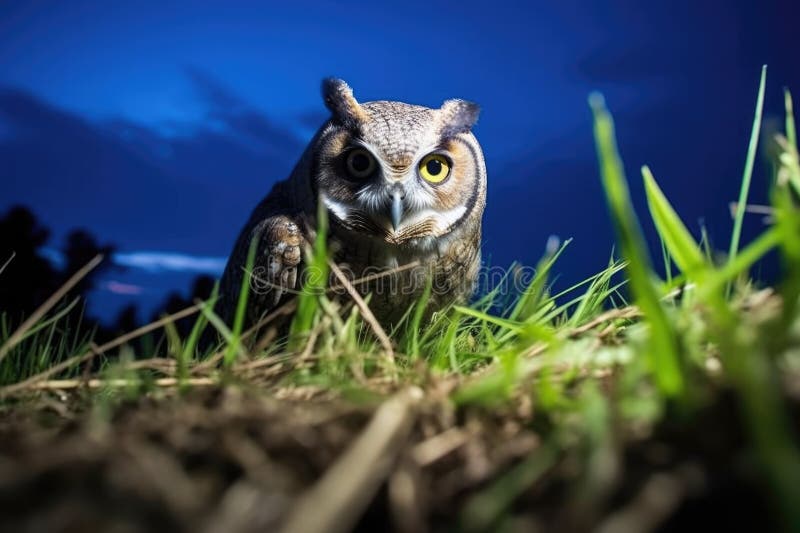
The night is not merely the absence of light—it is a realm of whispered secrets, where the boundaries between silence and sound blur into a symphony of survival. Among the most enigmatic performers in this nocturnal orchestra are owls, those silent sentinels of the dark, whose hunting prowess has captivated human imagination for millennia. Yet, as the glow of urban sprawl encroaches upon the once-pristine darkness, a silent predator stalks the skies: light pollution. This insidious infiltration of artificial luminescence doesn’t just dim the stars—it reshapes the very fabric of nocturnal ecosystems, altering the hunting grounds of these feathered phantoms in ways both subtle and profound.
The Vanishing Canvas of the Night: How Light Pollution Erases the Owl’s Hunting Grounds
Imagine, for a moment, the world through the eyes of an owl—a world where the absence of light is not a void but a canvas painted with the faintest brushstrokes of starlight and moonlight. Owls rely on the cloak of darkness not just for stealth but for the amplification of their other senses. Their eyes, adapted for low-light vision, are finely tuned to detect the slightest movement in the gloom. Yet, when artificial lights flood the night, they don’t merely illuminate—they obliterate. Streetlamps, neon signs, and the relentless glow of cities create a phenomenon known as “skyglow,” where the night sky itself is washed out, reducing the contrast that owls depend on to spot prey. The once-invisible rustle of a vole in the undergrowth becomes lost in the glare, leaving the owl’s keen senses adrift in a sea of artificial brightness.
But the impact doesn’t end there. Light pollution doesn’t just obscure the night—it fragments it. Owls, creatures of habit and territory, find their hunting grounds carved up by the unnatural division of light and dark. A once-continuous expanse of shadowy meadows or dense forests is now dissected by roads lined with sodium vapor lamps, their harsh yellow glow creating impassable barriers. The owl’s silent flight, once a seamless glide across unbroken darkness, is now met with the jarring interruption of illuminated zones where prey flees in panic, their own instincts betrayed by the sudden intrusion of day into night.
The Illusion of Safety: How Artificial Light Disrupts Prey Behavior
For prey animals, the night is a sanctuary—a time when the ever-watchful eyes of diurnal predators are closed. Mice, voles, and other small mammals have evolved to exploit this temporal refuge, their activity peaking under the cover of darkness. Yet, when artificial light floods their world, it shatters the illusion of safety. Studies have shown that even low levels of light pollution can cause prey species to alter their behavior dramatically. Nocturnal rodents, for instance, may reduce their foraging time or avoid areas near light sources altogether, retreating into burrows or dense vegetation where they are less visible. This behavioral shift doesn’t just make them harder to find—it starves the owls of their primary food source.
Worse still, some prey species adapt in ways that make them even more elusive. Certain rodents, for example, have been observed to become more nocturnal in response to light pollution, paradoxically increasing their activity during the brightest parts of the night when owls are most active. This creates a cruel irony: the very adaptation that ensures their survival in a lit world may render them invisible to the owls that depend on them. The result is a trophic cascade, where the ripple effects of light pollution extend far beyond the immediate loss of hunting grounds, destabilizing entire food webs.
The Silent Thief of the Night: How Light Pollution Silences the Owl’s Hunting Arsenal
Owls are the masters of stealth, their flight a whisper against the wind, their feathers designed to muffle sound. Yet, their hunting success hinges on more than just silence—it relies on the absence of light itself. The moment artificial illumination intrudes, it disrupts the delicate balance of the night. One of the most insidious effects is the suppression of the owl’s primary hunting tool: the element of surprise. In a world where every shadow is scrutinized by the unblinking eye of a streetlamp, the owl’s ability to remain undetected is compromised. Prey, once oblivious to the silent descent of wings, now has the advantage of early detection, their survival instincts sharpened by the unnatural illumination.
Moreover, light pollution can interfere with the owl’s own sensory perception. Owls rely not just on sight but on their extraordinary hearing to pinpoint prey in the dark. The low-frequency sounds of a vole moving through grass are amplified by the stillness of the night. Yet, when artificial light introduces noise—whether from traffic, machinery, or even the hum of poorly shielded bulbs—it creates a cacophony that drowns out the faintest rustles of life. The owl, already operating at the limits of its sensory capabilities, is left groping in a world where the signals it depends on are lost in the static.
The Psychological Toll: Stress and Displacement in a World That Never Sleeps
The impact of light pollution on owls isn’t merely ecological—it’s psychological. These birds are creatures of rhythm, their lives governed by the cyclical dance of day and night. When that rhythm is disrupted, the consequences can be severe. Owls subjected to chronic light exposure exhibit signs of stress, their behavior becoming erratic as they struggle to adapt to an environment that no longer aligns with their evolutionary blueprint. Nesting sites near artificial lights may be abandoned, as the constant illumination disrupts the cues that signal safety or territory. Juvenile owls, still learning the intricacies of their nocturnal world, find themselves disoriented, their hunting skills dulled by the unnatural brightness that surrounds them.
Even their reproductive success is at risk. Some owl species rely on the darkness to conceal their nests from predators or to synchronize breeding with optimal food availability. When light pollution intrudes, it can desynchronize these critical life events, leading to reduced fledgling success or even nest abandonment. The result is a slow but steady erosion of owl populations, their numbers dwindling not from direct persecution but from the silent, pervasive encroachment of a world that refuses to sleep.
The Unseen Victims: How Light Pollution Affects Owl Species Across the Globe
The effects of light pollution on owls are not uniform—they vary by species, habitat, and the intensity of the artificial light. In urban areas, for example, species like the Barn Owl (*Tyto alba*) face particularly acute challenges. These pale, ghostly hunters, adapted to the open fields and farmlands of Europe and North America, find their traditional hunting grounds transformed into concrete jungles where the night is never truly dark. Their reliance on open spaces makes them especially vulnerable to the fragmentation of their habitat by light, their silent flight rendered ineffective against the glare of city lights.
In contrast, forest-dwelling species like the Great Horned Owl (*Bubo virginianus*) may fare slightly better, as the dense canopy can provide some respite from artificial illumination. Yet, even they are not immune. The spread of light pollution into once-remote wilderness areas means that no owl, no matter how remote its habitat, is entirely safe. The Snowy Owl (*Bubo scandiacus*), a denizen of the Arctic tundra, faces a different kind of threat: the encroachment of light from oil drilling operations and research stations. For these birds, adapted to the endless daylight of the polar summer and the endless night of winter, the intrusion of artificial light disrupts their most fundamental biological rhythms.
The Path Forward: Mitigating the Glow to Preserve the Night
Despite the grim portrait painted by light pollution, there is hope. Conservationists and urban planners are increasingly recognizing the need to reclaim the night, not just for owls but for the countless species that depend on darkness. Solutions range from the simple to the innovative. On a local scale, communities can adopt “dark sky” lighting policies, replacing harsh streetlamps with shielded, low-intensity LEDs that direct light downward, where it’s needed, rather than scattering it into the sky. Motion-activated lighting can further reduce unnecessary illumination, ensuring that the night remains a place of rest and renewal.
At a broader level, the push for dark sky reserves—protected areas where artificial light is minimized—offers a lifeline to owl populations. These reserves not only provide safe havens for nocturnal species but also serve as living laboratories where the true cost of light pollution can be studied and mitigated. Meanwhile, public awareness campaigns can educate communities about the importance of darkness, fostering a cultural shift that values the night as a vital component of ecological health.
For owls, the battle to reclaim the night is far from over. Yet, with each step toward reducing light pollution, we take a step closer to restoring the balance that these magnificent birds have relied upon for millions of years. The night is not a void to be feared or erased—it is a living, breathing entity, a stage for the silent dramas of survival that play out under the cover of darkness. To protect the owls is to protect the night itself, and in doing so, we preserve a piece of the wild that is fast disappearing from our world.