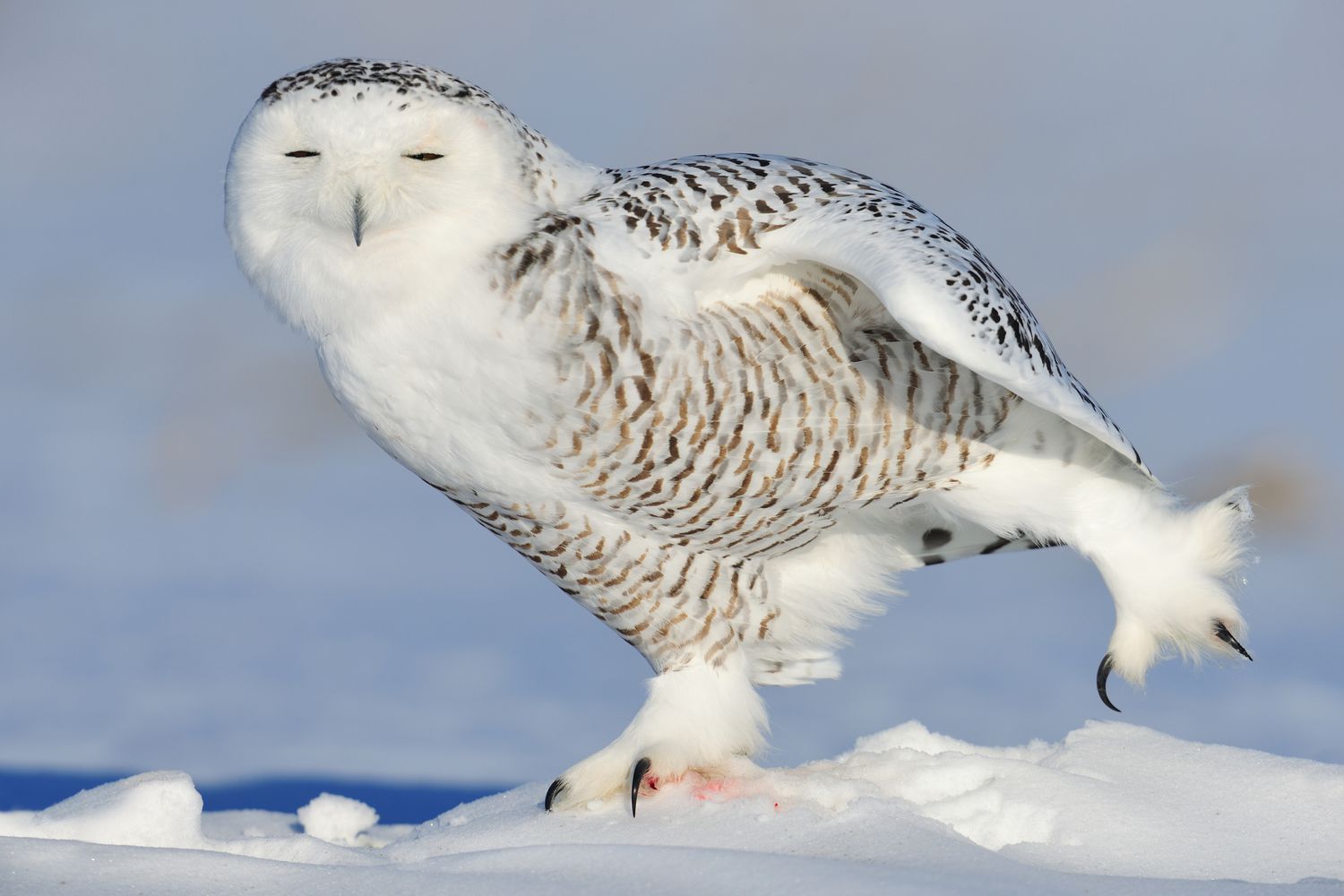
The Arctic tundra hums with a language older than human memory. Beneath the endless silver expanse of wind-carved snow, beneath the aurora’s electric shimmer, the snowy owl does not merely survive—it communicates, navigates, and negotiates a world in flux. For centuries, we have watched these silent sentinels of the north, mistaking their stillness for absence. But what if the owl’s true voice has been whispering all along, encoded not in feathers or flight, but in the very air it breathes? Bioacoustics—the science of sound in nature—is beginning to decode this language, revealing a story of climate stress that pulses through every call, every cry, every silence. This is not just a tale of birds and melting ice. It is a revelation of how sound, the most ephemeral of phenomena, can become a compass pointing toward ecological collapse—and, perhaps, toward resilience.
The Unseen Symphony: Why Snowy Owls Are Nature’s Bioacoustic Messengers
Imagine standing on the edge of a frozen lagoon at dusk, the air sharp with the scent of lichen and salt. A snowy owl perches on a driftwood stump, its golden eyes reflecting the low sun. You hear nothing. But if you could tune your senses to frequencies beyond human hearing, you would detect a world in motion—a symphony of infrasound, ultrasonic clicks, and tonal shifts that map the owl’s inner and outer landscape. Snowy owls are not silent. They are broadcasting. Their calls—from the piercing *klee-klee-klee* of territorial males to the soft, melodic *hoo-hoo* of females—are not mere signals. They are data packets, carrying information about health, stress, and environmental change.
Bioacoustics treats sound as a living archive. Each vocalization is a fingerprint of the owl’s physiological state, its social standing, and the ecological pressures it faces. When the Arctic warms, the ice fractures. The owl’s prey—lemmings, voles, and Arctic hares—become scarce. Their calls grow shorter, less frequent. The silence that follows is not emptiness. It is a warning. The owl’s voice, once a steady rhythm, now stutters. It is not adapting. It is signaling distress. And in that signal, we find a mirror held up to our own climate recklessness.
Frequency as Fate: How Sound Reveals the Body’s Climate Stress Response
Every living organism vibrates. From the hum of a neuron to the chorus of a dawn chorus, frequency is destiny. In snowy owls, the pitch and duration of calls are not arbitrary. They are physiological barometers. When exposed to prolonged heat stress, an owl’s body redirects energy from vocal production to thermoregulation. The result? A downward shift in call frequency. Lower frequencies require less energy to produce, but they also carry less information. The owl’s voice becomes muffled, its message obscured. This is not mere adaptation. It is survival at a cost.
Consider the male’s territorial call—a series of sharp, high-pitched notes that once rang across the tundra like a sonic beacon. Under normal conditions, these notes peak at 3.5 kHz. But during heatwaves, the peak drops to 2.8 kHz. The change is subtle, almost imperceptible to human ears. Yet to another owl, it is a siren. It signals: *This territory is no longer safe. The ice is thinning. The prey is fleeing.* The owl’s voice is not just a reflection of its environment. It is a real-time alert system, broadcasting ecological collapse before satellites or sensors can detect it.
Moreover, the owl’s ultrasonic clicks—inaudible to humans but detectable by specialized equipment—reveal stress at a cellular level. These clicks, used in echolocation and social bonding, become erratic under prolonged stress. Their rhythm fractures. The owl is not just hungry. It is metabolically compromised. Its body is burning through fat reserves not to hunt, but to survive the heat. The sound of an owl’s distress is not a lament. It is a biological audit, a ledger of environmental debt being paid in real time.
Silence as a Signal: The Vanishing Calls of a Changing Arctic
There are moments in nature when absence speaks louder than presence. When the dawn chorus of a forest falls silent, we know something is wrong. The same is true on the Arctic tundra. Snowy owls, once vocal year-round, are now falling into prolonged periods of vocal inactivity. This is not laziness. It is a survival strategy. When food is scarce and temperatures rise, the owl conserves energy by minimizing sound production. It becomes a ghost in the landscape, its presence known only by the faint rustle of wings or the occasional, desperate cry.
This silence is not passive. It is a form of resistance. The owl is not giving up. It is conserving its voice for when it matters most. But in doing so, it is also erasing its own data stream. Each unspoken call is a lost data point, a missing piece in the puzzle of climate change. Bioacousticians are racing to capture these silences, to map their patterns, and to understand what they mean for the owl’s long-term survival. Are these periods of silence temporary adaptations? Or are they the first whispers of extinction?
The Arctic is warming at three times the global average. The tundra is greening. The permafrost is thawing. The owl’s habitat is not just shrinking. It is transforming into something unrecognizable. And in that transformation, the owl’s voice is becoming a relic—a fossil of a world that once was. The silence of the snowy owl is not just a sound. It is a symptom. It is the Arctic’s fever breaking.
From Data to Action: How Bioacoustics Can Guide Conservation in a Warming World
Knowledge is power, but only if it is wielded with intention. Bioacoustics offers a new frontier in conservation—not just as a tool for observation, but as a blueprint for intervention. By analyzing the owl’s calls, scientists can identify critical habitats, predict population declines, and even design acoustic deterrents to protect nesting sites from human encroachment. Imagine a world where drones equipped with bioacoustic sensors patrol the Arctic, listening for the owl’s distress calls and triggering protective measures in real time. This is not science fiction. It is the future of conservation.
Moreover, bioacoustics can help us rethink our relationship with the Arctic. Instead of viewing it as a remote, inhospitable wasteland, we can see it as a living archive of sound, a symphony of survival that demands our attention. The owl’s voice is not just a scientific curiosity. It is a moral imperative. It is asking us to listen. To act. To change.
There is a term in bioacoustics: *soundscape ecology*. It refers to the study of how sound shapes and is shaped by ecosystems. The snowy owl’s soundscape is not just a collection of calls. It is a narrative of resilience, adaptation, and, ultimately, fragility. When we listen to the owl, we are not just hearing a bird. We are hearing the Arctic itself—a world on the brink, its voice trembling with the weight of our choices.
The Future is Sonic: What the Owl’s Voice Demands of Us
The snowy owl does not need us to save it. It has survived ice ages and human expansion. But it does need us to listen. To recognize that its voice is not just a sound. It is a story. A warning. A plea. In a world where climate change is often reduced to graphs and statistics, the owl’s call is a reminder that nature speaks in frequencies we are only beginning to understand.
This is not just about saving a species. It is about saving a language. The language of the Arctic. The language of sound. The language of survival. When the last snowy owl falls silent, we will not just lose a bird. We will lose a part of ourselves—a part that remembers what it means to listen, to adapt, to endure.
The owl’s voice is not fading into the wind. It is rising. It is demanding to be heard. And in that demand, we find our own voice. Our own responsibility. Our own chance to rewrite the story of the Arctic—not as a tragedy, but as a testament to what happens when we finally listen.