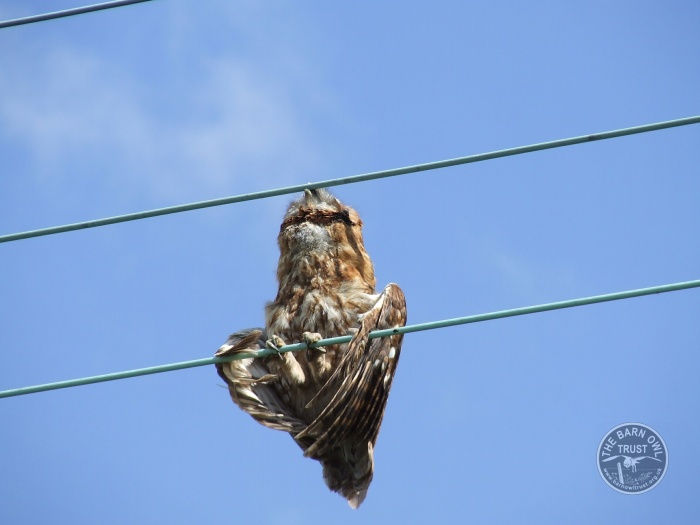
The night sky, a vast canvas of silent whispers, is where the barn owl reigns—a spectral sovereign of twilight, its ghostly plumage and heart-shaped face weaving through the dark like a living shadow. Yet, even this master of nocturnal prowess faces an invisible foe: the tangle of power lines that crisscross the landscape like the skeletal fingers of some slumbering titan. Electrocution is not merely a hazard; it is a silent predator, lurking in the very infrastructure that powers human civilization. For the barn owl, and indeed all raptors, these wires are a paradox—a lifeline for humanity, a death trap for the winged.
The Silent Predator: How Electrocution Claims Its Prey
Picture this: a barn owl, wings slicing through the cool night air, its golden eyes locked onto the faintest rustle of a vole below. It descends in a fluid arc, talons outstretched—only to meet an unseen adversary. Power lines, innocuous in daylight, become a deadly lattice when shrouded in darkness. Unlike the deliberate strikes of a great horned owl or the aerial acrobatics of a kestrel, the barn owl’s downfall is passive, almost accidental. It lands on a pole or wire, talons gripping the conductive surface, unaware that a single misstep could send a lethal current surging through its body.
The tragedy unfolds in an instant. The owl’s body, a marvel of lightweight efficiency, becomes a conduit for electricity. Its feathers, designed for silent flight, offer no insulation. The current courses through its nervous system, seizing control of every muscle. In the span of a heartbeat, the owl that once danced on the edge of the moon’s silver gaze is still. The wires hum on, indifferent to the life they’ve just extinguished.
The Invisible Web: Why Power Lines Are a Ravenous Trap
To understand the peril, one must first grasp the allure of power lines to owls. These structures mimic the natural perches owls seek—exposed, elevated, and devoid of obstructions. A utility pole is, in essence, a man-made tree, a sentinel in an otherwise barren landscape. For a barn owl, scanning the earth for prey, these poles offer the perfect vantage point. The problem? They are also the perfect death trap.
Unlike birds of prey that hunt in open skies, owls are creatures of stealth and surprise. Their hunting grounds are often agricultural fields, grasslands, and wooded edges—habitats increasingly dissected by power lines. The wires themselves are not always the direct cause of death; it’s the poles, crossarms, and insulators that prove fatal. An owl landing on a pole may inadvertently bridge two live conductors with its wings or tail, completing a circuit with lethal precision. Even if the owl avoids direct contact, the electric field around live wires can induce currents in its body, a phenomenon known as “step potential.”
The Toll on Populations: A Conservation Crisis in the Shadows
The loss of even a single owl is a ripple in the ecosystem. Barn owls are voracious predators of rodents, their presence a natural check on agricultural pests. When electrocution claims their lives, the balance tilts—fields overrun with voles, crops gnawed to stubble, and farmers forced to rely on chemical solutions. Yet the impact extends beyond economics. Owls are sentinels of environmental health. Their decline signals a landscape under strain, where human infrastructure and wildlife coexist in uneasy tension.
Studies estimate that electrocution claims the lives of thousands of raptors annually in the U.S. alone. The barn owl, with its low-flying hunting style, is particularly vulnerable. Unlike eagles or hawks, which may soar at higher altitudes, the barn owl’s hunting altitude often places it directly in the path of danger. In regions where power lines are ubiquitous, owl populations face a silent culling, their numbers dwindling without fanfare or outcry.
Solutions in the Dark: Engineering a Safer Future
Fortunately, where there is peril, there is also ingenuity. Conservationists and utility companies have begun to collaborate on solutions that protect both infrastructure and wildlife. One of the most effective strategies is the installation of “raptor-safe” poles and insulators. These designs incorporate perch guards, insulating materials, and wider spacing between conductors to prevent accidental bridging. Some systems even use “owl-friendly” perches—artificial platforms placed away from live wires, offering owls a safe vantage point.
Another promising approach is the use of “bird-friendly” wire designs. By increasing the distance between conductors or using insulated cables, the risk of electrocution is significantly reduced. In some European countries, underground cabling has been implemented in critical owl habitats, though the cost remains a barrier for widespread adoption. Technology, too, plays a role. Motion-activated deterrents, such as ultrasonic devices or flashing lights, can alert owls to the presence of danger, though their effectiveness varies.
The Human Factor: A Call to Stewardship
At its core, the issue of owl electrocution is a story of unintended consequences. The very infrastructure that illuminates our homes and powers our lives has become a silent killer for creatures that share our world. Yet, this is not a problem without solutions—it is a challenge that demands awareness, innovation, and a willingness to adapt. The barn owl, with its ethereal grace and ecological importance, deserves no less.
For those who walk the fields at dusk, the sight of an owl gliding overhead is a reminder of nature’s quiet majesty. It is a fleeting moment, a whisper of wings in the gathering dark. But for the owl, that moment could be its last if it alights on the wrong wire. The question is not whether we can afford to make these changes—it is whether we can afford not to. The barn owl’s survival is not just a matter of conservation; it is a test of our own humanity.
In the end, the wires that crisscross the sky need not be a death sentence. With thoughtful design, proactive measures, and a shared commitment to coexistence, we can ensure that the ghostly silhouette of the barn owl continues to dance on the edge of twilight—unfettered, unharmed, and free.