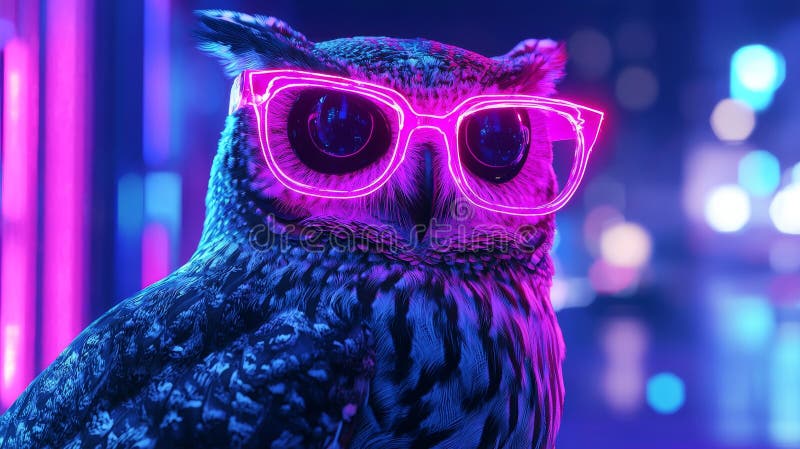
The night is a realm of whispers and shadows, where the boundaries between silence and sound blur into obscurity. Yet, in this cloak of darkness, a silent predator glides with eerie grace—its wings slicing through the air without so much as a murmur. The owl, a creature of paradox, has long captivated humanity with its uncanny ability to navigate the nocturnal world. But what secrets lie beneath its feathered cloak? How has evolution sculpted this master of stealth into a paragon of nighttime predation? Prepare to embark on a journey into the hidden mechanics of owl adaptations, where science unravels the mysteries of silent flight, razor-sharp vision, and a suite of other extraordinary traits that redefine the very essence of avian prowess.
The Whisper of Wings: The Enigma of Silent Flight
Imagine a predator whose approach is undetectable until the very moment of impact. This is the reality of the owl, whose flight is a symphony of near-silence. The secret lies in a constellation of adaptations that defy conventional aerodynamics. Unlike other birds, owls possess a unique wing structure, with serrated leading edges—fringed feathers that disrupt the turbulent airflow responsible for the telltale “whoosh” of wings in motion. This ingenious design, known as a comb-like fringe, scatters air pressure waves, muting the sound of flight to frequencies below human hearing.
But the owl’s stealth doesn’t end there. Beneath its plumage, a layer of soft, velvety down feathers absorbs vibrations, further dampening any residual noise. Even the owl’s flight feathers are specialized, with a downy fringe along their trailing edges that softens the air’s passage. Together, these adaptations transform the owl into a ghost of the night, a silent specter that strikes without warning. The implications are profound: if engineers could replicate this silent flight in drones or aircraft, the world of aviation would undergo a revolution. The owl’s wings are not just a marvel of nature—they are a blueprint for the future.
Eyes Like Moons: The Science of Nocturnal Vision
While the world sleeps, the owl sees with unparalleled clarity. Its eyes are not merely large; they are architectural marvels, occupying nearly the entire space of its skull. This extreme ocular real estate allows for a massive retina, packed with rod cells—light-sensitive photoreceptors that excel in low-light conditions. But the owl’s vision is more than just a matter of size; it’s a masterclass in optical engineering.
The owl’s eyes are tubular, a shape that minimizes distortion and maximizes light-gathering potential. Unlike human eyes, which are spherical and rely on a lens to focus light, the owl’s eyes are fixed in place, forcing it to rotate its head—a feat it accomplishes with a neck that boasts 270 degrees of rotation. This extreme flexibility is made possible by a unique arrangement of vertebrae and blood vessels that prevent the owl from suffering strokes during such contortions.
Yet, the owl’s vision is not without its trade-offs. Its eyes lack the ability to move independently, meaning the owl must turn its entire head to track prey. This limitation is offset by its extraordinary depth perception, achieved through forward-facing eyes that provide a wide field of binocular vision. In the darkness, the owl sees not just shapes and movements, but the very essence of its prey’s existence.
The Silent Stalker: Hunting Strategies and Sensory Mastery
The owl’s adaptations extend far beyond its wings and eyes. Its hunting strategy is a ballet of precision, a dance of patience and instinct. Unlike diurnal predators that rely on speed or strength, the owl is a master of ambush. It perches motionless, its plumage blending seamlessly with the night, until the perfect moment arrives. Then, with a sudden, explosive burst of speed, it descends upon its unsuspecting prey.
But how does the owl locate its target in the inky blackness? The answer lies in its acute hearing. The owl’s ears are asymmetrically placed—one higher than the other—allowing it to pinpoint the source of a sound with astonishing accuracy. This binaural disparity creates a three-dimensional map of sound, enabling the owl to triangulate the position of a rustling mouse or a scurrying insect with millimeter precision. In experiments, owls have been observed catching prey in complete darkness, relying solely on auditory cues. This sensory prowess is a testament to the owl’s evolutionary ingenuity, a reminder that nature’s solutions are often far more elegant than our own.
The owl’s talons are another marvel of adaptation. Unlike the grasping claws of other birds of prey, the owl’s talons are designed for a single purpose: to crush. Their curved, needle-like shape ensures a death grip on prey, while their incredible strength allows the owl to exert a force equivalent to several times its body weight. Even the owl’s beak is specialized, short and hooked for tearing flesh, a tool honed by millions of years of nocturnal predation.
Beyond the Night: The Owl’s Multifaceted Adaptations
The owl’s adaptations are not limited to flight, vision, and hunting. This enigmatic creature is a living testament to evolutionary innovation, with traits that extend into every facet of its existence. Consider its plumage: a camouflage of earthy hues and intricate patterns that blend seamlessly with its surroundings. Whether perched in the branches of a tree or nestled in the hollow of a trunk, the owl becomes one with the landscape, invisible to both predator and prey.
The owl’s metabolism is another marvel. Unlike many birds, which require constant feeding to maintain their energy levels, the owl can survive for extended periods without food. This adaptation is crucial for a creature that must endure long nights of hunting, often in harsh or unpredictable conditions. The owl’s digestive system is equally specialized, capable of processing bones, fur, and other indigestible materials by compressing them into pellets that are regurgitated later. This efficient system ensures that no part of its prey goes to waste.
Even the owl’s reproductive strategy reflects its adaptations. Many owl species are monogamous, forming lifelong bonds with their mates. This partnership ensures that both parents contribute to the rearing of their young, a necessity in the unforgiving world of nocturnal predation. The female owl, often larger and more aggressive than the male, takes the lead in defending the nest, while the male hunts to provide food for his family. This division of labor is a testament to the owl’s social intelligence, a trait that sets it apart from many other birds of prey.
The Owl’s Legacy: Lessons from a Silent Predator
The owl’s adaptations are more than just a curiosity of nature—they are a blueprint for survival in a world of darkness and uncertainty. In an era where human technology struggles to match the elegance of natural design, the owl stands as a reminder of nature’s ingenuity. From its silent wings to its razor-sharp vision, the owl is a masterclass in adaptation, a creature that has perfected the art of nocturnal predation.
But the owl’s story is not just one of predation; it is a story of balance. The owl’s presence in an ecosystem is a sign of health, a predator that keeps populations of rodents and insects in check. Its adaptations are a testament to the delicate interplay between form and function, a reminder that every trait serves a purpose. In a world where human activity often disrupts this balance, the owl’s story is a call to reconnect with the natural world, to learn from its wisdom, and to appreciate the intricate tapestry of life that surrounds us.
As we peer into the night, we are reminded that the world is far stranger and more wondrous than we often realize. The owl, with its silent flight and piercing gaze, is a symbol of this hidden complexity—a creature that challenges our perceptions and expands our understanding of what is possible. In its existence, we find not just a predator, but a teacher, a guide to the mysteries of the natural world.