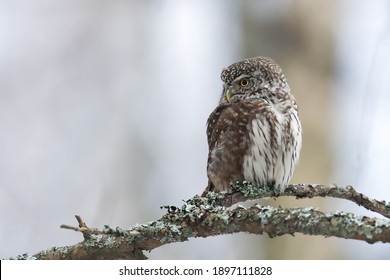
Have you ever encountered a creature so small it could perch on your fingertip, yet so fiercely independent it commands the respect of predators twice its size? Meet the pygmy owl—nature’s pocket-sized titan, a paradox wrapped in feathers and mischief. This diminutive raptor, barely larger than a sparrow, possesses a personality that belies its stature, blending cunning, curiosity, and an audacious spirit into a package no bigger than a clenched fist. But what happens when such a tiny titan faces the colossal challenges of survival in a world where size often dictates dominance?
The Pygmy Owl: A Feathered Paradox in the Wild
The pygmy owl is a study in contradictions. At just 15–25 centimeters tall, it’s one of the smallest owls on the planet, yet its presence is anything but insignificant. With round, piercing eyes that gleam like polished obsidian and a plumage that ranges from earthy browns to snowy whites, it moves through the forest with the stealth of a shadow and the boldness of a daredevil. Unlike its larger cousins, which often lurk in the depths of dense foliage, the pygmy owl perches in plain sight—sometimes on the highest twig of a birch tree—observing the world with an almost insolent confidence. It’s as if it knows that in the intricate dance of predator and prey, size is merely a suggestion.
Yet, this audacity comes with a price. The pygmy owl’s diminutive frame makes it vulnerable to a host of threats, from larger birds of prey to the encroachment of human development. Its survival hinges on a delicate balance: adaptability in the face of change, and an unyielding will to thrive despite the odds. How does such a small creature navigate a world that seems designed to dwarf it at every turn?
The Art of the Hunt: Precision in a Tiny Package
To witness a pygmy owl hunt is to witness a masterclass in precision. Unlike its larger relatives, which rely on silent swoops from the sky, the pygmy owl employs a more intimate strategy. It perches, motionless, until an unsuspecting prey—be it a mouse, a small bird, or even an insect—ventures within striking distance. Then, with a burst of speed that defies its size, it pounces, talons outstretched, in a blur of feathers and fury. Its hunting grounds are not the open skies but the tangled undergrowth, where its small stature allows it to navigate with ease.
But here lies the challenge: the pygmy owl’s hunting success is inextricably linked to its environment. A forest thinned by deforestation or a meadow overrun by invasive species can disrupt its delicate balance of stealth and speed. What happens when the undergrowth, once a haven of concealment, becomes a maze of obstacles? The pygmy owl’s hunting prowess, so finely tuned to its natural habitat, may falter in the face of an ever-changing landscape.
The Vocal Virtuoso: A Symphony of Sounds
Few creatures possess the vocal range of the pygmy owl. Its repertoire includes a high-pitched, whistling call that echoes through the forest like a tiny flute, as well as a series of sharp, staccato notes that sound almost mechanical. These calls serve multiple purposes: to stake out territory, to attract a mate, or to warn intruders of its presence. The pygmy owl’s voice is not just a tool—it’s a declaration of its existence in a world that often overlooks the small.
Yet, this vocal prowess can also be a double-edged sword. In an era of urban sprawl and noise pollution, the pygmy owl’s calls may go unheard, drowned out by the cacophony of human activity. How does a creature that relies so heavily on sound to communicate adapt when its voice is muffled by the din of progress?
Social Dynamics: The Lone Ranger of the Skies
The pygmy owl is a solitary creature, fiercely territorial and intolerant of intruders. Mated pairs may share a territory, but interactions between individuals are often marked by aggression and posturing. This solitary nature extends to its nesting habits, with pairs often reusing the same nest year after year, a testament to their loyalty to a specific patch of forest.
But this independence comes with its own set of challenges. In a world where cooperation can mean the difference between survival and extinction, the pygmy owl’s refusal to band together may leave it isolated in the face of larger threats. How does a creature that thrives on solitude navigate the pressures of a changing environment when collaboration could be its greatest asset?
Conservation Conundrum: Protecting the Unseen
Despite its diminutive size, the pygmy owl plays a crucial role in its ecosystem. As both predator and prey, it helps maintain the delicate balance of the forest. Yet, its survival is increasingly threatened by habitat loss, climate change, and human encroachment. Unlike larger, more charismatic species, the pygmy owl often slips under the radar of conservation efforts, its plight overshadowed by more visible threats.
So, what can be done to ensure the pygmy owl’s continued existence? Conservation strategies must focus on preserving its habitat, reducing noise pollution, and raising awareness of its ecological importance. But will these efforts be enough to protect a creature that, by design, remains hidden in plain sight?
The Pygmy Owl’s Legacy: A Lesson in Resilience
The pygmy owl is more than just a tiny bird with a big personality—it’s a symbol of resilience in the face of adversity. Its ability to thrive in a world that often overlooks it is a testament to the power of adaptability and determination. Yet, its story is far from over. As we continue to reshape the natural world, the pygmy owl’s fate hangs in the balance, a delicate thread in the tapestry of life.
Will we choose to see the pygmy owl not just as a curiosity of nature, but as a vital thread in the fabric of our ecosystems? Or will we allow it to fade into obscurity, a relic of a world that no longer has room for the small but mighty? The answer lies in our hands—and in our willingness to listen to the whispers of the wild.