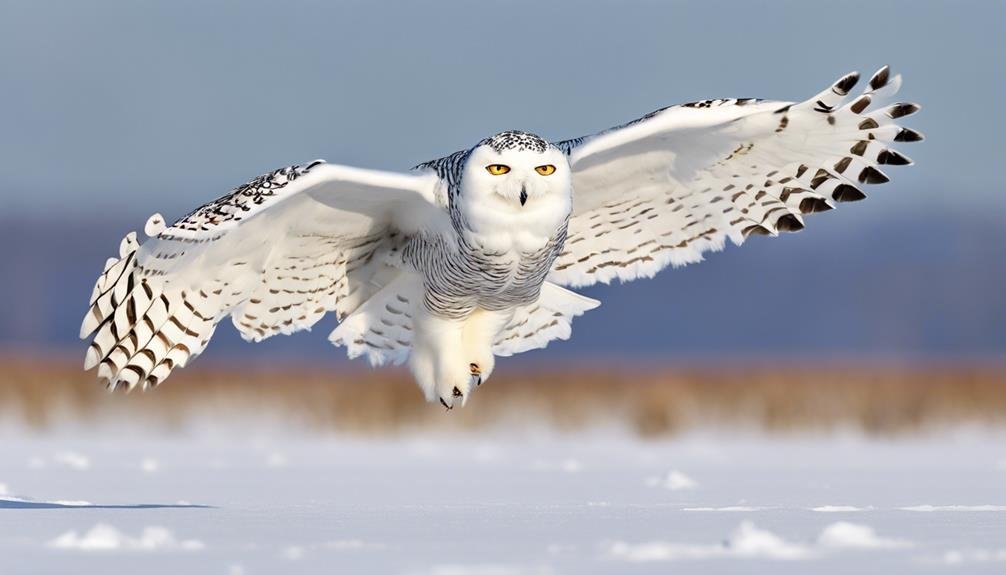
The Arctic, a realm of stark beauty and relentless extremes, is undergoing a transformation so profound that even its most resilient inhabitants—like the snowy owl—are struggling to keep pace. These birds, with their ghostly plumage and piercing yellow eyes, have long been symbols of endurance in a land where survival is never guaranteed. Yet today, their future hangs in the balance, threatened by the very climate shifts they once navigated with ease. The snowy owl, a creature of both myth and reality, is not merely a victim of circumstance; it is a harbinger of the Arctic’s silent crisis. To protect these magnificent birds is to confront the deeper fractures in our relationship with the natural world—where exploitation, neglect, and systemic indifference have eroded the foundations of an ecosystem that has thrived for millennia.
The Vanishing Ice: A Habitat in Freefall
The Arctic’s sea ice is retreating at a rate that defies comprehension, vanishing at a pace 13% per decade since 1980. For the snowy owl, this is not just a loss of real estate—it is the unraveling of a life strategy honed over generations. These owls rely on the tundra’s open expanses, where their mottled white plumage camouflages them against the snow and their keen eyesight scans for prey. But as the ice melts, the tundra is being overtaken by shrubs and grasses, a phenomenon known as “Arctic greening.” This vegetal encroachment disrupts the owl’s hunting grounds, forcing them into competition with other predators and reducing the visibility they depend on. The irony is cruel: the very changes that make the Arctic more habitable for some species are rendering it inhospitable for the snowy owl, a creature perfectly adapted to a world that is rapidly disappearing.
Consider the plight of the lemming, the snowy owl’s primary prey. These small rodents, whose populations boom and crash in cyclical patterns, are the linchpin of the Arctic food web. When lemming numbers plummet, snowy owls face starvation. Climate change has intensified these cycles, making them more erratic and severe. A single warm winter can decimate a lemming population, leaving owls to scavenge or starve. The owl’s reproductive success is directly tied to lemming abundance; without them, breeding seasons collapse. This is not just an ecological ripple—it is a systemic failure, one that exposes the fragility of an ecosystem that once seemed invincible.
The Human Footprint: Invisible Threats Lurking in the Snow
Beyond the specter of climate change, the snowy owl faces a more insidious foe: human encroachment. The Arctic, once a distant and inaccessible frontier, is now crisscrossed by industrial activity—oil rigs, shipping lanes, and mining operations that fracture the landscape and pollute the air and water. These disruptions are not merely physical; they are psychological. Snowy owls, like many Arctic species, are highly sensitive to human presence. The mere sight of a snowmobile or the sound of a helicopter can send them fleeing, abandoning nests and leaving chicks vulnerable. Even the glow of artificial lights in the endless Arctic night can disorient them, disrupting their natural behaviors.
Then there is the issue of pollution. Persistent organic pollutants (POPs), carried to the Arctic on atmospheric currents, accumulate in the fatty tissues of snowy owls. These toxins, which include pesticides and industrial chemicals, impair reproduction and weaken immune systems. The owl’s position at the top of the food chain means it bears the brunt of these contaminants, a cruel irony for a species that has survived for centuries in one of the harshest environments on Earth. The Arctic, often romanticized as a pristine wilderness, is in fact a sink for the world’s industrial sins—a fact that should shame us into action.
Conservation in the Age of Collapse: A Call to Radical Action
Protecting the snowy owl demands more than passive conservation; it requires a paradigm shift in how we view the Arctic and our role within it. Traditional conservation efforts, while necessary, are no longer sufficient. We must move beyond the confines of protected areas and address the root causes of the Arctic’s decline: fossil fuel extraction, unchecked industrialization, and the global carbon emissions that drive climate change. This means advocating for policies that prioritize the Arctic’s ecological integrity over short-term economic gains. It means supporting Indigenous communities, whose traditional knowledge of the land offers invaluable insights into sustainable coexistence. And it means reimagining our relationship with the natural world—not as conquerors, but as stewards.
One promising avenue is the expansion of Indigenous-led conservation initiatives. Across the Arctic, Indigenous peoples have long understood the delicate balance of their ecosystems. Their stewardship practices, such as controlled burns and seasonal hunting restrictions, have maintained biodiversity for generations. By centering these voices in conservation efforts, we can develop strategies that are both culturally respectful and ecologically effective. The snowy owl, as a species deeply intertwined with Arctic culture and mythology, stands to benefit from these collaborative approaches. Its survival is not just an environmental imperative; it is a moral one.
The Power of Perception: Why the Snowy Owl Captivates Us
There is something almost mythic about the snowy owl—a creature that embodies both fragility and ferocity, grace and grit. Its silent flight, its piercing gaze, its ability to thrive where few others can: these are the qualities that have fascinated humans for centuries. But our fascination is not merely aesthetic; it is existential. The snowy owl forces us to confront our own mortality and the impermanence of the natural world. In its struggle, we see a reflection of our own complacency, our own failure to act decisively in the face of crisis.
This is why the owl’s plight resonates so deeply. It is not just a bird in peril; it is a symbol of a planet in peril. Its decline is a warning, a canary in the coal mine of the Arctic’s unraveling. To protect it is to protect something far greater than a single species—it is to protect the idea of wilderness itself, the last bastions of a world that existed before us and must endure long after us. The snowy owl does not ask for our pity; it demands our respect. And in a world that has too often treated both animals and landscapes as disposable, that demand is nothing short of revolutionary.
A Future Written in Snow and Ice
The fate of the snowy owl is not yet sealed. There is still time to act, to reverse the tide of destruction that has brought us to this precipice. But time is running out, and the window for meaningful change is narrowing with each passing season. We must act with urgency, with creativity, and with a willingness to challenge the status quo. This means divesting from industries that harm the Arctic, supporting renewable energy, and holding our leaders accountable for their inaction. It means recognizing that the snowy owl is not just a creature of the wild—it is a part of our shared heritage, a testament to the resilience of life in the face of adversity.
The Arctic is not a distant abstraction; it is a living, breathing entity that sustains us all. Its ice reflects the sun’s rays, regulating global temperatures. Its ecosystems produce oxygen and sequester carbon. Its cultures hold wisdom that could save us from ourselves. To lose the snowy owl is to lose a piece of that magic, a piece of the wildness that makes our planet extraordinary. But to save it is to reclaim our own humanity—to remember that we are not separate from nature, but a part of it, bound together in a fragile and fleeting dance of survival.