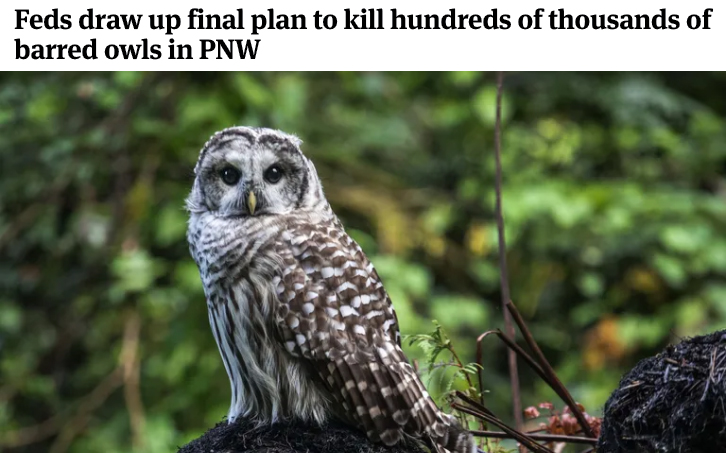
The barred owl, a creature of quiet forests and haunting calls, now finds itself at the center of a legal tempest. Once a symbol of wilderness, it has become the unwitting protagonist in a bitter dispute over ecological balance, conservation ethics, and the very meaning of justice in nature. In the lush green corridors of the Pacific Northwest, where ancient conifers stand as silent sentinels, barred owls are being culled—not by predators, but by human hands. This is not a hunt for survival, but a calculated intervention, a desperate attempt to save another species from extinction. Yet, as the chainsaws of bureaucracy grind into motion, the barred owl has become the unexpected plaintiff in a courtroom drama that asks: Who decides which lives are worth saving?
The Legal Arsenal: Who’s Taking Aim at Barred Owl Culling?
On one side of the courtroom aisle stands the U.S. Fish and Wildlife Service, armed with a 2023 experimental permit allowing the lethal removal of up to 450,000 barred owls over three decades. Their justification? To protect the northern spotted owl, a species teetering on the edge of oblivion due to habitat loss and competition with its barred cousin. The spotted owl, a relic of old-growth forests, has become an icon of conservation failure, its dwindling numbers a stark reminder of human impact. But the barred owl, a relative newcomer to the Pacific Northwest, thrives in fragmented landscapes, its adaptability a threat to the spotted owl’s fragile existence.
Yet, the Fish and Wildlife Service is not alone in this legal fray. Environmental groups such as the Center for Biological Diversity and the American Bird Conservancy have filed lawsuits challenging the culling permit, arguing that it violates the Endangered Species Act. They contend that the barred owl, though invasive, is not the root cause of the spotted owl’s decline—habitat destruction by logging is. To them, the culling is a misguided scapegoating, a Band-Aid on a gaping wound. The barred owl, they say, is being punished for humanity’s sins.
Meanwhile, Indigenous tribes, whose cultural and spiritual ties to the land stretch back millennia, have entered the fray with a different voice. For them, the barred owl is not just a competitor or a pest—it is kin. Some tribes have refused to participate in culling efforts, viewing the barred owl as a messenger between worlds, a guardian of sacred knowledge. Their legal arguments are rooted not in statute, but in sovereignty, tradition, and the unbroken thread of their relationship with the land.
The Moral Compass: Is Culling Ever Justified?
At the heart of this legal battle lies a question that gnaws at the conscience: Can killing one species ever be the moral path to saving another? Conservation biology often operates in shades of gray, where the best intentions collide with harsh realities. The barred owl, a native of eastern North America, expanded its range westward in the 20th century, likely due to climate change and human-altered landscapes. Its arrival in the Pacific Northwest disrupted an ancient ecological equilibrium, one that had already been fractured by deforestation and urban sprawl.
Proponents of the cull argue that nature is not a static tableau but a dynamic, ever-shifting web. If barred owls are outcompeting spotted owls, then intervention may be necessary to preserve biodiversity. They point to successful predator control programs elsewhere—wolves in Yellowstone, for instance—that restored balance to ecosystems. But critics counter that such logic is a slippery slope. If we start playing god with species populations, where does it end? Do we cull deer to save rare plants? Do we poison rats to protect nesting seabirds? The barred owl culling, they warn, sets a dangerous precedent, one where the strong decide the fate of the weak.
Then there is the matter of unintended consequences. Barred owls are not mindless machines of destruction; they are sentient beings capable of complex social structures and emotional bonds. Removing them en masse could disrupt entire ecosystems in ways we cannot predict. Predators do not exist in isolation—they are threads in a larger tapestry. Pull one thread, and the whole fabric may unravel.
The Courtroom as Battleground: Legal Strategies and Stumbling Blocks
The legal challenges to barred owl culling are not merely about ethics—they are about the interpretation of law, the limits of agency power, and the role of science in policymaking. The plaintiffs in these cases are wielding a variety of legal tools, each with its own strengths and weaknesses.
The first line of attack is the Endangered Species Act itself. The law requires that actions taken to protect endangered species must not jeopardize their survival. Plaintiffs argue that the Fish and Wildlife Service’s culling permit fails this test because it distracts from the real issue—habitat loss. By focusing on the barred owl, the agency is avoiding the harder work of reforestation and land restoration. The lawsuit hinges on whether the culling is a necessary evil or an unnecessary cruelty.
Another legal strategy involves the National Environmental Policy Act (NEPA), which mandates environmental impact assessments for federal actions. Critics claim that the Fish and Wildlife Service rushed through its environmental review, failing to adequately consider alternatives to lethal removal. Could non-lethal methods—such as habitat restoration or relocation—achieve the same conservation goals without bloodshed? The courts will have to decide whether the agency’s haste was a pragmatic necessity or a dereliction of duty.
Meanwhile, Indigenous groups are turning to treaties and tribal sovereignty to challenge the culling. Many tribes have reserved rights to hunt and gather on their ancestral lands, and some view the barred owl as a protected species under those rights. Their legal arguments are less about conservation science and more about cultural survival, weaving together the threads of law, tradition, and ecological wisdom.
The Human Factor: Who Bears the Burden of Conservation?
Beneath the legal jargon and scientific debates lies a deeper, more uncomfortable question: Who gets to decide which species live and which die? Conservation is never apolitical. It is shaped by power, privilege, and perspective. The barred owl culling is not just a biological experiment—it is a reflection of human values, a mirror held up to our relationship with nature.
For some, the culling is a pragmatic necessity, a small price to pay for the survival of a beloved species. For others, it is a moral failure, a betrayal of the principle that all life has intrinsic value. The debate forces us to confront uncomfortable truths: that conservation is not always gentle, that sometimes the kindest thing we can do is to step back and let nature take its course, even if that means watching a species fade away.
But there is another layer to this story—the human cost of conservation. The barred owl culling is not happening in a vacuum. It is taking place against a backdrop of environmental injustice, where marginalized communities bear the brunt of ecological decline. Indigenous peoples, rural communities, and low-income neighborhoods often face the harshest impacts of habitat destruction and species loss. Yet, when it comes to conservation decisions, their voices are frequently sidelined. The barred owl culling is a reminder that conservation cannot be separated from social justice. True ecological balance requires not just scientific rigor, but also ethical reflection and inclusive decision-making.
The Future of the Forest: What Lies Ahead?
As the legal battles rage on, the barred owl continues its haunting calls in the twilight of the old-growth forests. The outcome of these lawsuits will shape not just the fate of two owl species, but the very soul of conservation in America. Will we embrace a utilitarian approach, where the ends justify the means? Or will we reclaim a more holistic vision of nature, one that recognizes the inherent worth of every living being?
The barred owl culling is more than a policy debate—it is a cultural reckoning. It forces us to ask what kind of world we want to live in, and what kind of ancestors we want to be. Do we want to be remembered as the generation that played god with life and death? Or do we want to be remembered as the ones who finally learned to listen—to the barred owl’s call, to the whisper of the wind through the trees, to the unspoken wisdom of the land?
The courts will soon weigh in. But the real judgment will come from the forests themselves, from the silent witnesses of this unfolding drama. And their verdict may be the most unforgiving of all.